IPC-TM-650 EN 2022 试验方法--.pdf - 第220页
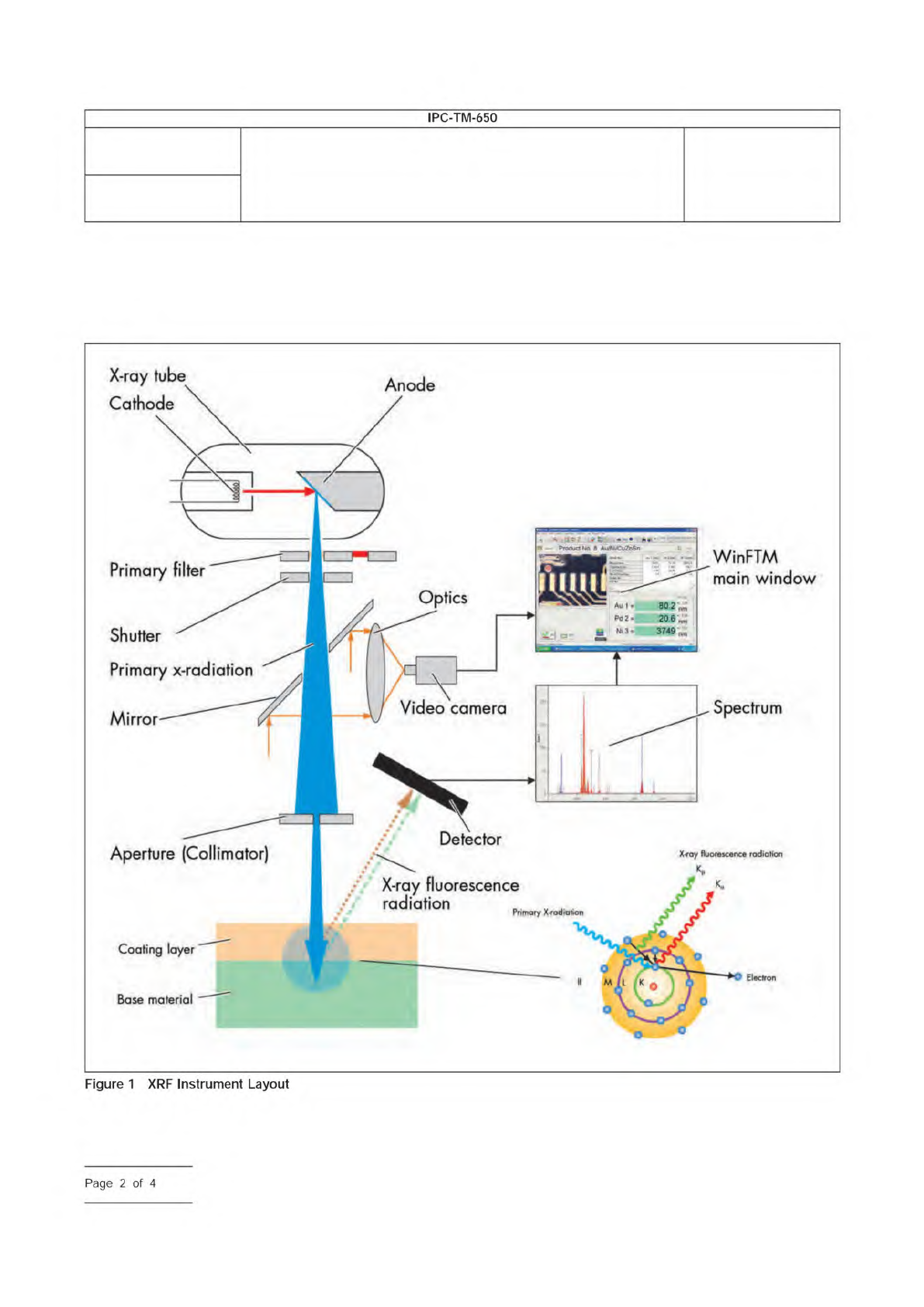
A Certified Reference M aterial ( C RM) covering the measuring range of the applic ation as described in 5.2. A typical instrument layout is shown in Figure 1 . IPC-2344-1 Number 2.3.44 Subject Determination of Thickness…

1 Scope
The purpose of this test method is to measure the
thickness and phosphorous (P) concentration of chemically
(electroless) deposited nickel (Ni) coatings by (energy disper-
sive) X-ray fluorescence (XRF) analysis.
The measurement is nondestructive and noncontact, and can
be performed either in ambient atmosphere or under vacuum.
Measurements
be made on a defined feature (equi-
valent to a typical SMT pad) of 1.5 mm x 1.5 mm [0.060 in x
0.060 in] or equivalent area, using a 0.6 mm diameter collima-
tor. This equates to a measuring spot size (analysis area) of
1 mm diameter.
This test method is designed primarily for failure analysis, pro-
cess qualification and process auditing. It is not intended for
daily production control, due to the complexity and cost of the
equipment required.
2 Applicable Documents
Specification for Electroless Nickel/Electroless
Palladium/Immersion Gold (ENEPIG) Plating for Printed Circuit
Boards
Specification for Electroless Nickel/Immersion
Gold (ENIG) Plating for Printed Circuit Boards
3 Test Specimen
This test method is primarily designed
for measurement of the phosphorus content in ‘‘as plated’’
ENIG PWBs. Other ENIG or electroless nickel (EN) plated sub-
strate materials may also be tested using this method, includ-
ing flexible circuits, silicon wafers, aluminum or steel. The typi-
cal thickness range of the NiP layer on PWB substrates is 3 to
6 µm [118.1 to 236.2 µin]. The Phosphorous content can
range from 0 % to 14% by weight. Minimum and maximum
thickness for single layers of electroless nickel required for
accurate determination of the P content is 0.5 µm to 25 µm
[19.7 µin to 984 µin]. The maximum thickness of gold present
on the surface of the specimen when tested
be less
than 0.10 µm [0.004 µin]. For samples with thicker gold, the
gold must be removed by chemical stripping or Ion milling
prior to evaluation.
While this test method is also suitable for evaluating phospho-
rus content in ENEPIG samples, the thickness of both the
gold (Au) and palladium (Pd) layers needs to be considered.
The maximum thicknesses of the layers over the electroless
nickel on ENEPIG specimens when tested
exceed
0.05 µm [0.002 µin] of Au and 0.10 µm [0.004 µin] of Pd on
top of the EN layer. This constraint will impact measurement
of ENEPIG samples plated on the higher side of the current
IPC-4556 specification. For samples with gold thicknesses
above 0.05 µm [0.002 µin], chemical or Ion milling stripping
may be carried out prior to evaluation. With the gold removed,
the maximum thickness of palladium on a specimen when
tested
be 0.25 µm [0.0098 µin].
Electroless palladium deposits may also contain phos-
phorus and its contribution to the total phosphorus content
must be taken into account when reporting the phosphorus
content of the deposit.
The sample to be tested should be flat and ideally not popu-
lated with components in the area of measurement. If testing
is done on populated boards, consideration has to be given to
measurement location, such that none of the electronic com-
ponents block the fluorescent radiation from reaching the
detector, as described in Section 5.4.
The test specimen requires no other sample preparation.
4 Apparatus
An X-ray fluorescence spectrometer consist-
ing of the following:
• A radiation source (X-ray tube with adjustable HV power
supply from 10 kV to 50 kV).
• A primary beam filter and safety shutter assembly.
• A video camera.
• An X-ray collimator or a polycapillary X-ray optic.
• An energy dispersive Silicon Drift Detector SDD (a device in
which charge carriers created by the incidence of X-ray pho-
tons on a high purity silicon substrate are directed to a mea-
suring electrode by an applied transverse electric field),
including electronics.
• Evaluation software capable of simultaneously measuring
coating thickness and composition of multiple layers. The
software of the instrument
have the capability of mul-
tiple excitation modes. It is necessary to apply different exci-
tation conditions; a soft excitation for the excitation of P-K at
10 kV and a hard excitation for Ni-K at 50 kV.
• A programmable X-Y positioning stage (accurate positioning
is required especially if small areas are to be analyzed).
• The instrument must be able to record the Intensities of the
individual radiation components of the Phosphorous K
energy line (I
P-K
) and the Nickel K energy line (I
Ni-K
) with suf-
ficient precision.
3000 Lakeside Drive, Suite 105N
Bannockburn, IL 60015-1249
IPC-TM-650
TEST METHODS MANUAL
Number
2.3.44
Subject
Determination of Thickness and Phosphorus
Content in Electroless Nickel (EN) Layers by X-Ray
Fluorescence (XRF) Spectrometry
Date
03/16
Revision
Originating Task Group
Plating Processes Subcommittee (4-14)
Association
Connecting
Electronics
Industries
shall
shall
Note:
IPC-4556
IPC-4552
shall
shall
shall
not
Material
in
this
Test
Methods
Manual
was
voluntarily
established
by
Technical
Committees
of
I
PC.
This
material
is
advisory
only
and
"s
use
or
adaptation
is
entirely
voluntary.
IPC
disclaims
all
liability
of
any
kind
as
to
the
use,
application,
or
adaptation
of
this
material.
Users
are
also
wholly
responsible
for
protecting
themselves
against
all
claims
or
liabilities
for
patent
infringement.
Equipment
referenced
/s
for
the
convenience
of
the
user
and
does
not
imply
endorsement
by
IPC.
Page
1
of
4
A Certified Reference Material (CRM) covering the measuring
range of the application as described in 5.2.
A typical instrument layout is shown in Figure 1.
IPC-2344-1
Number
2.3.44
Subject
Determination of Thickness and Phosphorus Content in
Electroless Nickel (EN) Layers by X-Ray Fluorescence (XRF)
Spectrometry
Date
03/16
Revision
IPC-TM-650
—
Anode
Primary
filter
Shutter
3749
Primary
x-radiation
Spectrum
Mirror
Detector
Aperture
(Collimator)
Primary
X-rodiation
Coating
laye
Electron
Base
material
X-ray
tube
Cathode
Video
camera
X<ay
fluorescence
radiation
WinFTM
main
window
Figure
1
XRF
Instrument
Layout
Page
2
of
4
5 Procedure
5.1 Instrument Setup
Prior to the purchase of the Certi-
fied Reference Materials (CRMs), confirm with the XRF
manufacturer that the instrument is capable of measuring
phosphorus content and obtain details of the recommended
machine set-up and operational procedures.
Instrument setups usually contain a product file that contains
the required measurement specific hardware and software
settings for the application. In addition, the product file con-
tains a calibration file which defines the calibration settings
and certified reference material to be used.
5.2
Typical Instrument setup conditions and measuring
ranges are as follows:
• Aperture Size: 1 mm for both 10kV and 50kV applications.
• Anode Current (I): I=1 mA for 10kV and I=0.15 mA for 50kV
(Anode current setup maximizing achievable instrument
count rates will yield best instrument repeatability, reference
5.3).
• Primary Beam Filter: NO filter for 10 kV and Ni Filter for
50 kV.
• Measurement Time: 120 s for 10kV and 20 s for 50kV.
5.3 Instrument Calibration
Calibration be per-
formed with CRM’s according to the instrument manufacturer
instructions. The CRM’s
be traceable to national labora-
tories. The structure of the reference material
be similar
to the samples under investigation, i.e., NiP/Cu/PCB, Au/NiP/
Cu/PCB or Au/Pd/NiP/Cu/PCB. Individual calibration foils
be used for multilayer coatings. The certified refer-
ence standards
have compositions and thicknesses
similar to the samples to be measured. If desired, it is possible
to calibrate an instrument over the full (low to high) phospho-
rous range. However, optimum accuracy can be achieved by
calibrating each phosphorous range (low, mid, and high)
separately. Each phosphorous content range should be cali-
brated with no less than 4 standards per range. No less than
3 measurements per calibration standard
be performed.
Calibration checks should be performed after each calibration
and periodically by re-measuring the calibration standards. If
the results are within the measurement uncertainty of the
standards and the uncertainty of the measurement itself, no
action is required. If not, a recalibration of the instrument is
required. Typical CRM standards used and results obtained
are summarized in Table 1.
5.4 Sample Placement
There are some basic rules for
positioning specimens. For each measurement, it
be
ensured that the X-ray fluorescence radiation can reach the
detector without obstruction. For flat, unpopulated PCB
boards, this is not a problem.
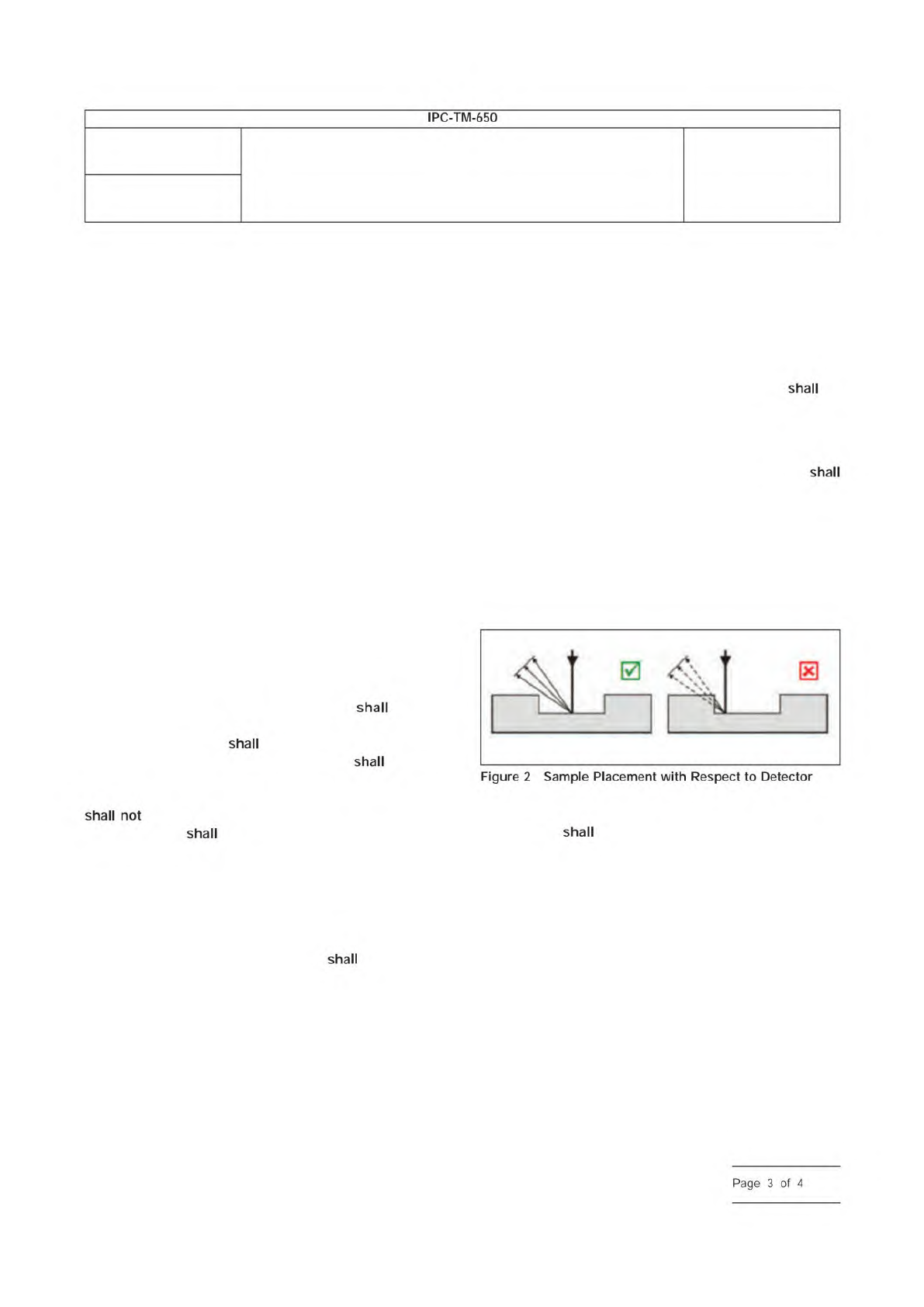
If populated boards are being measured, the operator
note the position of the detector and position the sample such
that no components are present in locations that would
prevent the radiation emanating from the measurement loca-
tion from reaching the detector, as illustrated schematically in
Figure 2.
The area measured should be flat and not tilted.
5.5 Measurement
XRF equipment operation is instrument
specific and
be in accordance with the instrument
manufacturer’s instructions. Always ensure that the correct
measurement file is selected for the application to be mea-
sured. Typically, instruments will slide the measuring stage out
of the instrument when the measurement chamber is opened.
The test sample is then positioned on the programmable X-Y
stage such that the laser pointer points at the measurement
location. When the measurement chamber is closed, the
stage will automatically retract into the chamber.
IPC-2344-2
Number
2.3.44
Subject
Determination of Thickness and Phosphorus Content in
Electroless Nickel (EN) Layers by X-Ray Fluorescence (XRF)
Spectrometry
Date
03/16
Revision
IPC-TM-650
shall
shall
shall
shall
not
shall
shall
Figure
2
Sample
Placement
with
Respect
to
Detector
shall
Page
3
of
4