IPC-TM-650 EN 2022 试验方法--.pdf - 第516页
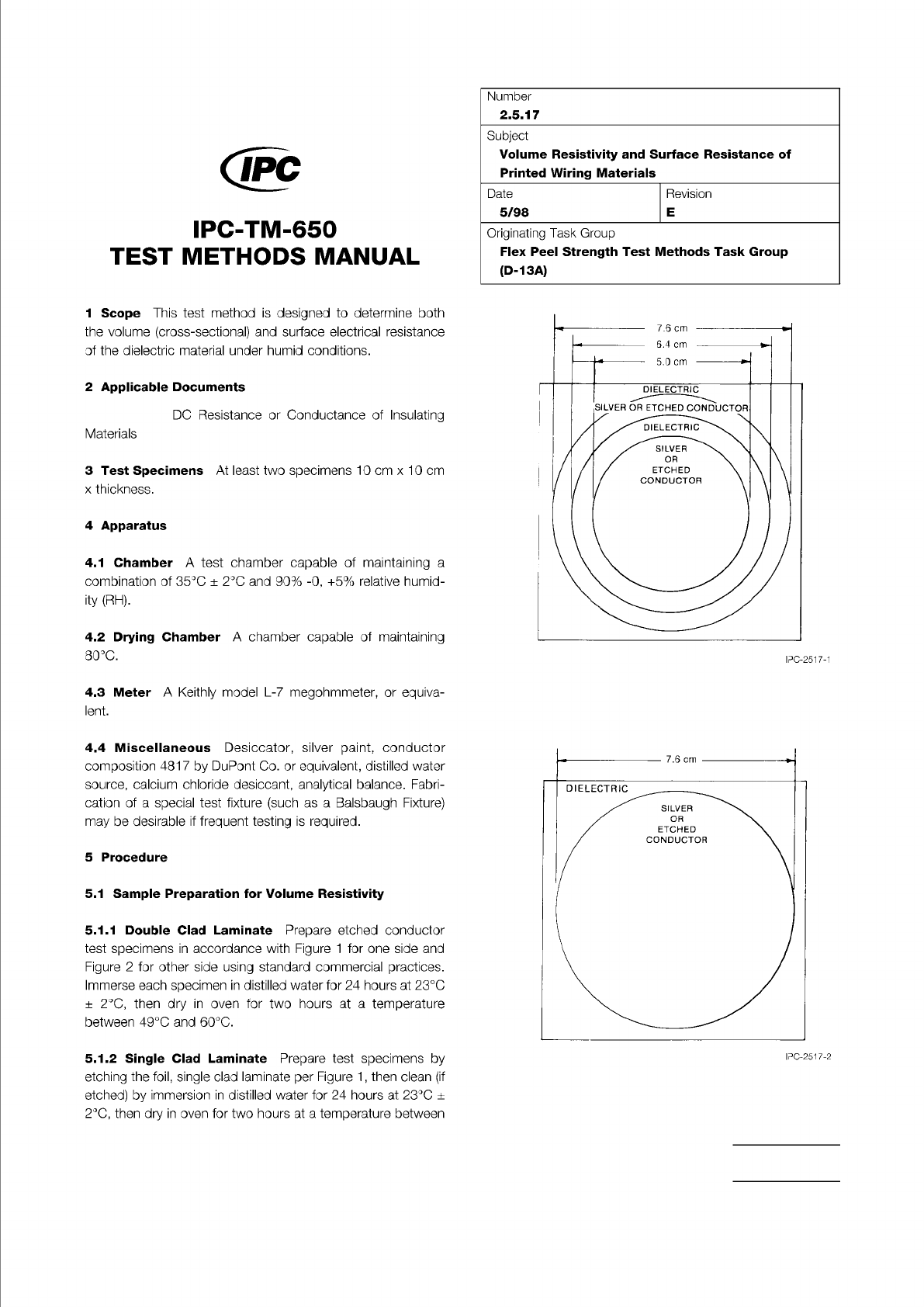
ASTM-D-257 Figure 1 V olume and Surface Re sistivity T e st Pattern . (Side 1) Figure 2 V olume and Surface Re sistivity T e st Pattern . (Side 2) The Institute for Int erconnecting and Packaging E lectronic Circuits 221…
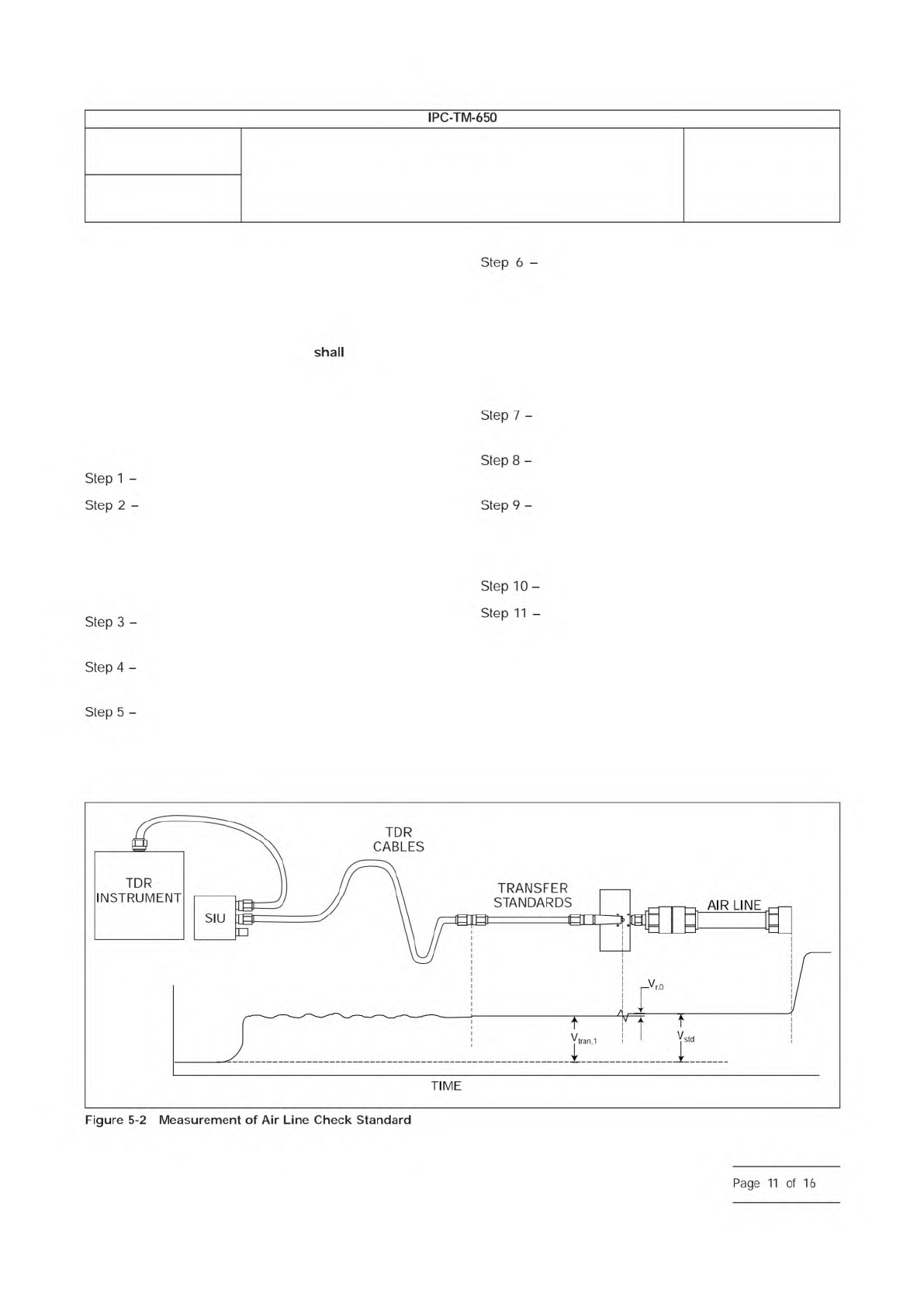
5.2.1.2 Verification Field Check
The method includes a
verification procedure to test the success of the measurement
set-up in determining propagation delay. The verification pro-
cedure follows the same steps used when characterizing test
specimens, but uses known and precise delay verification ele-
ments (as described in 4.3.7.) The user
perform this field
check prior to reporting delay results from the test specimens.
The user must fabricate their own transition cards that allow
electrical connection to the end of the coaxial air lines using
the probes of the measurement set-up. Figure 5-2 shows the
probe contacting a transition to coaxial adapter.
Turn on the TDR source and enable triggering.
Connect the probe-to-coax adapter to one end of
the longer air line check standard, leaving the opposite end
open circuit. For beadless air lines, this requires the addition
of an open circuit coax adapter at the far end in order to hold
the center conductor in place. As with all coax connections,
use the appropriate connection torque (see 4.3.1).
Connect the probe to the contact pads of the tran-
sition adapter.
Adjust the waveform epoch to capture the reflection
signal from the far end of the longer open circuit air line.
Measure the arrival time of the reflection signal from
the open circuit by testing when the reflection signal crosses
V
REF
as defined above for the user-selected value of x. Record
the arrival time value as t
T1
.
Connect the same probe-to-coax adapter used
above in Step 2 to one end of the shorter air line check stan-
dard, leaving the opposite end open circuit. For beadless air
lines, this requires the addition of an open circuit coax adapter
at the far end in order to hold the center conductor in place.
Use the same open circuit coax adapter used in Step 2. As
with all coax connections, use the appropriate connection
torque (see 4.3.1).
Connect the probe to the contact pads of the tran-
sition adapter.
Adjust the waveform epoch to capture the reflection
signal from the far end of the shorter open circuit air line.
Measure the arrival time of the reflection signal from
the open circuit by testing when the reflection signal crosses
V
REF
as defined above for the user-selected value of x. Record
the arrival time value as t
T2
.
Calculate the propagation time t
p
= t
T1
- t
T2
.
Compare t
p
to the difference in delay values pro-
vided by the air line manufacturer or calibration lab, and test
whether or not the measurement system t
p
agrees with the
standards to within the uncertainty target of the measurement
system or desired uncertainty required by the test specimens.
The propagation time will not be known to contain a better
resolution than that established in 4.1.2.
IPC-25511-5-2
Number
2.5.5.11
Subject
Propagation Delay of Lines on Printed Boards by TDR
Date
04/2009
Revision
SIU
TIME
TDR
INSTRUMENT
Step
1
-
Step
2
-
Step
3
-
Step
4
-
Step
5
-
Step
6
-
Step
7
-
Step
8
-
Step
9
-
Step
10
-
Step
11
-
Figure
5-2
Measurement
of
Air
Line
Check
Standard
IPC-TM-650
—
Page
11
of
16
ASTM-D-257
Figure 1 Volume and Surface Resistivity Test Pattern.
(Side 1)
Figure 2 Volume and Surface Resistivity Test Pattern.
(Side 2)
The Institute for Interconnecting and Packaging Electronic Circuits
2215 Sanders Road • Northbrook, IL 60062
Material in this Test Methods Manual was voluntarily established by Technical Committees of the IPC. This material is advisory only
and its use or adaptation is entirely voluntary. IPC disclaims all liability of any kind as to the use, application, or adaptation of this
material. Users are also wholly responsible for protecting themselves against all claims or liabilities for patent infringement.
Equipment referenced is for the convenience of the user and does not imply endorsement by the IPC.
Page 1 of 2
IPC-TM-650
TEST
METHODS
MANUAL
1
Scope
This
test
method
is
designed
to
determine
both
the
volume
(cross-sectional)
and
surface
electrical
resistance
of
the
dielectric
material
under
humid
conditions.
2
Applicable
Documents
DC
Resistance
or
Conductance
of
Insulating
Materials
3
Test
Specimens
At
least
two
specimens
10
cm
x
10
cm
x
thickness.
4
Apparatus
4.1
Chamber
A
test
chamber
capable
of
maintaining
a
combination
of
35℃
±
2
℃
and
90%
-0,
+5%
relative
humid¬
ity
(RH).
4.2
Drying
Chamber
A
chamber
capable
of
maintaining
80℃.
4.3
Meter
A
Keithly
model
L-7
megohmmeter,
or
equiva¬
lent.
4.4
Miscellaneous
Desiccator,
silver
paint,
conductor
composition
4817
by
DuPont
Co.
or
equivalent,
distilled
water
source,
calcium
chloride
desiccant,
analytical
balance.
Fabri¬
cation
of
a
special
test
fixture
(such
as
a
Balsbaugh
Fixture)
may
be
desirable
if
frequent
testing
is
required.
5
Procedure
5.1
Sample
Preparation
for
Volume
Resistivity
5.1.1
Double
Clad
Laminate
Prepare
etched
conductor
test
specimens
in
accordance
with
Figure
1
for
one
side
and
Figure
2
for
other
side
using
standard
commercial
practices.
Immerse
each
specimen
in
distilled
water
for
24
hours
at
23℃
±
2
℃,
then
dry
in
oven
for
two
hours
at
a
temperature
between
49℃
and
60℃.
5.1.2
Single
Clad
Laminate
Prepare
test
specimens
by
etching
the
foil,
single
clad
laminate
per
Figure
1
,
then
clean
(if
etched)
by
immersion
in
distilled
water
for
24
hours
at
23℃
±
2
℃,
then
dry
in
oven
for
two
hours
at
a
temperature
between
Number
2.5.17
Subject
Volume
Resistivity
and
Surface
Resistance
of
Printed
Wiring
Materials
Date
Revision
5/98
E
Originating
Task
Group
Flex
Peel
Strength
Test
Methods
Task
Group
(D-13A)

6 Special Considerations and Notes
6.1 General
6.1.1 Quality Control
Measurements for manufacturing
control are performed to identify and correct process or mate-
rials problems occurring during a manufacturing run, as well
as to assure that a product will perform electrically as
designed. To facilitate the large number of measurements
required in a production environment, and to maximize mea-
surement repeatability and reproducibility between different
operators and test systems, it is particularly useful to auto-
mate the TDR calibration and measurement by using com-
puter control. This can be easily achieved using a computer
and suitable automation equipment, resulting in access to suf-
ficient repeated measurements to track the statistics of
parameter variation.
The following list provides examples of parameter variations
detectable by TDR, and that are evidence of process or mate-
rials problems:
a. Over/under-etching (line width problems)
b. Over/under-plating (line width and thickness problems)
c. Permittivity of the dielectric
d. Thickness of the dielectric
e. Degradation from excessive heating and humidity
f. Damage from excessive pressure during the multilayer pro-
cess
g. Variations in the laminate glass-to-resin content
h. Variations in additional coatings applied to the PB surface,
e.g., solder mask
Measurement repeatability is described in IPC-TM-650,
Method 1.9, ‘‘Measurement Precision Estimation for Variables
Data.’’ Method 1.9 also describes a process to evaluate the
reproducibility of a measurement system for multiple opera-
tors, on different days, and when using different instruments.
This evaluation process should be followed and a precision-
to-tolerance ratio acceptable to the customer should be
obtained.
6.1.2 Single-Ended and Differential Lines
Increased
performance requirements for computer and other electronic
products often demand even greater signal fidelity, time pre-
cision, and noise immunity than can be obtained with a single-
ended transmission line. A single-ended transmission line is a
transmission line design consisting of a single signal conduc-
tor placed over one ground plane, as in a microstrip, or
between two ground planes, as in a stripline. Single-ended
lines may be called unbalanced transmission lines. Differential
lines are used to increase signal fidelity with improved time
precision and increased noise immunity to common-mode
sources. Differential lines may also be called balanced or
coupled transmission lines. The required TDR sources and
samplers are different for differential lines, as are the probes
used to make contact to the test structures, but this method
is directly applicable to differential waveforms.
6.1.3 Environmental Factors
Temperature and humidity
should be monitored during the test. Long exposures to tem-
perature and humidity other than standard laboratory condi-
tions (temperature range of 20 to 23 °C and relative humidity
range of 35 to 65%) can affect the dielectric properties of the
materials in the test objects, and thus the propagation delay.
Furthermore, the electrical characteristics of the TDR, such as
sampler gain, are temperature dependent. Therefore, for the
most repeatable measurements, the TDR instrumentation
should be maintained within the manufacturer recommended
temperature and humidity ranges. Low relative humidity may
result in electrostatic discharge damage to the TDR unit.
6.1.4 Measurement Accuracy and Repeatability
Accu-
racy and repeatability depend on the impedance of the line
being measured, the type and condition of probes, cables,
sampling head, and the experience of the test technician.
Accuracy is the difference between the most likely measure-
ment and the defined standard. The most likely measurement
is also called the mode of all measurements within a sample
set. Three times the standard deviation around each side of
the mode is the repeatability.
The ability to resolve a measurement value is fundamental to
the accuracy of any measurement process. The TDR instru-
ment should have sufficient measurement resolution to facili-
tate the accuracy requirements of the measurement method
described herein. The total risetime of the TDR system (includ-
ing cables, probes, etc.) and step aberrations define the
impedance resolution (see 4.1.2).
6.1.5 General Cautionary Statement
TDR test systems
and associated accessories are precision high frequency
devices. Most TDRs include hardware to protect the static-
sensitive sampling heads. However, operators and mainte-
nance staff should take proper ESD precautions (see manu-
facturer’s recommendations). High frequency cables, because
they typically use solid center conductors, are not as flexible
as typical coaxial cables. Consequently, care should be taken
not to excessively bend and flex the high frequency cables.
Number
2.5.5.11
Subject
Propagation Delay of Lines on Printed Boards by TDR
Date
04/2009
Revision
IPC-TM-650
Page
13
of
16