IPC-TM-650 EN 2022 试验方法--.pdf - 第629页
5.2.2 Position the c oupons at each test head by at taching male to female connecto rs. 5.2.3 B aseline Performance (Optional) Establish a per- formance baseline by completing two Method A cycles and then stop the test a…

3.1 Coupon Design Rules
Certain designs rules must be
applied to achieve thermal uniformity. Electronic design files
for coupon construction are available from the equipment
supplier or printed board supplier. The resistance values (volt-
age drops) for each coupon are monitored independently for
each electrical net in test, using a four wire measurement
technique.
The test coupon(s) is incorporated on the panel to monitor or
qualify design, materials, or processes of product and/or reli-
ability assurance.
4 Apparatus or Material
At the time of publication of this
test method, 4.1 and 4.2 list the only known equipment
manufacturers of this test equipment. Equivalent test systems
may be used that operate on principles similar to those iden-
tified in Method A or B. IPC encourages their submission
along with relevant validation test data. This test method will
be revised as necessary to include these test systems as this
information becomes available.
Validation of this test method was performed with the equip-
ment listed in 4.1 and 4.2. Test conditions for the validation
are provided in 6.5. If alternate test equipment is used, valida-
tion in accordance with IPC-MDP-650 and 6.5 is recom-
mended.
4.1 Method A
4.1.1
This equipment is available from:
PWB Interconnect Solutions Inc. (Canada)
URL: www.pwbcorp.com
Equipment Type: IST
4.1.2
Two (2) four-pin, 2.54 mm [0.1 in] male connector
(ITW Pancon MFSS100-4-D or equivalent).
4.1.3
Sn60Pb40, Sn63Pb37, or lead free solder.
4.1.4
Solder flux.
4.1.5
Soldering iron.
4.2 Method B
4.2.1
This equipment is available from:
i3 Electronics (USA)
(formerly Endicott Interconnect Technologies)
URL: www.i3electronics.com
Equipment Type: CITC, CITC-TCR
4.2.2
4-wire multimeter, capable of measuring milliohms
4.2.3
Thermal imaging equipment – optional
5 Procedures
5.1 Sample Selection
5.1.1
Bench top measure the resistance of each net of the
coupon with a 4-wire multimeter. A net with an open cannot
be tested. A net with a short must be reworked to test the
coupon.
5.1.2 Coupon Selection
Select coupons for evaluation
based upon the test required as described in 5.1.2.1 through
5.1.2.3.
5.1.2.1 Random Sampling
A sample chosen without
regard to any characteristic of the individual coupons within a
population, within one or more lots.
5.1.2.2 Selective Sampling
A sample chosen based on
the resistance measurements of the sense and power nets.
Testing may include high, midrange and low resistance mea-
surements.
5.1.2.3 Comparative Sampling
A sample chosen based
on the resistance measurements of the sense and power
nets. Testing should include similar resistance measurements
for the populations being tested.
5.2 Method A Procedure
5.2.1 Single Sense Testing
Solder two four-pin male con-
nectors in the 1.02 mm [0.040 in] holes at the left and right
edges of the coupon (see Figure 3-1). A solder fillet must be
apparent on both sides of the coupon.
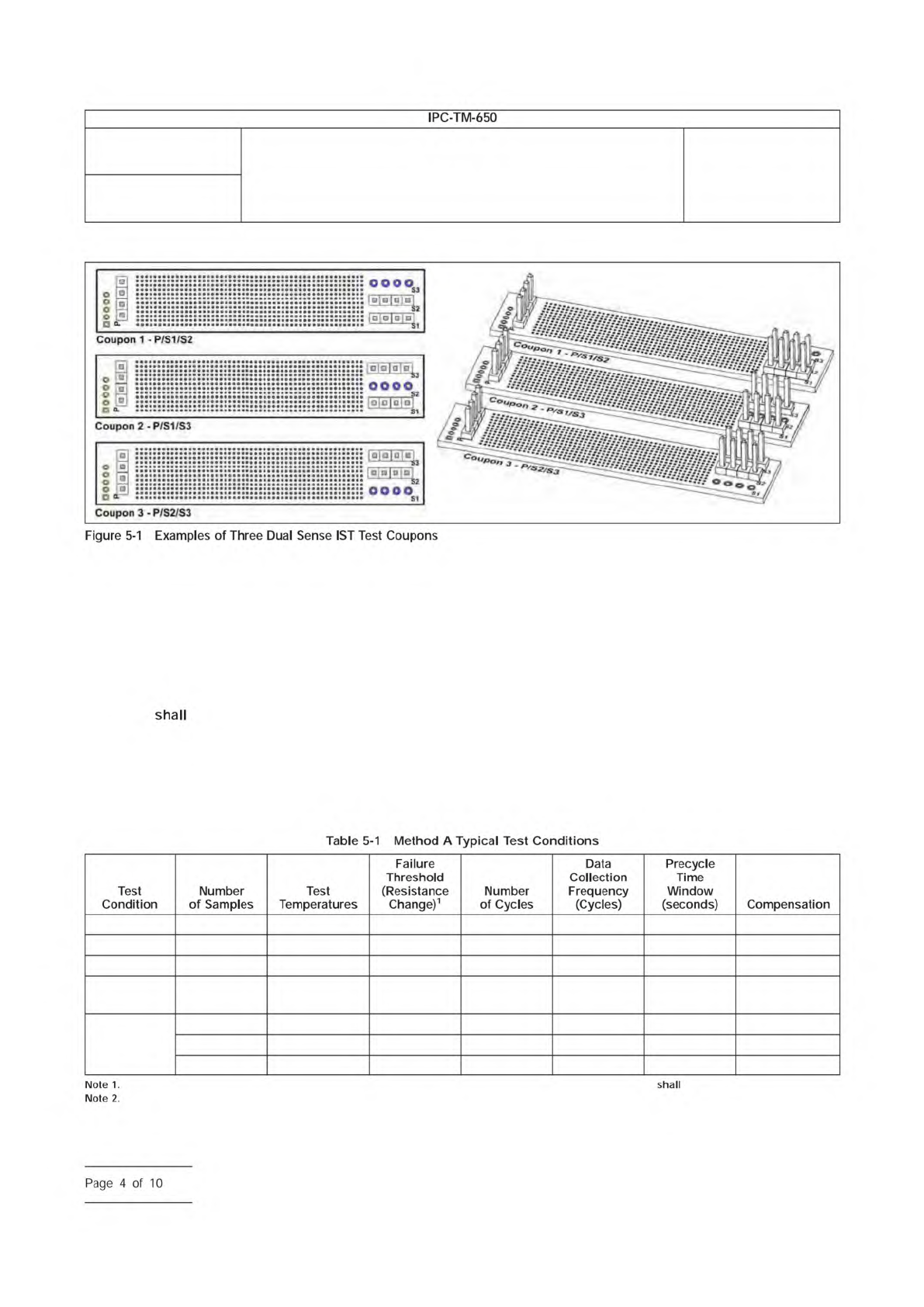
5.2.1.1 Dual Sense Testing (Optional)
When Dual Sense
Testing is required, solder three four-pin male connectors in
the 1.02 mm [0.040 in] holes at the edges of the coupon (see
Figure 5-1). A solder fillet must be apparent on both sides of
the coupon.
Dual Sense coupons may be tested using the Single
Sense Testing method.
Number
2.6.26
Subject
DC Current Induced Thermal Cycling Test
Date
5/14
Revision
A
IPC-TM-650
NOTE:
Page
3
of
10
5.2.2
Position the coupons at each test head by attaching
male to female connectors.
5.2.3 Baseline Performance (Optional)
Establish a per-
formance baseline by completing two Method A cycles and
then stop the test at the end of the cooling cycle.
5.2.4 Capacitance Test (Optional)
If required, the capaci-
tance test
be performed per IPC-TM-650, Method
2.5.35.
5.2.5 Assembly Precondition (Optional)
Assembly pre-
conditioning is recommended to simulate the assembly envi-
ronment to which the printed boards are exposed (see 6.1).
5.2.6
Unless otherwise specified by the user, test all via
types and materials per the default test condition in accor-
dance with Table 5-1. For testing of samples containing
microvia structures, use the microvia test condition. For test-
ing of samples containing polyimide materials, use the polyim-
ide test condition.
5.2.7 Pre-Cycling Test Sequence
The following para-
graphs detail the sequence for a single coupon, however this
sequence is done at all test heads simultaneously. The ambi-
ent resistance, resistance at test temperature, rejection resis-
tance, and current are calculated for each coupon and dis-
played on the PC monitor.
IPC-2626-5-1
(Top-Down View as shown at left and Isometric View as shown at right)
Default 6 150 °C 10% 250 25 3 Calculated
Polyimide 6 AABUS 10% 250 25 3 Calculated
Microvias
2
6 190 °C 10% 250 25 3 None
Polyimide
Microvias
2
6 AABUS 10% 250 25 5 None
Survivability
Testing
6 230 °C 10% 10 1 5 None
6 245 °C 10% 10 1 5 None
6 260 °C 10% 10 1 5 None
For Dual Sense Testing, both the ‘‘Cycle Using’’ and the ‘‘Cycle Failing On’’ fields on the Method A test equipment be set to ‘both sense circuits.’
Power on the microvia or heating trace net.
Number
2.6.26
Subject
DC Current Induced Thermal Cycling Test
Date
5/14
Revision
A
IPC-TM-650
[0同可&
回叫
oooo
Coupon
1
-P/S1/S2
Coupon
2
-
P/S1/S3
Coupon
3
-
P/S2/S3
Figure
5-1
Examples
of
Three
Dual
Sense
1ST
Test
Coupons
shall
Table
5-1
Method
A
Typical
Test
Conditions
Note
1.
Note
2.
Test
Condition
Number
of
Samples
Test
Temperatures
Failure
Threshold
(Resistance
Change)1
Number
of
Cycles
Data
Collection
Frequency
(Cycles)
Precycle
Time
Window
(seconds)
Compensation
0000c
-n
p-d
O0O0D
d
OOOOQ
Page
4
of
10
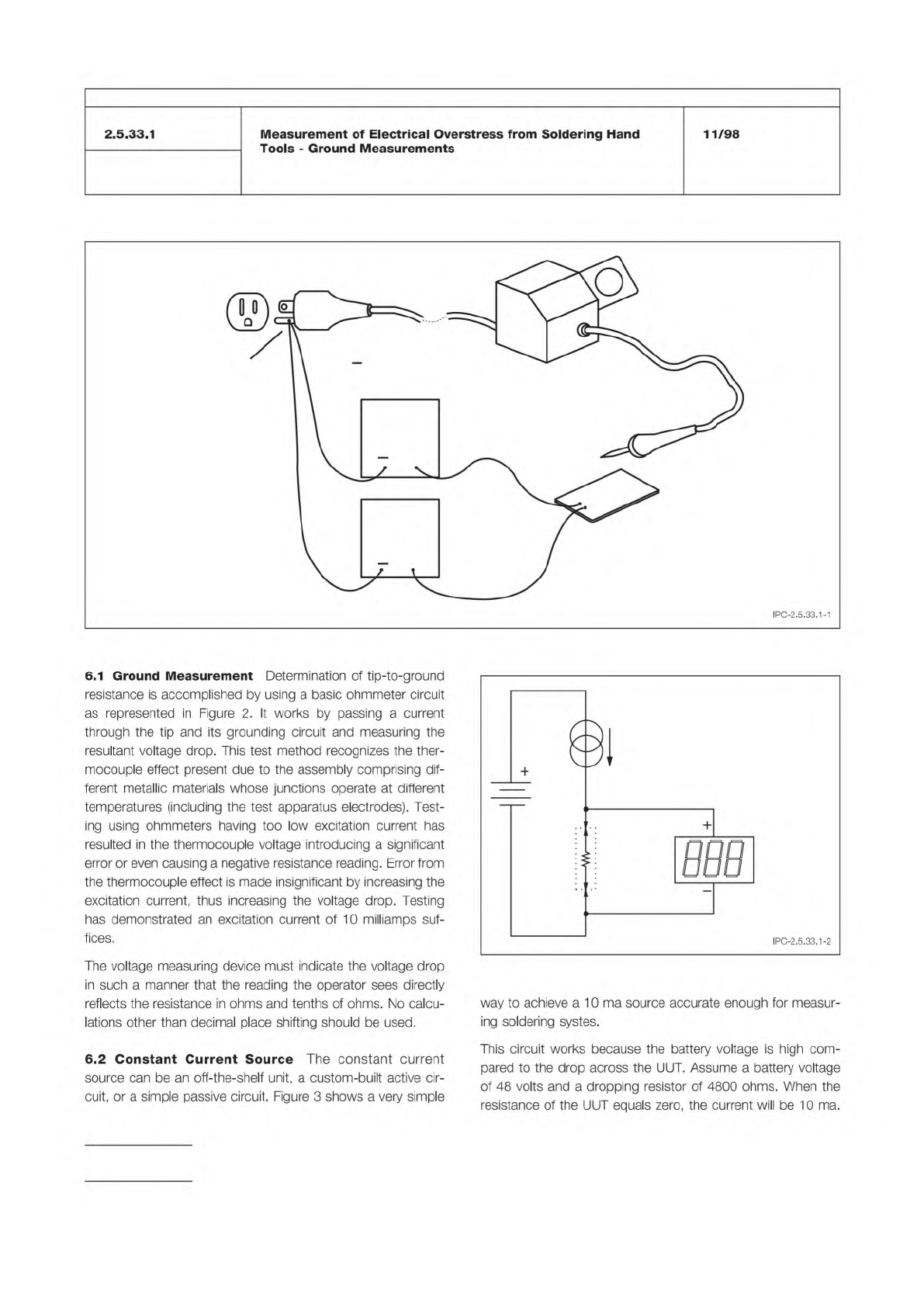
Figure 1 Test Apparatus
10 MA.
CURRENT
SOURCE
GROUND
REFERENCE
POINT
MILLI-
VOL
T
METER
+
+
+
ELECTRODE
( )
UNIT UNDER
TEST (UUT)
TEST
ELECTRODE ( )
Figure 2 Block Diagram of Test Apparatus
UUT
10 MA
CURRENT
REGULATOR
MILLIVOLT
METER
IPC-TM-650
Number
Subject Date
Revision
Page 2 of 3
2.5.33.1
Measurement
of
Electrical
Overstress
from
Soldering
Hand
Tools
-
Ground
Measurements
11/98
IPC-2.5.33.1-1
6.1
Ground
Measurement
Determination
of
tip-to-ground
resistance
is
accomplished
by
using
a
basic
ohmmeter
circuit
as
represented
in
Figure
2.
It
works
by
passing
a
current
through
the
tip
and
its
grounding
circuit
and
measuring
the
resultant
voltage
drop.
This
test
method
recognizes
the
ther¬
mocouple
effect
present
due
to
the
assembly
comprising
dif¬
ferent
metallic
materials
whose
junctions
operate
at
different
temperatures
(including
the
test
apparatus
electrodes).
Test¬
ing
using
ohmmeters
having
too
low
excitation
current
has
resulted
in
the
thermocouple
voltage
introducing
a
significant
error
or
even
causing
a
negative
resistance
reading.
Error
from
the
thermocouple
effect
is
made
insignificant
by
increasing
the
excitation
current,
thus
increasing
the
voltage
drop.
Testing
has
demonstrated
an
excitation
current
of
10
milliamps
suf¬
fices.
The
voltage
measuring
device
must
indicate
the
voltage
drop
in
such
a
manner
that
the
reading
the
operator
sees
directly
reflects
the
resistance
in
ohms
and
tenths
of
ohms.
No
calcu¬
lations
other
than
decimal
place
shifting
should
be
used.
6.2
Constant
Current
Source
The
constant
current
source
can
be
an
off-the-shelf
unit,
a
custom-built
active
cir¬
cuit,
or
a
simple
passive
circuit.
Figure
3
shows
a
very
simple
way
to
achieve
a
10
ma
source
accurate
enough
for
measur¬
ing
soldering
systes.
This
circuit
works
because
the
battery
voltage
is
high
com¬
pared
to
the
drop
across
the
UUT.
Assume
a
battery
voltage
of
48
volts
and
a
dropping
resistor
of
4800
ohms.
When
the
resistance
of
the
UUT
equals
zero,
the
current
will
be
10
ma.