IPC-TM-650 EN 2022 试验方法--.pdf - 第387页
IPC-TM-650 Number Subject Date Revision Page 3 of 2 2.4.47 Flux Residue Dryness 1/95 6.0 Notes 6.1 Safety Observe all appropriate precautions on MSDS for chemicals involved in this test method.
IPC-TM-650
Number
Subject Date
Revision
Page 2 of 2
2.4.47
Flux
Residue
Dryness
1/95
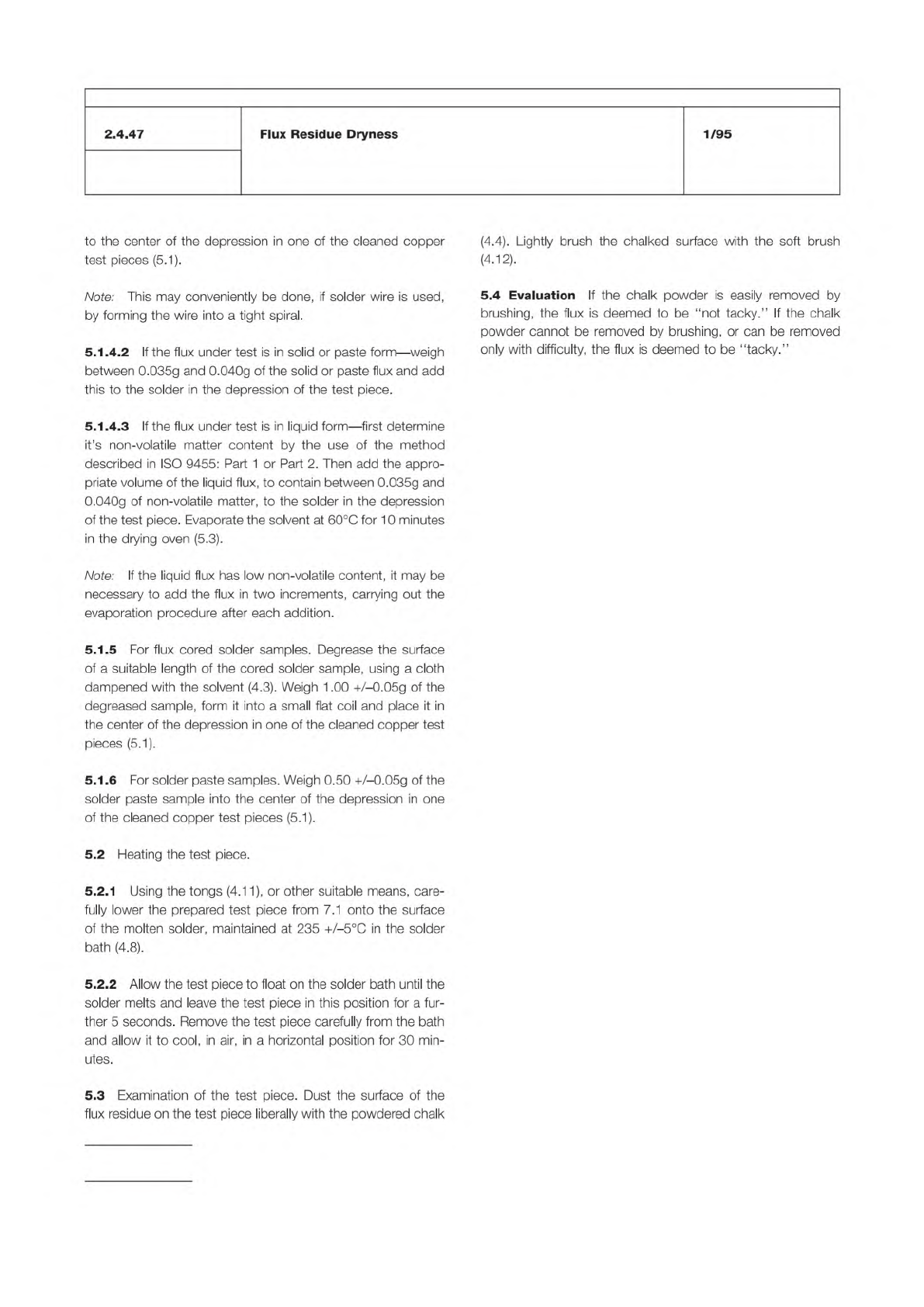
to
the
center
of
the
depression
in
one
of
the
cleaned
copper
test
pieces
(5.1).
Note:
This
may
conveniently
be
done,
if
solder
wire
is
used,
by
forming
the
wire
into
a
tight
spiral.
5.
1.4
.2
If
the
flux
under
test
is
in
solid
or
paste
form
—
weigh
between
0.035g
and
0.040g
of
the
solid
or
paste
flux
and
add
this
to
the
solder
in
the
depression
of
the
test
piece.
5.1.
4
.3
If
the
flux
under
test
is
in
liquid
form
—
first
determine
it's
non-volatile
matter
content
by
the
use
of
the
method
described
in
ISO
9455:
Part
1
or
Part
2.
Then
add
the
appro¬
priate
volume
of
the
liquid
flux,
to
contain
between
0.035g
and
0.040g
of
non-volatile
matter,
to
the
solder
in
the
depression
of
the
test
piece.
Evaporate
the
solvent
at
60℃
for
1
0
minutes
in
the
drying
oven
(5.3).
Note:
If
the
liquid
flux
has
low
non-volatile
content,
it
may
be
necessary
to
add
the
flux
in
two
increments,
carrying
out
the
evaporation
procedure
after
each
addition.
5.1.5
For
flux
cored
solder
samples.
Degrease
the
surface
of
a
suitable
length
of
the
cored
solder
sample,
using
a
cloth
dampened
with
the
solvent
(4.3).
Weigh
1
.00
+/-0.05g
of
the
degreased
sample,
form
it
into
a
small
flat
coil
and
place
it
in
the
center
of
the
depression
in
one
of
the
cleaned
copper
test
pieces
(5.1).
5.1.6
For
solder
paste
samples.
Weigh
0.50
+/-0.05g
of
the
solder
paste
sample
into
the
center
of
the
depression
in
one
of
the
cleaned
copper
test
pieces
(5.1).
5.2
Heating
the
test
piece.
5.2.1
Using
the
tongs
(4.1
1),
or
other
suitable
means,
care¬
fully
lower
the
prepared
test
piece
from
7.1
onto
the
surface
of
the
molten
solder,
maintained
at
235
+/-5℃
in
the
solder
bath
(4.8).
5.2.2
Allow
the
test
piece
to
float
on
the
solder
bath
until
the
solder
melts
and
leave
the
test
piece
in
this
position
for
a
fur¬
ther
5
seconds.
Remove
the
test
piece
carefully
from
the
bath
and
allow
it
to
cool,
in
air,
in
a
horizontal
position
for
30
min¬
utes.
(4.4)
.
Lightly
brush
the
chalked
surface
with
the
soft
brush
(4.12).
5.4
Evaluation
If
the
chalk
powder
is
easily
removed
by
brushing,
the
flux
is
deemed
to
be
"not
tacky."
If
the
chalk
powder
cannot
be
removed
by
brushing,
or
can
be
removed
only
with
difficulty,
the
flux
is
deemed
to
be
“tacky.”
5.3
Examination
of
the
test
piece.
Dust
the
surface
of
the
flux
residue
on
the
test
piece
liberally
with
the
powdered
chalk
IPC-TM-650
Number
Subject Date
Revision
Page 3 of 2
2.4.47
Flux
Residue
Dryness
1/95
6.0
Notes
6.1
Safety
Observe
all
appropriate
precautions
on
MSDS
for
chemicals
involved
in
this
test
method.
Complex Relative Permittivity
Permittivity
Relative Permittivity
Loss Tangent
IPC-T-50
IPC-MF-150
IPC-TM-650
IPC-TM-650
ASTM
D3380-75
Material in this Test Methods Manual was voluntarily established by Technical Committees of the IPC. This material is advisory only
and its use or adaptation is entirely voluntary. IPC disclaims all liability of any kind as to the use, application, or adaptation of this
material. Users are also wholly responsible for protecting themselves against all claims or liabilities for patent infringement.
Equipment referenced is for the convenience of the user and does not imply endorsement by the IPC.
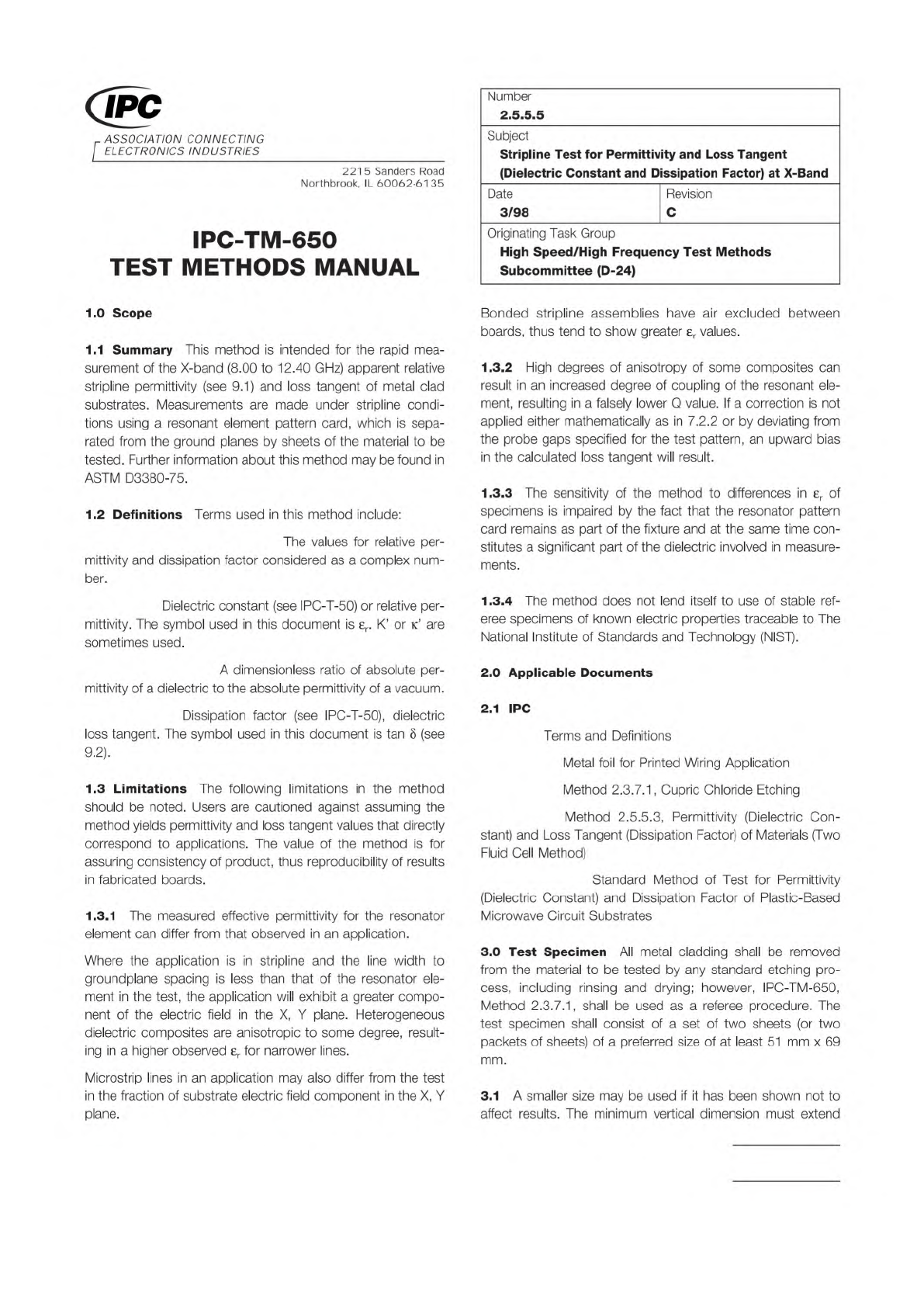
Page 1 of 25
Number
r
ASSOCIATION
CONNECTING
/
ELECTRONICS
INDUSTRIES
221
5
Sanders
Road
Northbrook,
IL
60062-6135
IPC-TM-650
TEST
METHODS
MANUAL
1
.0
Scope
1.1
Summary
This
method
is
intended
for
the
rapid
mea¬
surement
of
the
X-band
(8.00
to
12.40
GHz)
apparent
relative
stripline
permittivity
(see
9.1)
and
loss
tangent
of
metal
clad
substrates.
Measurements
are
made
under
stripline
condi¬
tions
using
a
resonant
element
pattern
card,
which
is
sepa¬
rated
from
the
ground
planes
by
sheets
of
the
material
to
be
tested.
Further
information
about
this
method
may
be
found
in
ASTM
D3380-75.
1.2
Definitions
Terms
used
in
this
method
include:
The
values
for
relative
per¬
mittivity
and
dissipation
factor
considered
as
a
complex
num¬
ber.
Dielectric
constant
(see
IPC-T-50)
or
relative
per¬
mittivity.
The
symbol
used
in
this
document
is
er.
K'
or
k'
are
sometimes
used.
A
dimensionless
ratio
of
absolute
per¬
mittivity
of
a
dielectric
to
the
absolute
permittivity
of
a
vacuum.
Dissipation
factor
(see
IPC-T-50),
dielectric
loss
tangent.
The
symbol
used
in
this
document
is
tan
8
(see
9.2).
1.3
Limitations
The
following
limitations
in
the
method
should
be
noted.
Users
are
cautioned
against
assuming
the
method
yields
permittivity
and
loss
tangent
values
that
directly
correspond
to
applications.
The
value
of
the
method
is
for
assuring
consistency
of
product,
thus
reproducibility
of
results
in
fabricated
boards.
1.3.1
The
measured
effective
permittivity
for
the
resonator
element
can
differ
from
that
observed
in
an
application.
Where
the
application
is
in
stripline
and
the
line
width
to
groundplane
spacing
is
less
than
that
of
the
resonator
ele¬
ment
in
the
test,
the
application
will
exhibit
a
greater
compo¬
nent
of
the
electric
field
in
the
X,
Y
plane.
Heterogeneous
dielectric
composites
are
anisotropic
to
some
degree,
result¬
ing
in
a
higher
observed
er
for
narrower
lines.
Microstrip
lines
in
an
application
may
also
differ
from
the
test
in
the
fraction
of
substrate
electric
field
component
in
the
X,
Y
plane.
2.5.5.5
Subject
Stripline
Test
for
Permittivity
and
Loss
Tangent
(Dielectric
Constant
and
Dissipation
Factor)
at
X-Band
Date
Revision
3/98
C
Originating
Task
Group
High
Speed/High
Frequency
Test
Methods
Subcommittee
(D-24)
Bonded
stripline
assemblies
have
air
excluded
between
boards,
thus
tend
to
show
greater
er
values.
1.3.2
High
degrees
of
anisotropy
of
some
composites
can
result
in
an
increased
degree
of
coupling
of
the
resonant
ele¬
ment,
resulting
in
a
falsely
lower
Q
value.
If
a
correction
is
not
applied
either
mathematically
as
in
7.2.2
or
by
deviating
from
the
probe
gaps
specified
for
the
test
pattern,
an
upward
bias
in
the
calculated
loss
tangent
will
result.
1.3.3
The
sensitivity
of
the
method
to
differences
in
er
of
specimens
is
impaired
by
the
fact
that
the
resonator
pattern
card
remains
as
part
of
the
fixture
and
at
the
same
time
con¬
stitutes
a
significant
part
of
the
dielectric
involved
in
measure¬
ments.
1
.3.4
The
method
does
not
lend
itself
to
use
of
stable
ref¬
eree
specimens
of
known
electric
properties
traceable
to
The
National
Institute
of
Standards
and
Technology
(NIST).
2
.0
Applicable
Documents
2.1
IPC
Terms
and
Definitions
Metal
foil
for
Printed
Wiring
Application
Method
2.3.7.
1
,
Cupric
Chloride
Etching
Method
2.
5.5.
3,
Permittivity
(Dielectric
Con¬
stant)
and
Loss
Tangent
(Dissipation
Factor)
of
Materials
(Two
Fluid
Cell
Method)
Standard
Method
of
Test
for
Permittivity
(Dielectric
Constant)
and
Dissipation
Factor
of
Plastic-
Based
Microwave
Circuit
Substrates
3
.0
Test
Specimen
All
metal
cladding
shall
be
removed
from
the
material
to
be
tested
by
any
standard
etching
pro¬
cess,
including
rinsing
and
drying;
however,
IPC-TM-650,
Method
2.3.7.
1
,
shall
be
used
as
a
referee
procedure.
The
test
specimen
shall
consist
of
a
set
of
two
sheets
(or
two
packets
of
sheets)
of
a
preferred
size
of
at
least
51
mm
x
69
mm.
3.1
A
smaller
size
may
be
used
if
it
has
been
shown
not
to
affect
results.
The
minimum
vertical
dimension
must
extend