IPC-TM-650 EN 2022 试验方法--.pdf - 第734页
1 Sc ope Thi s t est m etho d des cri bes th e pro ced ure fo r est ablishing t he serv ice tem perature for metal-c lad fle xible base material (laminate) as de scribed in IPC-4204 as we ll as co ver m ater ia ls a nd a…
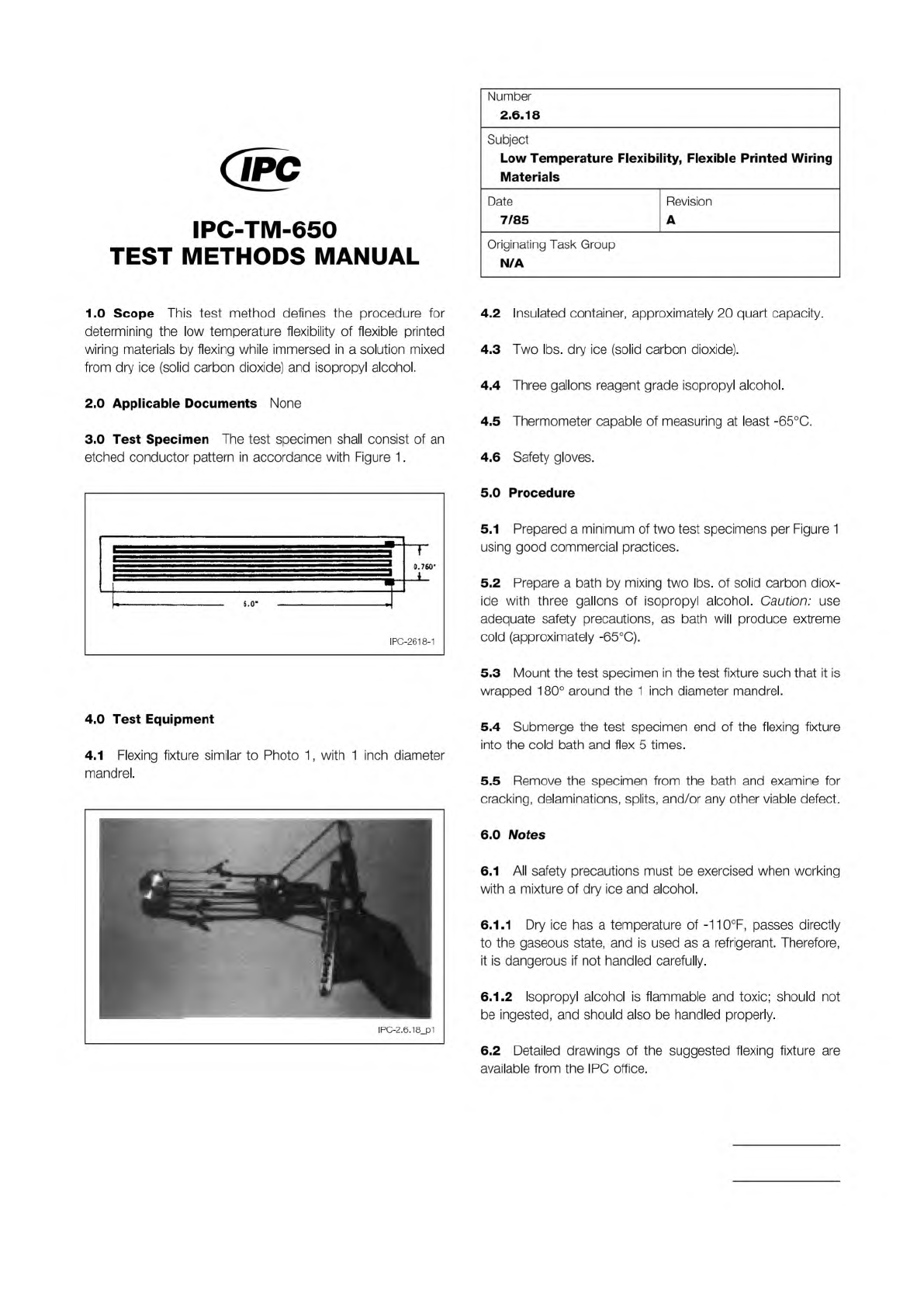
Figure 1 Low Temperature Flexibility Test Pattern. Note:
Conductors are 0.060 inch wide on 0.100 inch centers.)
Photo 1 Low Temperature Flexibility Flexing Fixture.
(Note: Fixture Drawing available from IPC.)
The Institute for Interconnecting and Packaging Electronic Circuits
2215 Sanders Road • Northbrook, IL 60062-6135
Material in this Test Methods Manual was voluntarily established by Technical Committees of the IPC. This material is advisory only
and its use or adaptation is entirely voluntary. IPC disclaims all liability of any kind as to the use, application, or adaptation of this
material. Users are also wholly responsible for protecting themselves against all claims or liabilities for patent infringement.
Equipment referenced is for the convenience of the user and does not imply endorsement by the IPC.
Page 1 of 1
IPC-TM-650
TEST
METHODS
MANUAL
1
.0
Scope
This
test
method
defines
the
procedure
for
determining
the
low
temperature
flexibility
of
flexible
printed
wiring
materials
by
flexing
while
immersed
in
a
solution
mixed
from
dry
ice
(solid
carbon
dioxide)
and
isopropyl
alcohol.
2
.0
Applicable
Documents
None
3
.0
Test
Specimen
The
test
specimen
shall
consist
of
an
etched
conductor
pattern
in
accordance
with
Figure
1
.
0.760"
6.0.
*
I
PC-261
8-1
4
.0
Test
Equipment
4.1
Flexing
fixture
similar
to
Photo
1
,
with
1
inch
diameter
mandrel.
Number
2.6.18
Subject
Low
Temperature
Flexibility,
Flexible
Printed
Wiring
Materials
Date
Revision
7/85
A
Originating
Task
Group
N/A
4.2
Insulated
container,
approximately
20
quart
capacity.
4.3
Two
lbs.
dry
ice
(solid
carbon
dioxide).
4.4
Three
gallons
reagent
grade
isopropyl
alcohol.
4.5
Thermometer
capable
of
measuring
at
least
-65℃.
4.6
Safety
gloves.
5
.0
Procedure
5
J
Prepared
a
minimum
of
two
test
specimens
per
Figure
1
using
good
commercial
practices.
5
.2
Prepare
a
bath
by
mixing
two
lbs.
of
solid
carbon
diox¬
ide
with
three
gallons
of
isopropyl
alcohol.
Caution:
use
adequate
safety
precautions,
as
bath
will
produce
extreme
cold
(approximately
-65℃).
5
.3
Mount
the
test
specimen
in
the
test
fixture
such
that
it
is
wrapped
180°
around
the
1
inch
diameter
mandrel.
5
.4
Submerge
the
test
specimen
end
of
the
flexing
fixture
into
the
cold
bath
and
flex
5
times.
5
.5
Remove
the
specimen
from
the
bath
and
examine
for
cracking,
delaminations,
splits,
and/or
any
other
viable
defect.
6.0
Notes
6
・1
All
safety
precautions
must
be
exercised
when
working
with
a
mixture
of
dry
ice
and
alcohol.
6.1.1
Dry
ice
has
a
temperature
of
-1
10°F,
passes
directly
to
the
gaseous
state,
and
is
used
as
a
refrigerant.
Therefore,
it
is
dangerous
if
not
handled
carefully.
6.1.2
Isopropyl
alcohol
is
flammable
and
toxic;
should
not
be
ingested,
and
should
also
be
handled
properly.
IPC-2.6.18_p1
6.2
Detailed
drawings
of
the
suggested
flexing
fixture
are
available
from
the
IPG
office.
1 Scope
This test method describes the procedure for
establishing the service temperature for metal-clad flexible
base material (laminate) as described in IPC-4204 as well as
cover materials and adhesive bonding films (unsupported
adhesive and supported bond plies) as described in IPC-
4203. For purposes of this test method, cover material
consist of coverlay and coverfilm but include cover-
coat materials. Properties evaluated after thermal aging in this
test are: visual, peel strength and dielectric strength.
2 Applicable Documents
2.1 IPC
1
Terms and Definitions for Interconnecting and
Packaging Electronic Circuits
Test Methods Manual
2
2.4.9 Peel Strength, Flexible Dielectric Materials
2.4.13 Solder Float Resistance Flexible Printed Wiring
Materials
Adhesive Coated Dielectric Films for Use as Cover
Sheets for Flexible Printed Circuitry and Flexible Adhesive
Bonding Films
Metal Foil for Printed Board Applications
2.2 ASTM International
3
Standard Test Method for Dielectric Break-
down Voltage and Dielectric Strength of Solid Electrical Insu-
lating Materials at Commercial Power Frequencies
3 Bond Strength Test Procedure
3.1 Specimen Preparation for Metal-Clad Flexible Base
Material (Laminate)
3.1.1
Prepare twelve specimens according to the procedure
outlined for method A of IPC TM-650, method 2.4.9, using
appropriate photolithographic processes. Etch four conduc-
tors 3.2 mm [0.126 in] wide, 5.7 mm [0.224 in] pitch, 230 -
250 mm [9 - 10 in] long on a nominal 25 mm [1 in] wide strip
of flexible base dielectric (see Figure 1).
Single-clad or double-clad flexible base material
be
tested in the format supplied. If the flexible base material
under test is double-clad, prepare a separate set of speci-
mens for each side. It is permissible to leave the unetched
copper on the non-test side (see Notes 6.1 and 6.2).
3.2 Specimen Preparation for Cover Material
3.2.1
Single-clad base material be produced from
specimens of the cover materials. Cover material
be
bonded to the shiny side of 34.3 µm [1.35 mil] copper foil,
type CU-E1-1S or CU-E7-1S per IPC-4562 (CU-E1-1S
be the referee material). Copper foil cleaning be per the
manufacturer’s normal cleaning procedure. The referee clean-
ing procedure
be per Table 1.
3.2.2
Prepare twelve specimens according to the procedure
outlined for method A of IPC TM-650, method 2.4.9, using
appropriate photolithographic processes. Etch four conduc-
tors 3.2 mm [0.126 in] wide, 5.7 mm [0.224 in] pitch, 230 -
250 mm [9 - 10 in] long on a nominal 25 mm [1 in] wide strip
of flexible base dielectric (see Figure 1).
3.3 Specimen Preparation for Adhesive Bonding Film
3.3.1
Metal-clad flexible base material be produced
from specimens of the adhesive bonding film being evaluated.
Adhesive bonding film
be bonded to the shiny side of
34.3 µm [1350 µin] ED copper foil, type CU-E1-1S or RA
copper foil, CU-E7-1S per IPC-4562 (CU-E1-1S
be the
referee material). Adhesive bonding film
be bonded
between the copper foil and CU-E1-1S as support material as
illustrated in Figure 2. Copper foil cleaning
be per the
manufacturer’s normal cleaning procedure. The referee clean-
ing procedure
be per Table 1, the same as detailed in
IPC-4203.
Prepare specimens according to the procedure outlined for
method A of IPC TM-650, method 2.4.9, using appropriate
1. www.ipc.org
2. Current and revised IPC Test Methods are available on the IPC Web site (www.ipc.org/html/testmethods.htm)
3. www.astm.org
3000 Lakeside Drive, Suite 309S
Bannockburn, IL 60015-1249
IPC-TM-650
TEST METHODS MANUAL
Number
2.6.21
Subject
Service Temperature of Metal-Clad Flexible Laminate,
Cover Material and Adhesive Bonding Films
Date
6/11
Revision
B
Originating Task Group
Flexible Circuits Test Methods Subcommittee
(D-15)
Association
Connecting
Electronics
Industries
shall
shall
not
shall
IPC-T-50
IPC-TM-650
IPC-4203
IPC-4562
ASTM
D-149
shall
shall
shall
shall
shall
shall
shall
shall
shall
shall
shall
Material
/n
this
Test
Methods
Manual
was
voluntarily
established
by
Technical
Committees
of
I
PC.
This
material
/s
advisory
only
and
"s
use
or
adaptation
,
s
entirely
voluntary.
IPC
disclaims
all
liability
of
any
kind
as
to
the
use,
application,
or
adaptation
of
this
material.
Users
are
also
wholly
responsible
for
protecting
themselves
against
all
claims
or
liabilities
for
patent
infringement.
Equipment
referenced
/s
for
the
convenience
of
the
user
and
does
not
imply
endorsement
by
IPC.
Page
1
of
5
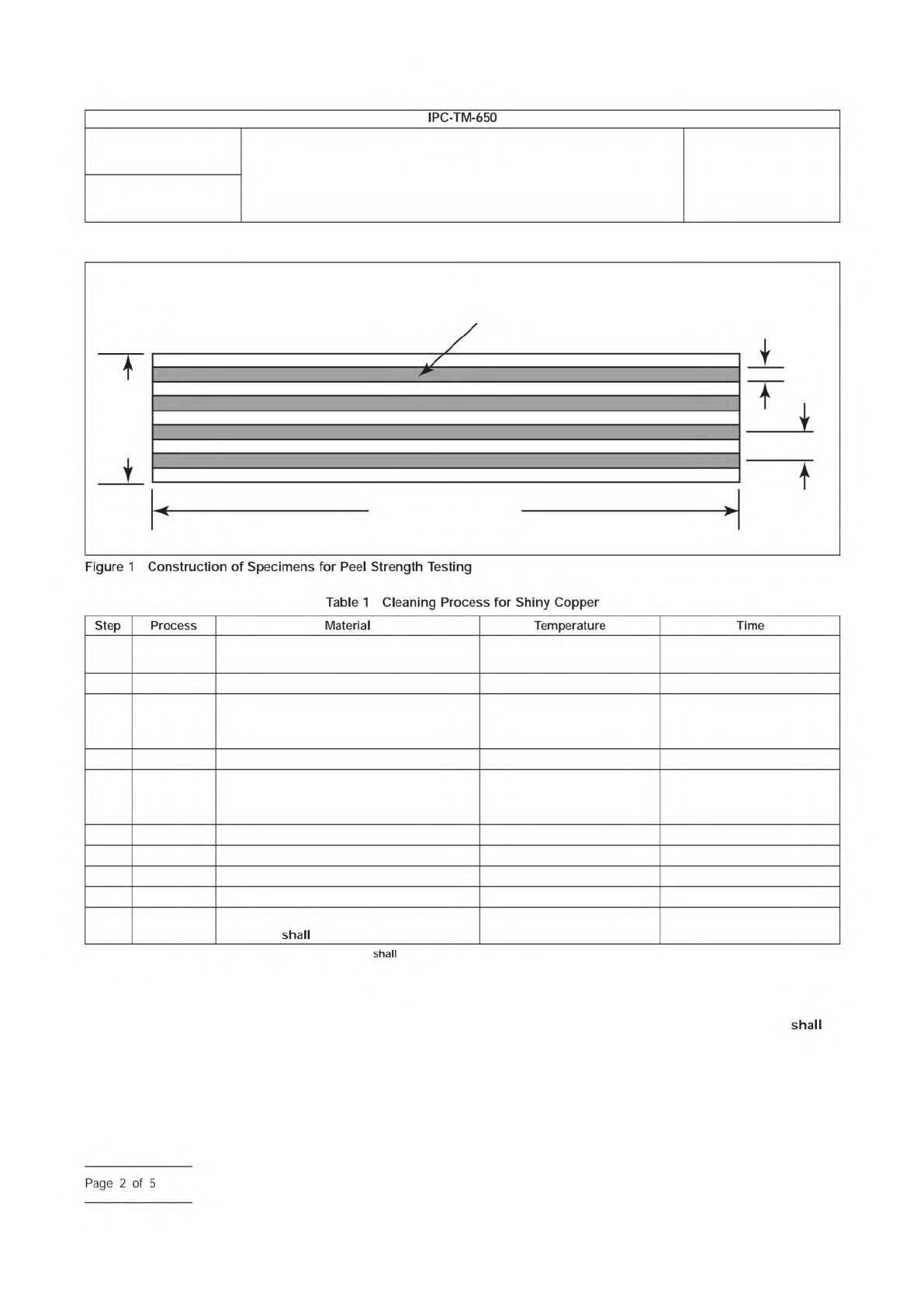
photolithographic processes such that a minimum of twelve
good specimens are yielded at the end of 3.4.5. On the ‘‘Test
Surface,’’ etch four conductors 3.2 mm [0.126 in] wide,
5.7 mm [0.224 in] pitch, 230 - 250 mm [9 - 10 in] long on a
nominal 25 mm [1 in] wide strip of flexible base dielectric (see
Figures 1 and 2).
3.4 Conditioning and Aging Procedure
3.4.1
Twelve specimens, as described in section 3, be
subjected to a stabilization period of a minimum of 24 hours
at 23 °C ± 2 °C [73.4 °F ± 3.6 °F] and 50% ± 5% RH.
IPC-2-6-21a
Metal Conductor (4 each)
3.2 mm
[0.126 in]
25 mm [1 in]
(nom.)
230–250 mm [9–10 in]
5.7 mm
[0.224 in]
1 Soak Clean
Use commercially available acid or alkaline
cleaners
Per supplier recommended
temperature
Per supplier recommended
time
2 Rinse Running tap water Room Temperature 3 - 5 minutes
3 Microetch
Sodium persulfate: Two liters of deionized
water, 280 grams of sodium persulfate,
25 cc sulfuric acid
Room Temperature 1 - 2 minutes
4 Rinse Running tap water Room Temperature 1 minute
5 Acid Dip
Sulfuric acid 10% by volume, dilution 1.8
liters deionized water, 200 cc sulfuric acid
96% assay
Room Temperature 45 seconds
6 Rinse Running tap water Room Temperature 1 minute
7 Rinse Deionized water Room Temperature 1 minute
8 Dry Force air dry or blot with paper towels Room Temperature 1 - 3 minutes
9 Bake Bake in clean air-circulating oven 110 ± 5 °C [230.0 ± 9.0 °F] 10 to 15 minutes
10 Lamination
*Maximum delay between bake and
lamination
be 30 minutes
*Lamination conditions (e.g., pressure, temperature, time, etc.) conform to suppliers’ recommendations.
Number
2.6.21
Subject
Service Temperature of Metal-Clad Flexible Laminate, Cover
Material and Adhesive Bonding Films
Date
6/11
Revision
B
IPC-TM-650
—
Figure
1
Construction
of
Specimens
for
Peel
Strength
Testing
Table
1
Cleaning
Process
for
Shiny
Copper
shall
Step
Process
Material
Temperature
Time
shall
shall
Page
2
of
5