IPC-TM-650 EN 2022 试验方法--.pdf - 第449页
The same technique can be used for extracting the res istive and dielectric losses in t he presence of metal roughness and dielectric inhomogeneities and for differential wiring. 5. 4 SE T2D IL Pro cedu re Thi s s pe cif…
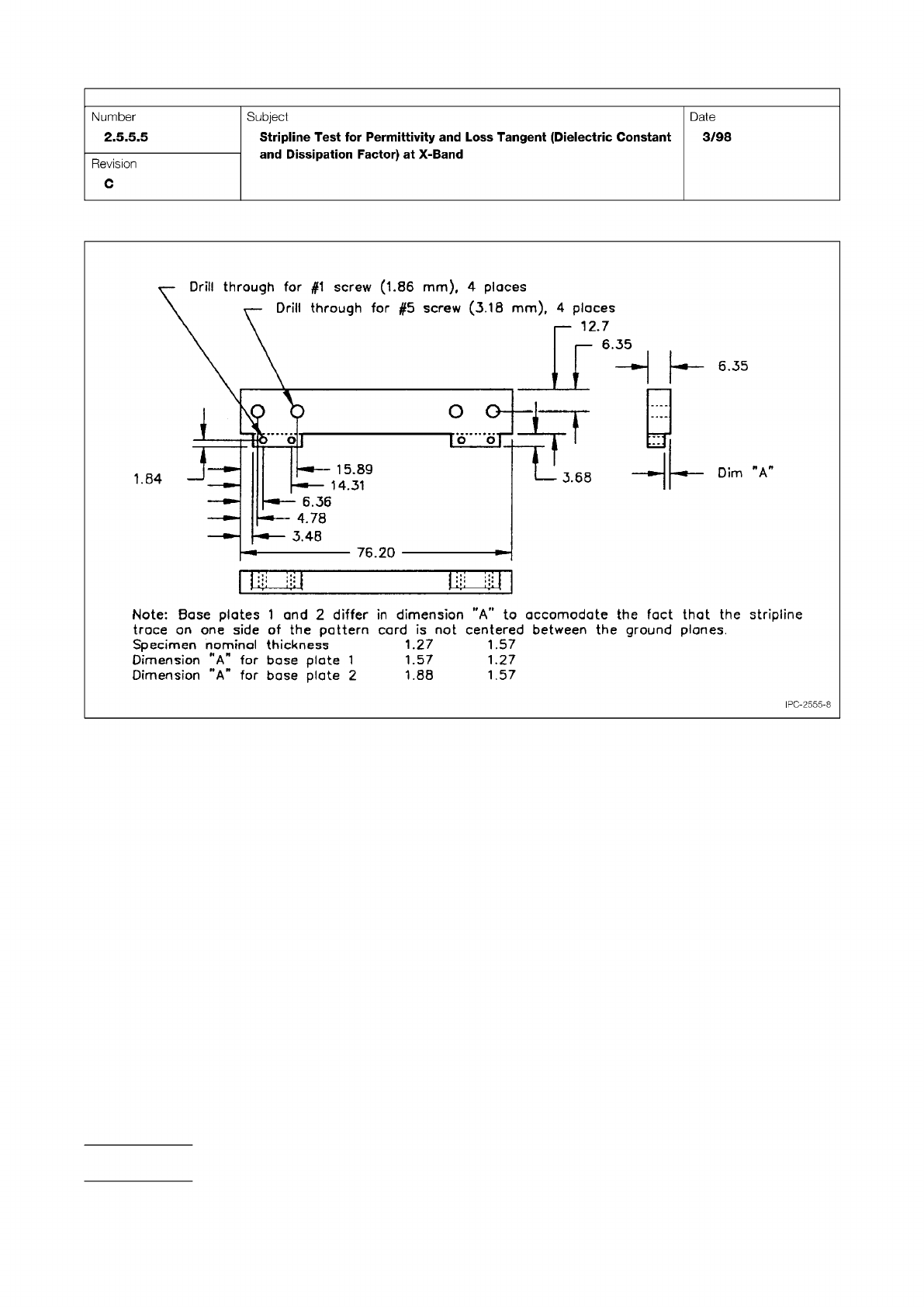
Figure
8 Brass or Aluminum Base Plate for Clamping the Base Cards and Connecting Launcher Bodies to the Base Card
IPC-TM-650
Page 16 of 25
Number
2.5.5.5
Subject
Stripline
Test
for
Permittivity
and
Loss
Tangent
(Dielectric
Constant
and
Dissipation
Factor)
at
X-Band
Date
3/98
Revision
C
6.35
o
L£
Dim
"A
76.20
Drill
through
for
#1
screw
(1.86
mm),
4
places
Drill
through
for
#5
screw
(3.18
mm),
4
places
12.7
15.89
14.31
-
•-
6.36
4.78
—
3.48
stripline
Note:
Base
plates
1
and
2
differ
in
dimension
"A”
to
accomodate
the
fact
that
the
trace
on
one
side
of
the
pattern
card
is
not
centered
between
the
ground
planes.
Specimen
hominal
thickness
1.27
1.57
Dimension
“A”
for
base
plate
1
1.57
1.27
Dimension
“A"
for
base
plate
2
L88
1.57
IPC-2555-8
The same technique can be used for extracting the resistive
and dielectric losses in the presence of metal roughness and
dielectric inhomogeneities and for differential wiring.
5.4 SET2DIL Procedure
This specification outlines the
fundamental principles behind SET2DIL; the exact method will
be instrument-dependent. Vendors providing SET2DIL capa-
bility are responsible for ensuring correlation between stan-
dard SDD21 measurements (VNA) and their implementation of
SET2DIL.
5.4.1 SET2DIL Structure
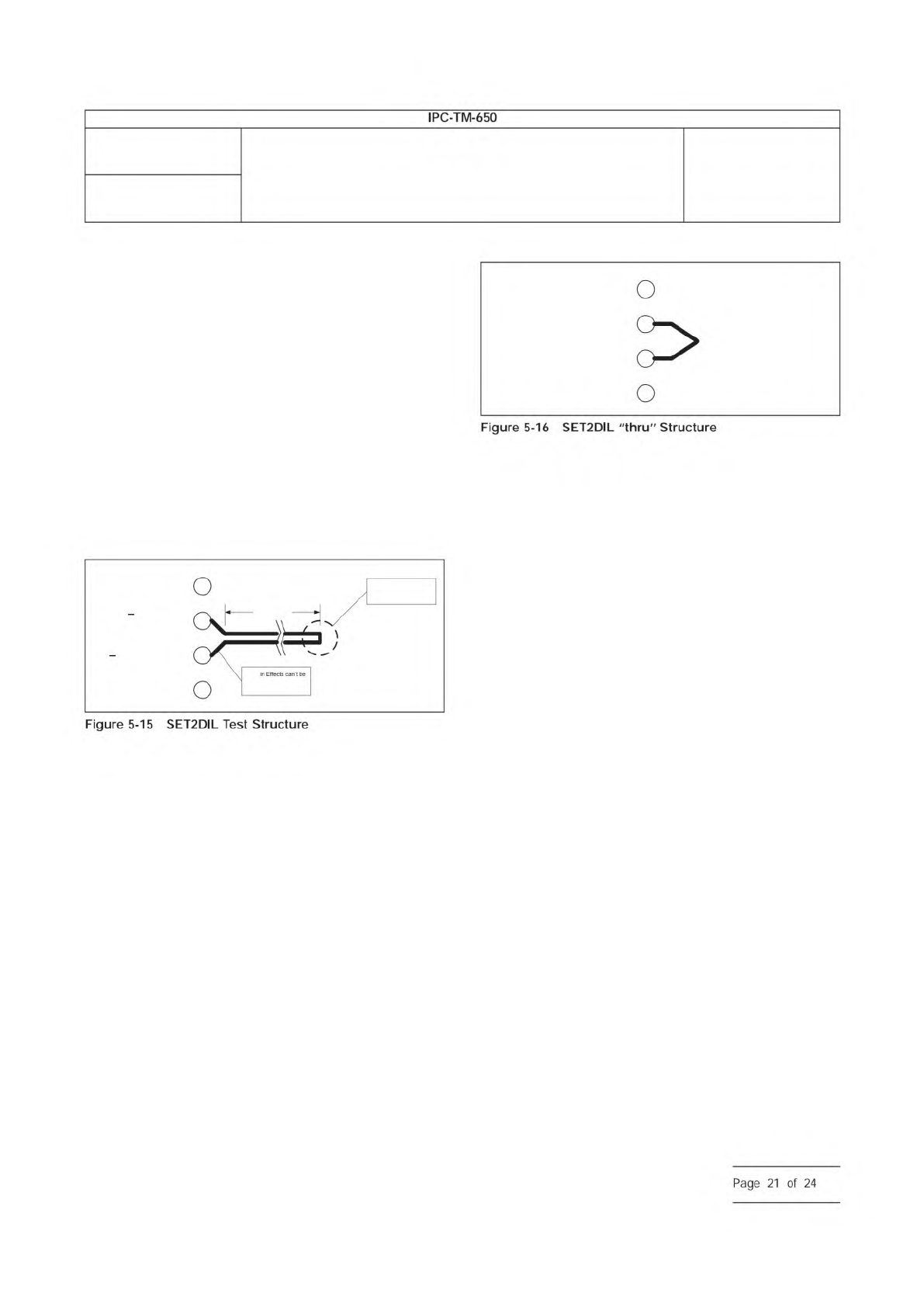
The SET2DIL structure is a
101.6 mm [4.0 in] representative piece of the differential pair
(or single-ended signal) being characterized (see Figure 5-15).
It has an effective length of 203.2 mm [8.0 in]. A ‘‘thru’’ struc-
ture is used as a reference (see Figure 5-16).
5.4.2 SET2DIL Measurement
A TDR pulse is injected into
‘‘q1’’ while the waveforms at q1 and q2 are monitored. The
q1 waveform will represent single-ended impedance with the
far end cross talk (FEXT) pulse superimposed on that. Like-
wise, the q2 waveform will represent the near end cross talk
(NEXT) pulse with the TDT pulse superimposed on that (see
Figure 5-17).
5.4.3 SET2DIL TDD21 Extraction
The TDT pulse is
extracted from the q2 waveform, and the FEXT pulse is
extracted from the q1 waveform. FEXT is subtracted from TDT
to form TDD21. A detailed description of the waveform
manipulation is available as the 2010 DesignCon paper
‘‘SET2DIL: Method to Derive Differential Insertion Loss from
Single-Ended TDR/TDT Measurements.’’ Figure 5-18 shows
the extracted waveforms and the resultant TDD21.
5.4.4 SET2DIL SDD21 Calculation
The FFT of the deriva-
tive of TDD21 is divided by the FFT of the derivative of the
‘‘thru’’ waveforms to calculate SDD21 of the SET2DIL struc-
ture. Figure 5-19 shows the time and frequency domain wave-
forms (SET2DIL frequency domain results compared to VNA
measurements on the right). SDD21 as a function of fre-
quency can then be compared to expected values to deter-
mine if the printed board construction is adequate to meet the
insertion loss requirements of the design.
IPC-25512-5-15
G
+
G
q1 excitation/
measurement
DUT/2 (4")
q2 measurement
DUT looped back
at end
Lead-
de-embedded;
must be minimized
IPC-25512-5-16
Ref Structure
(thru)
G
-
+
G
q1: excitation
q2: measurement
Number
2.5.5.12
Subject
Test Methods to Determine the Amount of Signal Loss on
Printed Boards
Date
07/12
Revision
A
IPC-TM-650
—
o
o
Figure
5-16
SET2DIL
"thru"
Structure
Page
21
of
24
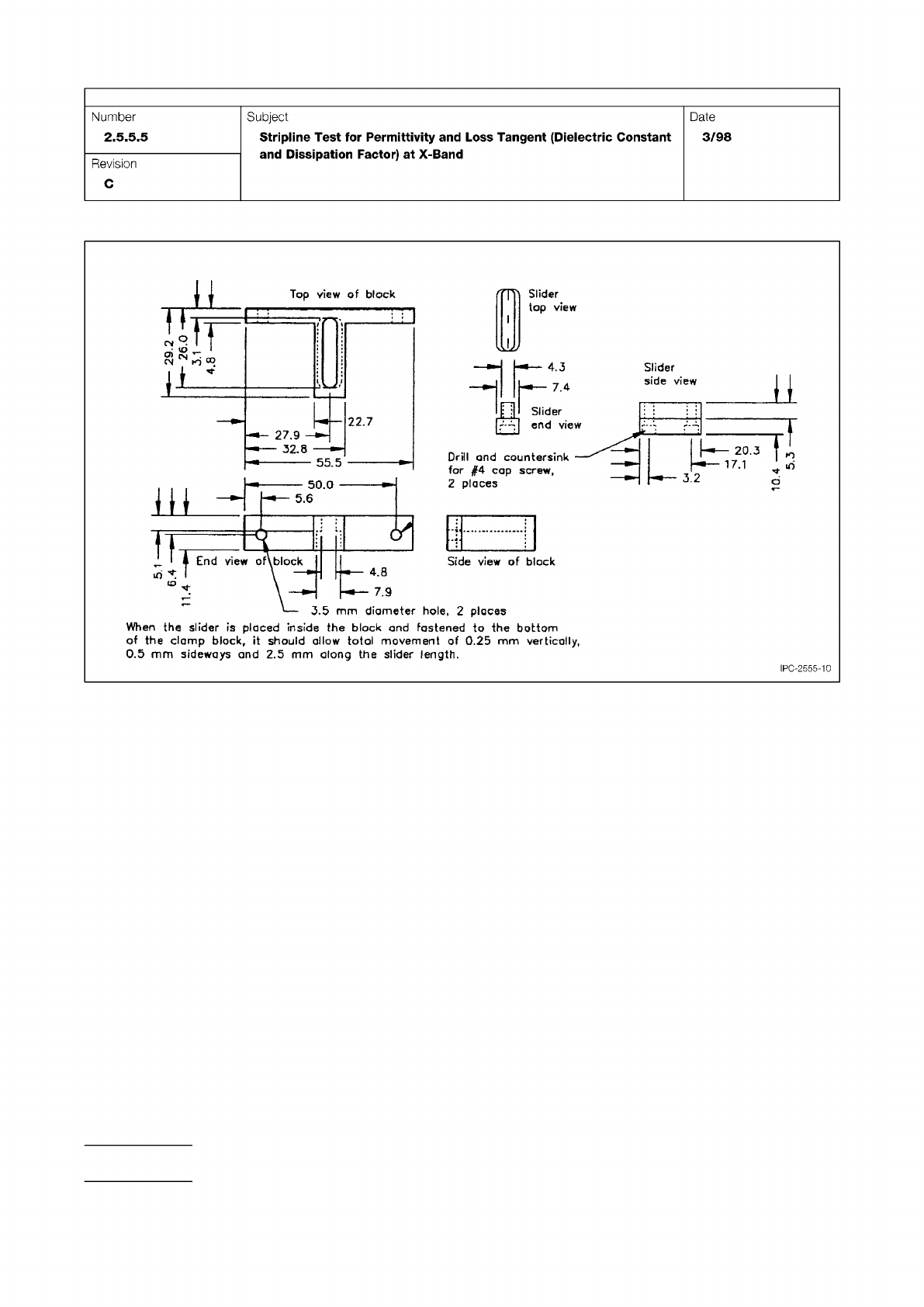
Figure 10 Slider and Block for Connecting Pressure Block and Base Plate with Allowance for Opening the Fixture
IPC-TM-650
Page 18 of 25
IPC-2555-10
When
the
slider
is
placed
inside
the
block
and
fastened
to
the
bottom
of
the
clamp
block,
it
should
allow
total
movement
of
0.25
mm
vertically,
0.5
mm
sideways
and
2.5
mm
along
the
slider
length.
Number
2.5.5.5
Subject
Stripline
Test
for
Permittivity
and
Loss
Tangent
(Dielectric
Constant
and
Dissipation
Factor)
at
X-Band
Date
3/98
Revision
C