IPC-TM-650 EN 2022 试验方法--.pdf - 第664页
1 Scope This test method defines the procedures for deter- mining t he surface i nsulation resistance of a copper foil clad flexible dielectric materi al in the p resence o f moisture. This test method may be used for te…
5.8.3 Class T Evaluation
5.8.3.1
Three separate sets of measurements are to be
recorded for the uncoated specimen, the ‘as received’ speci-
men, and the specimen after solder exposure. Each set of
readings shall be averaged and shall be greater than the mini-
mum listed in the relevant specification. No individual insula-
tion resistance (IR) value may be less than 0.1 x IR
min
, where
IR
min
is the minimum in the set of IR values measured. Two
measurements may be excluded from calculating the average
if there is an assignable cause of low insulation resistance that
can be attributable to the laminate itself or to the process
used to produce the board. Such assignable causes include
but are not limited to:
a. Contamination of the insulating surface of the board such
as lint, solder splines, or water droplets from the condition-
ing chamber.
b. Incompletely etched patterns that decrease the insulating
space between conductors by more than the amount
allowed in the appropriate design requirements drawing.
c. Scratched, cracked or obviously damaged insulation
between conductors.
5.8.3.2
The average insulation resistance (IRavg) is calcu-
lated from:
IR
avg
= 10
[
1
N
Σ
1
N
log IR
i
]
Where:
N = Number of test points (12 nominal)
IR
i
= Individual insulation resistance measurements.
5.8.3.3
After completion of all electrical testing and following
the nominal 24-hour stabilization at laboratory ambient tem-
peratures (see 5.8.1.6), the test specimens shall be examined
for mealing, blisters, delamination or other forms of degrada-
tion.
6 Notes
6.1
Initial wire placement must be maintained to ensure
reproducible results.
6.2
Specimens may be stabilized at ambient conditions
specified, inside the chamber.
Number
2.6.3.1
Subject
Solder Mask - Moisture and Insulation Resistance
Date
03/07
Revision
E
IPC-TM-650
Page
5
of
5
1 Scope
This test method defines the procedures for deter-
mining the surface insulation resistance of a copper foil clad
flexible dielectric material in the presence of moisture. This
test method may be used for testing both metal clad dielec-
tric as produced per IPC-4204 and bondply dielectric that
must be evaluated for surface insulation resistance in a lami-
nated format as metal clad dielectric.
The moisture resistance test is performed for the purpose of
evaluating, in an accelerated manner, the resistance of mate-
rials to the deleterious effects of high humidity and heat con-
ditions. The test method is designed to simultaneously assess
leakage current caused by ionized water films and electro-
chemical degradation (corrosion and dendritic growth) of the
test vehicle.
2 Applicable Documents
2.1 IPC
Acceptability Guidelines
3 Test Specimen
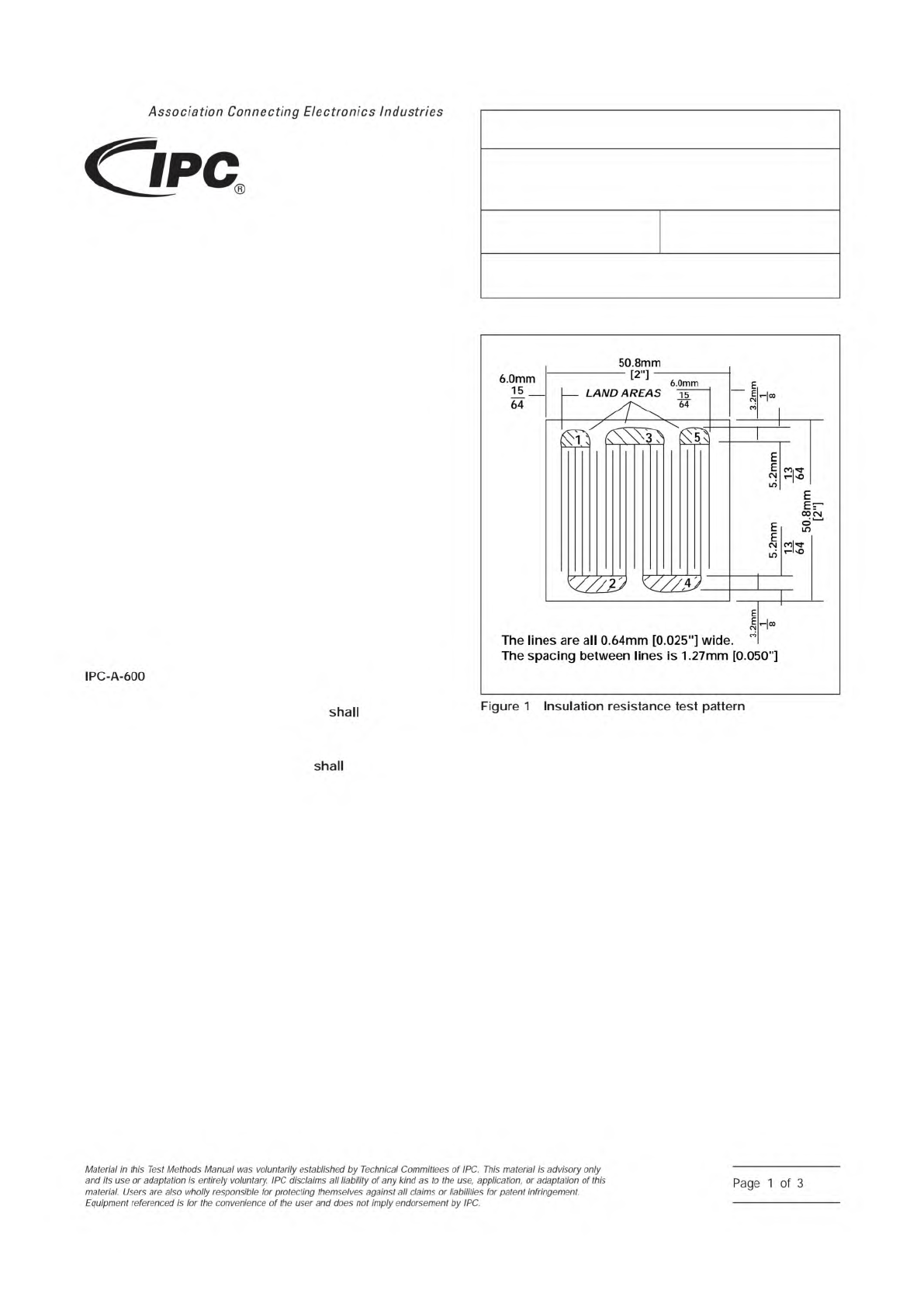
The test specimen consist of an
etched conductor pattern in accordance with Figure 1. Test a
minimum of three test specimens per clad side. For double
clad material, a separate sample unit
be prepared for
each side.
3.1
The test points for comb patterns are 1 to 2, 2 to 3, 3 to
4, and 4 to 5. Test points 1-3-5 are connected to the positive
(+) terminal, and test points 2-4 are connected to the negative
(-) terminals of the resistance meter.
4 Apparatus
4.1 Test Chamber
A test chamber capable of producing
and recording an environment of 65 °C ± 2 °C [149 °F ±
3.6 °F] and 85% - 93% relative humidity and which will allow
the insulation resistance to be measured while the specimens
are under the specified conditions. This chamber is to be used
for static insulation resistance testing, involving a single tem-
perature and relative humidity to stress the test specimen over
the specified test time.
4.2 Power Supply
A power supply capable of producing a
bias potential of 100 volts dc with a tolerance of ± 10%.
4.3 Resistance Meter
A resistance meter capable of read-
ing 10
12
ohms or greater, with a measurement error not to
exceed 10%, with a test voltage of 500 volts dc.
4.4 Other Equipment or Materials
4.4.1
Soft bristle brush.
4.4.2
Deionized or distilled water (2 megohm cm minimum
resistivity recommended).
4.4.3
Isopropyl alcohol.
4.4.4
Single-stranded* PTFE or other fluorocarbon insulated
wire. (Shielded wire recommended.) [*single-stranded mini-
mizes flux wicking]
4.4.5
Soldering iron (25 - 40 watts).
4.4.6
Drying oven capable of maintaining at least 60 °C.
IPC-2632-1
▼
▼
▼
▼
▼
▼
▼
▼
▼
▼
▼
▼
▼
▼
▼
▼
▼
▼
▼
3000 Lakeside Drive, Suite 105N
Bannockburn, IL 60015-1249
IPC-TM-650
TEST METHODS MANUAL
Number
2.6.3.2
Subject
Surface Insulation and Moisture Resistance,
Copper Clad Flexible Dielectric Material
Date
8/14/15
Revision
C
Originating Task Group
D-15
Association
Connecting
Electronics
Industries
6.0mm
—
LAND
AREAS
0.050"]
6.0mm
15
__
64
all
0.64mm
[0.025"]
wide,
between
lines
is
1.27mm
50.8mm
The
lines
are
The
spacing
IPC-A-600
shall
shall
Figure
1
Insulation
resistance
test
pattern
Material
/n
this
Test
Methods
Manual
was
voluntarily
established
by
Technical
Committees
of
I
PC.
This
material
/s
advisory
only
and
"s
use
or
adaptation
,
s
entirely
voluntary.
IPC
disclaims
all
liability
of
any
kind
as
to
the
use,
application,
or
adaptation
of
this
material.
Users
are
also
wholly
responsible
for
protecting
themselves
against
all
claims
or
liabilities
for
patent
infringement.
Equipment
referenced
is
for
the
convenience
of
the
user
and
does
not
imply
endorsement
by
IPC.
Page
1
of
3
5
4
EEZE
J
EE8.09
EE^
EE^
5 Procedure
5.1 Test Conditions
5.1.1
The test conditions be set at 65 °C ± 2 °C [149
°F ± 3.6 °F]; 85% – 93% RH for a minimum of 96 hours.
5.2 Specimen Preparation
5.2.1
Permanently identify each test specimen.
5.2.2
Visually inspect the test specimens for any obvious
defects, as described in IPC-A-600. If there is any doubt
about the overall quality of a test specimen, it should be
discarded.
5.2.3
Solder single-stranded PTFE or other fluorocarbon
insulated wire to each land of the test specimen. As flux resi-
due is of great concern with this test, soldering should initially
be attempted without use of any flux. If flux is required by
qualitative observation, use rosin (RO), low activity flux. The
solder and/or rosin must not spread beyond the land areas.
These wires will be used to connect each land for polarization
and for insulation resistance testing. The test pattern
exhibit any spatter of the flux or solder. It is recommended
to cover or otherwise protect the test patterns during the sol-
dering operation.
5.2.4
Spray rinse thoroughly with deionized water. Hold test
specimen at an approximate 30° angle and spray from top to
bottom.
5.2.5
Immerse the test specimen in deionized water and
scrub with a soft bristle brush for a minimum of 30 seconds.
During the remainder of the specimen preparation, handle test
specimens by the edges only.
5.2.6
Immerse the test specimen in clean, virgin isopropyl
alcohol and agitate for a minimum of 30 seconds. Scrub with
a soft bristle brush to remove flux residue. Rinse specimen
thoroughly with clean isopropyl alcohol.
5.2.7
Dry the cleaned test specimens in a drying oven for a
minimum of three hours at 49 °C - 60 °C [120 °F - 140 °F].
5.3 Initial Insulation Resistance Measurement at Stan-
dard Laboratory Conditions (Ambient)
5.3.1
Condition test specimens a minimum of 24 hours at
standard laboratory conditions of 23 °C ± 5 °C [73 °F ± 9 °F]
and 50 % ± 10 % relative humidity. This is Test Condition A.
5.3.2
Take an initial insulation resistance measurement
between each pair of terminals, 1 to 2, 2 to 3, 3 to 4, and 4
to 5 at standard laboratory conditions. Before taking the mea-
surement, apply a polarizing potential of 500 volts dc ± 50
volts dc, with the resistance meter for one minute, then take
the measurement at 500 volts dc ± 50 volts dc.
5.4 Insulation Resistance Measurement at Elevated
Temperature and Humidity
5.4.1
Place the test specimens from Test Condition A in the
test chamber, in a vertical position parallel to airflow, and
under a condensation drip shield. Apply a 100 volt dc
polarization potential to each pair of terminals of the test
specimens.
5.4.2
Expose the material test specimens to the conditions
of 65 °C ± 2 °C [149 °F ± 3.6 °F] and 85% -93% relative
humidity for a minimum of 96 hours.
5.4.3
Disconnect the 100 volt dc polarization potential.
5.4.4
Apply a reverse polarization potential of 500 ± 50 volts
dc with the resistance meter for one minute, then take the
measurement at 500 volts dc ± 50 volts dc between each pair
of terminals, 1 to 2, 2 to 3, 3 to 4, and 4 to 5, of the test
specimen.
5.4.5
Measure and record the insulation resistance at the
end of the nominal 96 hour conditioning period. These tests
are to be conducted without opening the test chamber.
5.5 Insulation Resistance Measurement after Recovery
from Elevated Temperature and Humidity
5.5.1
Remove the test specimens from the test chamber
after disconnecting the bias voltage (100 volts dc).
5.5.2
Stabilize the test specimens, at the following condi-
tions: 23 °C ± 5 °C [73.4 °F ± 9 °F] and 50% ± 10% relative
humidity, for 24 hours [+ 0.5 hours / - 0 hours].
5.5.3
Take the insulation resistance measurements and
record such at laboratory ambient temperature at 23 °C ±
5 °C [73.4 °F ± 9 °F] after the above stabilization conditioning.
Number
2.6.3.2
Subject
Surface Insulation and Moisture Resistance, Copper Clad
Flexible Dielectric Material
Date
8/14/15
Revision
C
IPC-TM-650
—
shall
not
shall
Page
2
of
3