IPC-TM-650 EN 2022 试验方法--.pdf - 第765页
7. When t he thermocouple/ thermometer measures 150 °C, record the resistance of th e Sense net with a 4-wire c able and a bench top multi -meter. 8. Fo r val ida tion, com par e th e re sista nce rea ding s o f the manu…
6.4 Optional Testing
Instances of optional testing
throughout this test method represent tests that have not
been validated in accordance with IPC-MDP-650.
6.5 Validation Testing
Validation of test machines refer-
enced in 4.1 and 4.2
test the following key aspects of
the test method. The TCR is used to associate resistance val-
ues to the test temperature, and the designated test
temperature/resistance at the beginning of the thermal cycling
test. These validation activities
be done at 2 or more
independent test sites that use the test machine. The testing
is assessing that there is no statistical difference between
independent test machines at a 95% confidence limit on a
minimum of 16 test coupons.
6.5.1 Method A
6.5.1.1 Temperature Coefficient of Resistance (TCR)
Validation
1. Verify the equipment is calibrated and ready for use.
2. Load coupons into all the test heads on the test machine
3. Record the resistance of the each coupon at 150 °C on the
Sense net.
4. Remove the coupons from the test equipment and attach
wires to the (4) header pins on the Sense net.
5. Attach thermocouple wires to the laminate surface of each
coupon.
6. Place coupons in an oven set at 150 °C.
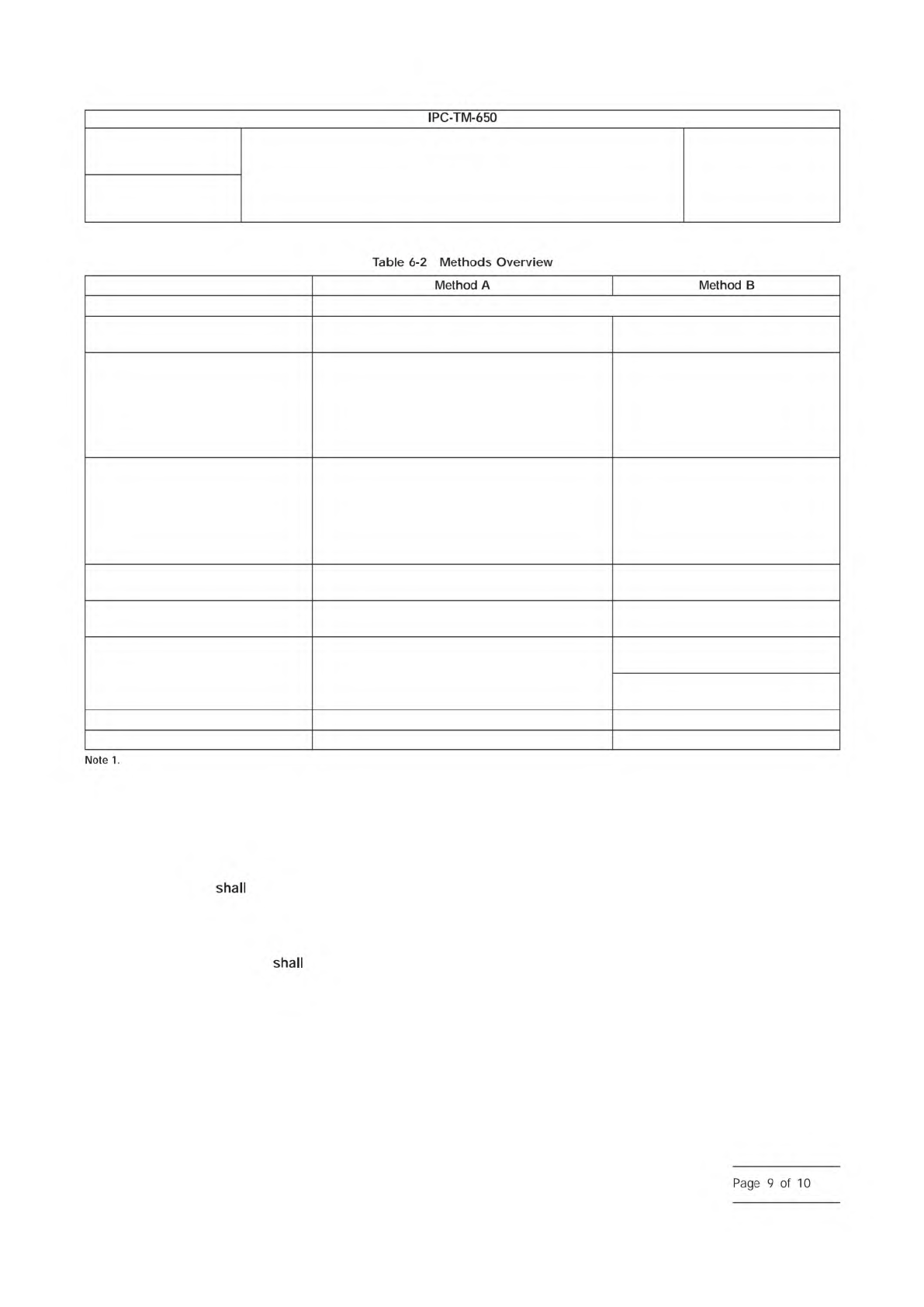
DC Current Applied To Plated Structure, Conductor, Land and Internal Connections
Temperature Coefficient
of Resistance (TCR)
Estimated Measured
Assembly Preconditioning
1
3 minute to temperature
230 °C for tin-lead
245 °C for low temperature lead-free
260 °C for high temperature lead-free
Or alternate assembly preconditioning method,
such as per IPC-TM-650, Method 2.6.27
3 or 5 °C per second to temperature
220 °C for eutectic tin-lead assembly
245 or 260 °C for lead-free assembly
Test Temperature
150 °C for standard FR4
170 °C for standard polyimide
190 °C for microvias on standard FR4
210 °C for microvias on Polyimide
230 °C for Survivability tin-lead
245 or 260 °C for Survivability lead-free
220 °C for eutectic tin/lead assembly
245 °C for lead-free assembly
Heating Rate or Time
3 minutes maximum
Variable based on application
3 or 5 °C per second
Dwell time at
maximum temperature
1 second
Variable based on application
40 seconds
Failure Threshold
10% increase in resistance over
resistance at test temperature
For each cycle, 5% change in
resistance for R
High
or R
Low
10% increase in resistance over
resistance at ambient temperature
Cooling Method Forced ambient air Forced ambient air
Resistance Monitored Continuous Continuous
When testing at reflow temperature, assembly preconditioning and test temperature may be combined.
Number
2.6.26
Subject
DC Current Induced Thermal Cycling Test
Date
5/14
Revision
A
IPC-TM-650
—
Table
6-2
Methods
Overview
Note
1.
Method
A
Method
B
—
Page
9
of
10
7. When the thermocouple/ thermometer measures 150 °C,
record the resistance of the Sense net with a 4-wire cable
and a bench top multi-meter.
8. For validation, compare the resistance readings of the
manual measurements in the oven and the test machine
for each coupon.
6.5.1.2 Test Temperature/Resistance Validation
1. Verify the equipment is calibrated and ready for use.
2. Load coupons into all test heads on the test machine.
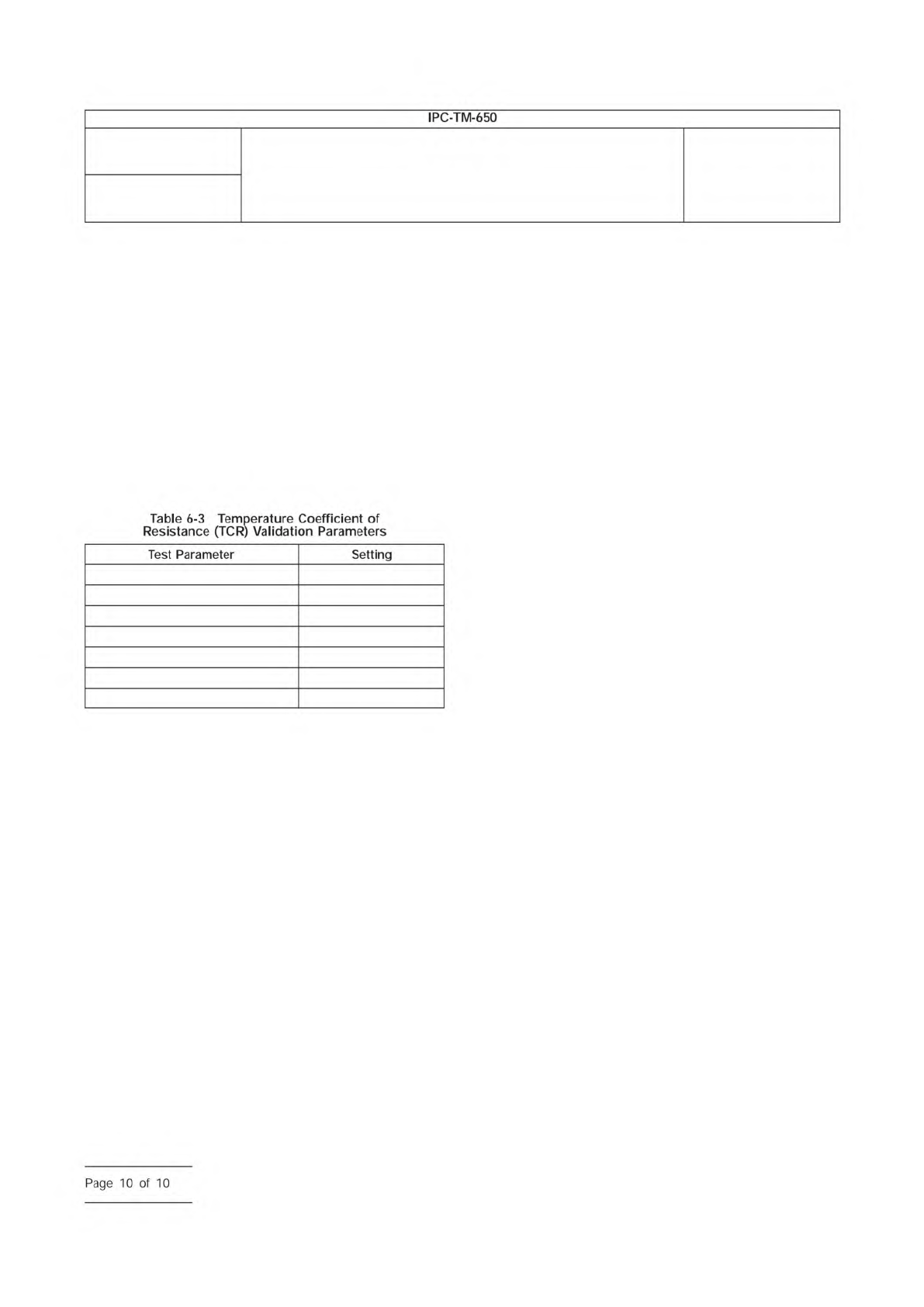
3. Enter the test parameters shown in Table 6-3 (or equiva-
lent) into the test machine.
4. For Cycle 2, measure the resistance at 150 °C and at room
temperature on the test machine.
5. For validation, compare the resistance measurement at
150 °C between test machines and at room temperature
between test machines.
6.5.2 Method B
6.5.2.1 Temperature Coefficient of Resistance (TCR)
Validation
1. Label coupons and record 4-wire resistance with bench
top multi-meter.
2. Measure the temperature and resistance at the following
equilibrium temperatures: 23, 75, 125, 150, 175, 200, and
220 °C. Calculate TCR for test temperature 23-220 °C.
3. For validation, compare the measured TCR values
between test machines.
6.5.2.2 Test Temperature/Resistance Validation
1. Run 3 cycles for test temperature 23-220 °C using the
mean TCR measured in 6.5.2.1.
2. For Cycle 3, record the calculated temperature T(calc,
high) at end of high temperature dwell.
3. For validation, compare the T(calc, high) value between
test machines.
Maximum # Cycles 5
Data Recorded 1
Test Temperature 150 °C
% Rejection Sense Circuit 10%
% Rejection Power Circuit 10%
Precycle Time 5
Compensation Calculated
Number
2.6.26
Subject
DC Current Induced Thermal Cycling Test
Date
5/14
Revision
A
IPC-TM-650
Table
6-3
Temperature
Coefficient
of
Resistance
(TCR)
Validation
Parameters
Test
Parameter
Setting
Page
10
of
10
1 Scope and Purpose
1.1 Scope
This method is intended to simulate exposure to
the thermal conditions by convection reflow assembly.
1.2 Purpose
This method be used to replicate the
thermodynamic effects by assembly on the test specimen.
The use of this method is intended to simulate those effects
that are the result of soldering thermal excursions.
1.2.1
This method be used for qualification testing of
an applicable test specimen. The evaluation of acceptability
for qualification
be in accordance with the requirements
defined in 5.3.
1.2.2
This method may be used for lot acceptance. The
evaluation for lot acceptability should be in accordance with
the requirements defined in 5.3 or as agreed upon between
user and supplier (AABUS).
2 Applicable Documents
Terms and Definitions
Generic Standard on Printed Board Design
Acceptability of Printed Boards
Printed Board Handling and Storage Guidelines
Qualification and Performance Specification for
Rigid Printed Boards
Qualification and Performance Specification for
Flexible Printed Boards
Qualification and Performance Specification for
High Frequency (Microwave) Printed Boards
Guidelines for Microsection Preparation
User’s Guide for IPC-TM-650, Method 2.6.27
Test Methods Manual
1
2.1.1 Microsectioning – Microsectioning, Manual and Semi
or Automatic Method
3 Test Specimen
3.1 Design/Construction Criteria
3.1.1
The test specimen be the A/B, AB-R, and/or the
D coupon as designed in accordance with the requirements of
IPC-2221 Appendix A or B. Use of alternate specimens
be AABUS.
3.1.2
The test specimen(s) be constructed with holes
contained in the printed board it represents as follows:
a. A/B, A/B-R and D coupons
be constructed with
both the largest plated through-holes (PTHs) and the
smallest vias.
b. Propagated B and D coupons
be constructed with
the intended via structure. (Multiple B and D coupons are
used for designs with multiple structures.)
3.1.2.1
The test specimen(s) contain the representa-
tive ground and power planes of the printed board design.
3.1.2.2
The test specimen(s) contain the representa-
tive filled through vias, applicable blind and/or buried vias,
including microvias, of the printed board design.
3.1.3
The test specimen(s) allow for microsection
evaluation of all the applicable, representative PTHs and vias
defined in 3.1.2 after exposure to the conditions of this Test
Method.
Special tooling may be required for potting an entire
‘‘D’’ Coupon for microsection examination.
3.1.4
Deviations to the test specimen design/construction
or use of an alternate test specimen such as the printed board
or a section of the printed board
be AABUS.
4 Apparatus
4.1 Drying Oven
4.1.1
The oven be capable of maintaining a uniform
set temperature within the 105 to 125 °C [221 to 257 °F]
range.
1. Current and revised IPC Test Methods are available on the IPC Web site (www.ipc.org/test-methods.aspx).
3000 Lakeside Drive, Suite 105N
Bannockburn, IL 60015-1249
IPC-TM-650
TEST METHODS MANUAL
Number
2.6.27
Subject
Thermal Stress, Convection Reflow Assembly
Simulation
Date
2/2020
Revision
B
Originating Task Group
Thermal Stress Test Methodology Subcommittee
(D-32)
Association
Connecting
Electronics
Industries
shall
shall
shall
shall
shall
shall
shall
shall
IPC-T-50
IPC-2221
IPC-A-600
IPC-1601
IPC-6012
IPC-6013
IPC-6018
IPC-9241
IPC-9631
IPC-TM-650
Note:
shall
shall
shall
shall
shall
Material
/n
this
Test
Methods
Manual
was
voluntarily
established
by
Technical
Committees
of
I
PC.
This
material
/s
advisory
only
and
"s
use
or
adaptation
,
s
entirely
voluntary.
IPC
disclaims
all
liability
of
any
kind
as
to
the
use,
application,
or
adaptation
of
this
material.
Users
are
also
wholly
responsible
for
protecting
themselves
against
all
claims
or
liabilities
for
patent
infringement.
Equipment
referenced
/s
for
the
convenience
of
the
user
and
does
not
imply
endorsement
by
IPC.
Page
1
of
10