IPC-TM-650 EN 2022 试验方法--.pdf - 第597页
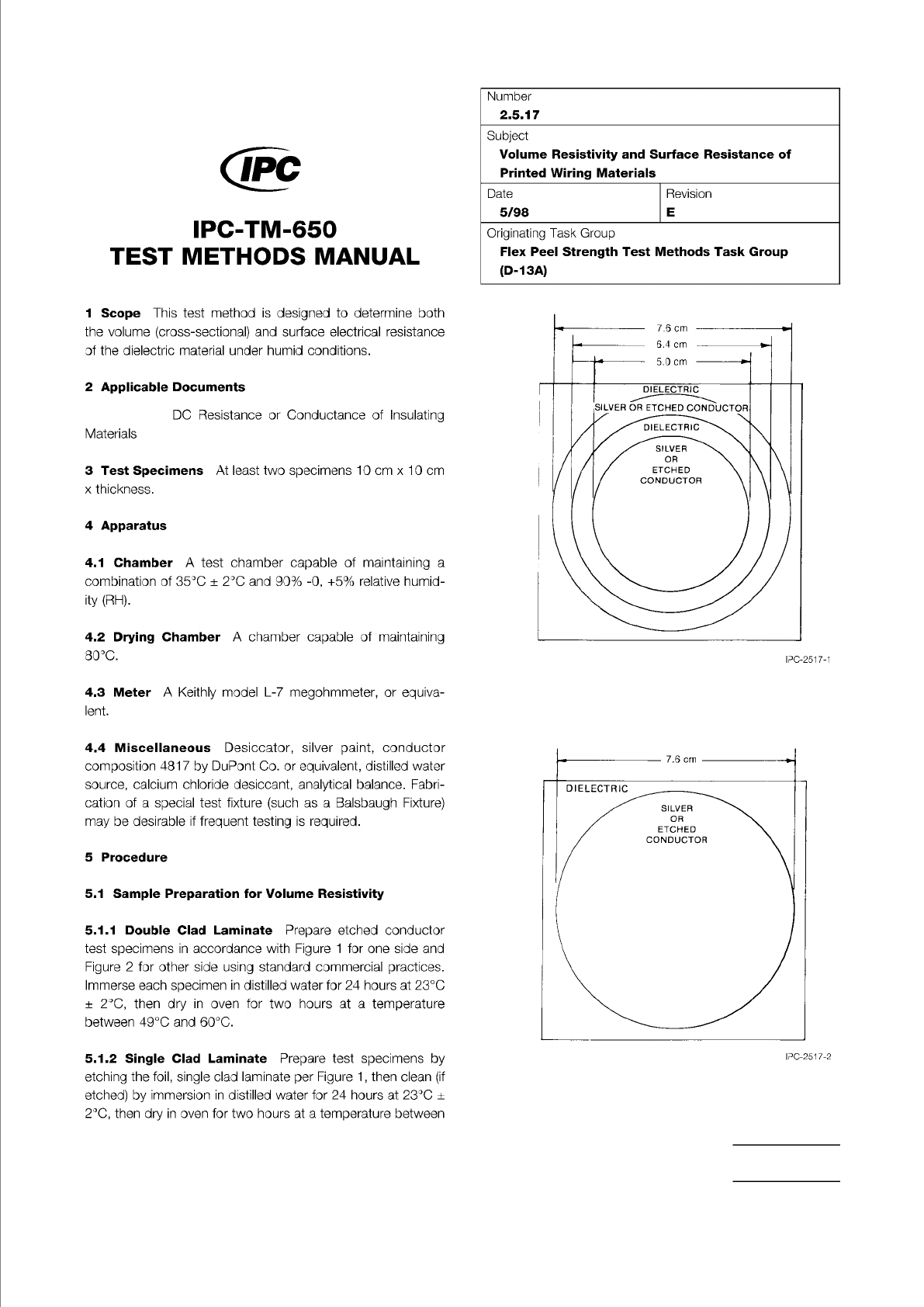
Megohmmeter Leads Specimen Location Megohmmeter Leads Specimen Location IPC-TM-650 Number Subject Date Revision Page 2 of 2 2.5.17 Volume Resistivity and Surface Resistance of Printed Wiring Materials 5/98 E 49℃ and 60℃.…
ASTM-D-257
Figure 1 Volume and Surface Resistivity Test Pattern.
(Side 1)
Figure 2 Volume and Surface Resistivity Test Pattern.
(Side 2)
The Institute for Interconnecting and Packaging Electronic Circuits
2215 Sanders Road • Northbrook, IL 60062
Material in this Test Methods Manual was voluntarily established by Technical Committees of the IPC. This material is advisory only
and its use or adaptation is entirely voluntary. IPC disclaims all liability of any kind as to the use, application, or adaptation of this
material. Users are also wholly responsible for protecting themselves against all claims or liabilities for patent infringement.
Equipment referenced is for the convenience of the user and does not imply endorsement by the IPC.
Page 1 of 2
IPC-TM-650
TEST
METHODS
MANUAL
1
Scope
This
test
method
is
designed
to
determine
both
the
volume
(cross-sectional)
and
surface
electrical
resistance
of
the
dielectric
material
under
humid
conditions.
2
Applicable
Documents
DC
Resistance
or
Conductance
of
Insulating
Materials
3
Test
Specimens
At
least
two
specimens
10
cm
x
10
cm
x
thickness.
4
Apparatus
4.1
Chamber
A
test
chamber
capable
of
maintaining
a
combination
of
35℃
±
2
℃
and
90%
-0,
+5%
relative
humid¬
ity
(RH).
4.2
Drying
Chamber
A
chamber
capable
of
maintaining
80℃.
4.3
Meter
A
Keithly
model
L-7
megohmmeter,
or
equiva¬
lent.
4.4
Miscellaneous
Desiccator,
silver
paint,
conductor
composition
4817
by
DuPont
Co.
or
equivalent,
distilled
water
source,
calcium
chloride
desiccant,
analytical
balance.
Fabri¬
cation
of
a
special
test
fixture
(such
as
a
Balsbaugh
Fixture)
may
be
desirable
if
frequent
testing
is
required.
5
Procedure
5.1
Sample
Preparation
for
Volume
Resistivity
5.1.1
Double
Clad
Laminate
Prepare
etched
conductor
test
specimens
in
accordance
with
Figure
1
for
one
side
and
Figure
2
for
other
side
using
standard
commercial
practices.
Immerse
each
specimen
in
distilled
water
for
24
hours
at
23℃
±
2
℃,
then
dry
in
oven
for
two
hours
at
a
temperature
between
49℃
and
60℃.
5.1.2
Single
Clad
Laminate
Prepare
test
specimens
by
etching
the
foil,
single
clad
laminate
per
Figure
1
,
then
clean
(if
etched)
by
immersion
in
distilled
water
for
24
hours
at
23℃
±
2
℃,
then
dry
in
oven
for
two
hours
at
a
temperature
between
Number
2.5.17
Subject
Volume
Resistivity
and
Surface
Resistance
of
Printed
Wiring
Materials
Date
Revision
5/98
E
Originating
Task
Group
Flex
Peel
Strength
Test
Methods
Task
Group
(D-13A)
Megohmmeter Leads Specimen Location
Megohmmeter Leads Specimen Location
IPC-TM-650
Number
Subject Date
Revision
Page 2 of 2
2.5.17
Volume
Resistivity
and
Surface
Resistance
of
Printed
Wiring
Materials
5/98
E
49℃
and
60℃.
Coat
unclad
side
with
silver
conductive
paint
(per
Figure
2).
Sand
all
edges
to
remove
any
silver
paint
to
prevent
a
conductive
path.
5.1.3
Bare
Dielectric
Prepare
test
specimens
by
immers¬
ing
in
distilled
water
for
24
hours
at
23℃
土
2
℃,
then
dry
in
an
oven
for
two
hours
at
a
temperature
between
49℃
and
60℃.
Coat
the
unclad
material
with
silver
conductive
paint
(one
side
per
Figure
1
and
the
other
per
Figure
2).
Sand
all
edges
to
remove
any
silver
paint.
5.2
Conditioning
5.2.1
Condition
specimens
together
with
the
test
fixture
at
35℃
±
2
℃
and
90%
-0,
+5%
RH
for
96
hours.
5.2.2
Specimens
(and
test
fixture)
must
remain
in
the
cham¬
ber
for
all
phases
of
both
the
volume
resistivity
and
surface
resistance
tests.
5.2.3
These
conditions
may
vary
depending
on
the
request
of
the
material
user.
5.3
Test
5.3.1
After
conditioning,
and
without
removing
specimens
from
the
chamber,
connect
specimen
to
electrodes
as
fol¬
lows:
High
Guarded
(5.0
cm
circle)
Ground
Guarded
(6.35
cm
ring)
Test
Unguarded
(7.6
cm
circle)
5.3.2
Turn
on
the
megohm
meter
and
allow
to
warm
up
for
a
minimum
of
15
minutes.
5.3.4
Read
the
meter
(in
megohms)
after
the
test
switch
is
held
depressed
for
60
seconds.
5.4
Evaluation
5.4.1
Calculate
the
volume
resistivity
(r)
in
megohm
centime¬
ters
as
derived
from
the
following
formula:
RA
T
r
=
volume
resistivity
in
megohm
cm
L
=
thickness
of
specimen
in
cm
A
=
area
of
guarded
electrodes
is
25.6
cm2
R
二
volume
resistance
in
megohms
(meter
reading)
5.5
Preparation
for
Surface
Resistance
Leave
the
same
specimens
in
the
test
chamber
and
prepare
to
test
surface
resistance
by
connecting
the
specimens
to
electrodes
as
fol¬
lows:
High
Guarded
Ground
Unguarded
Test
Guard
5.6
Test
Perform
the
same
testing
procedures
per
5.3.
5.7
Evaluation
The
surface
resistance
is
the
direct
reading
of
the
megohmmeter
scale
and
should
be
recorded
in
mego¬
hms.
6
Notes
This
method
may
also
be
used
for
rigid
dielectric
materials.
6.1
For
additional
information
see
ASTM-D-257,
DC
Resis¬
tance
or
Conductance
of
Insulating
Materials.
5.3.3
After
warm
up,
calibrate
meter
and
adjust
internal
volt¬
age
to
500
volts
DC.
ASTM-D-257 D-C Resistance or Conductance of Insulating
Materials
IPC-TM-650
The Institute for Interconnecting and Packaging Electronic Circuits
2215 Sanders Road • Northbrook, IL 60062
Material in this Test Methods Manual was voluntarily established by Technical Committees of the IPC. This material is advisory only
and its use or adaptation is entirely voluntary. IPC disclaims all liability of any kind as to the use, application, or adaptation of this
material. Users are also wholly responsible for protecting themselves against all claims or liabilities for patent infringement.
Equipment referenced is for the convenience of the user and does not imply endorsement by the IPC.
Page 1 of 4
IPC-TM-650
TEST
METHODS
MANUAL
1
.0
Scope
This
test
method
is
designed
to
determine
vol¬
ume
resistivity
and
surface
resistivity
of
metallic-clad
or
unclad
laminates
under
conditions
of
specified
humidity
and
tempera¬
ture
and
at
elevated
temperatures.
2
.0
Applicable
Documents
Method
2.3.6,
Etching,
Ammonium
Persulfate
Method,
2.3.7
Etching,
Ferric
Chloride
Method
2.3.
7.1,
Cupric
Chloride
Etching
Method
2.6.3,
Moisture
and
Insulation
Resistance,
Rigid,
Rigid/Flex
and
Flex
Printed
Wiring
Boards
3
.0
Test
Specimens
3.1
Laminate
thickness
of
0.51
mm
[0.020
in]
or
greater.
Three
specimens
of
dimensions
101
.6
土
3.2
mm
x
101
.6
±
3.2
mm
[4.0
±
0.125
in
x
4.0
±
0.125
in]
by
thickness
shall
be
prepared
for
each
test
condition,
unless
otherwise
specified.
3.2
Laminate
thickness
of
less
than
0.51
mm
[0.020
in].
Three
specimens
of
dimensions
50.8
±
1
.6
mm
x
50.8
±
1
.6
mm
[2.0
±
0.062
x
2.0
±
0.062
in]
by
the
thickness
shall
be
prepared
for
each
test
condition,
unless
otherwise
specified.
4
.0
Equipment
Apparatus
4.1
Conditioning
chamber
capable
of
maintaining
35
土
2
℃
[95
±
3.6°F]
and
90
+5,-0%
relative
humidity.
4.2
Conditioning
chamber
capable
of
attaining
the
tempera¬
ture
and
humidity
conditions
specified
in
IPC-TM-650,
Method
2.6.3.
4.3
Air
circulating
oven
capable
of
maintaining
the
specified
test
temperatures
to
within
土
2
℃
[±3.6°F]-
4.4
Resistance
measuring
instrumentation
capable
of
mea¬
suring
to
1012
meg-ohms,
minimum,
with
an
accuracy
of
±
5
percent
at
its
highest
scale
setting.
The
equipment
shall
have
the
capability
of
applying
500
volts
de
to
the
test
specimen.
Number
2.5.17.1
Subject
Volume
and
Surface
Resistivity
of
Dielectric
Materials
Date
Revision
12/94
A
Originating
Task
Group
MIL-P-13949
Test
Methods
Task
Group
(7-1
1b)
4.5
A
system/fixture
for
electrical
connections
into
the
tem¬
perature
and
humidity
chambers
(see
4.1
,
4.2,
4.3).
Three
separate
cables
shall
be
provided
to
make
connections
to
each
specimen
being
conditioned/tested.
The
center
conduc¬
tor
of
each
cable
shall
be
connected
to
one
of
the
three
elec¬
trodes
applied
to
the
test
specimen.
The
opposite
ends
of
the
cables
shall
be
brought
outside
the
chamber
and
terminated
at
a
convenient
location
for
connection
to
the
measuring
instrument.
Shields
shall
be
trimmed
back
from
the
ends
of
the
center
conductor
insulation
and
interconnected
to
the
guard
post
of
the
measuring
instrument.
See
6.2
for
additional
information.
Support
the
specimen
parallel
to
the
air
flow
through
the
chamber
during
conditioning.
Special
care
should
be
taken
to
ensure
that
materials
used
in
the
fixture
are
such
that
resistance
readings
are
that
of
the
material
being
tested
and
not
the
fixture.
4.6
A
measurement
device
capable
of
measuring
laminate
thickness
to
the
nearest
0.0025
mm
[0.0001
in].
4.7
Material
and
apparatus
for
formation
of
specimen
con¬
ductors.
4.7.1
Conductor
silver
paint;
composition
4817
by
Dupont
Company,
or
equivalent.
4.7.2
A
system
for
applying
the
paint
to
the
specimen,
such
as
silk
screening.
4.7.3
A
mask,
fixture,
photoprinting
system,
or
equivalent,
for
applying
the
applicable
electrodes/test
pattern
to
the
specimen
(See
Dimension
Table).
4.8
Etching
system
in
accordance
with
IPC-TM-650,
Method
2.3.6,
2.3.7,
or
2.3.7.1
.
5
.0
Procedure
5・1
Specimen
Preparation
5.1.1
Test
patterns
with
the
applicable
dimensions
shown
in
the
Dimension
Table,
and
in
accordance
with
Figures
1
,
2,
and
3
shall
be
generated,
as
follows: