创建组件识别数据的方法.pdf - 第18页
18/178 IM-SMT-VSNDI C-0002 -000 1.4.2. Component sizes (ch ip component) W hen the chip component ( capacitors) and other c omponents whose t ip is rounde d, the component si ze on the im age ma y be diff erent from the …
17/178
IM-SMT-VSNDIC-0002-000
Items to be set Set value Items to be set Set value
Lead Number 1W vnum Lead Number 2W 0
Reflect LL 1W (mm)
length Reflect LL 2W (mm) 0
Lead Width 1W (mm)
width Lead Width 2W (mm) 0
Lead Pitch 1W (mm)
pitch Lead Pitch 2W (mm) 0
Find Pos X 1W (mm)
vposx Find Pos X 2W (mm) 0
Find Pos Y 1W (mm)
vposy Find Pos Y 2W (mm) 0
Table 5
Caution:
In Table 5, the reference lead positions are displayed as the Find Pos.
In this way, the component data can normally be created just by specifying the minimum
necessary data.
1.4 Precautions concerning the component data definitions
This section describes points to notice on component data setting.
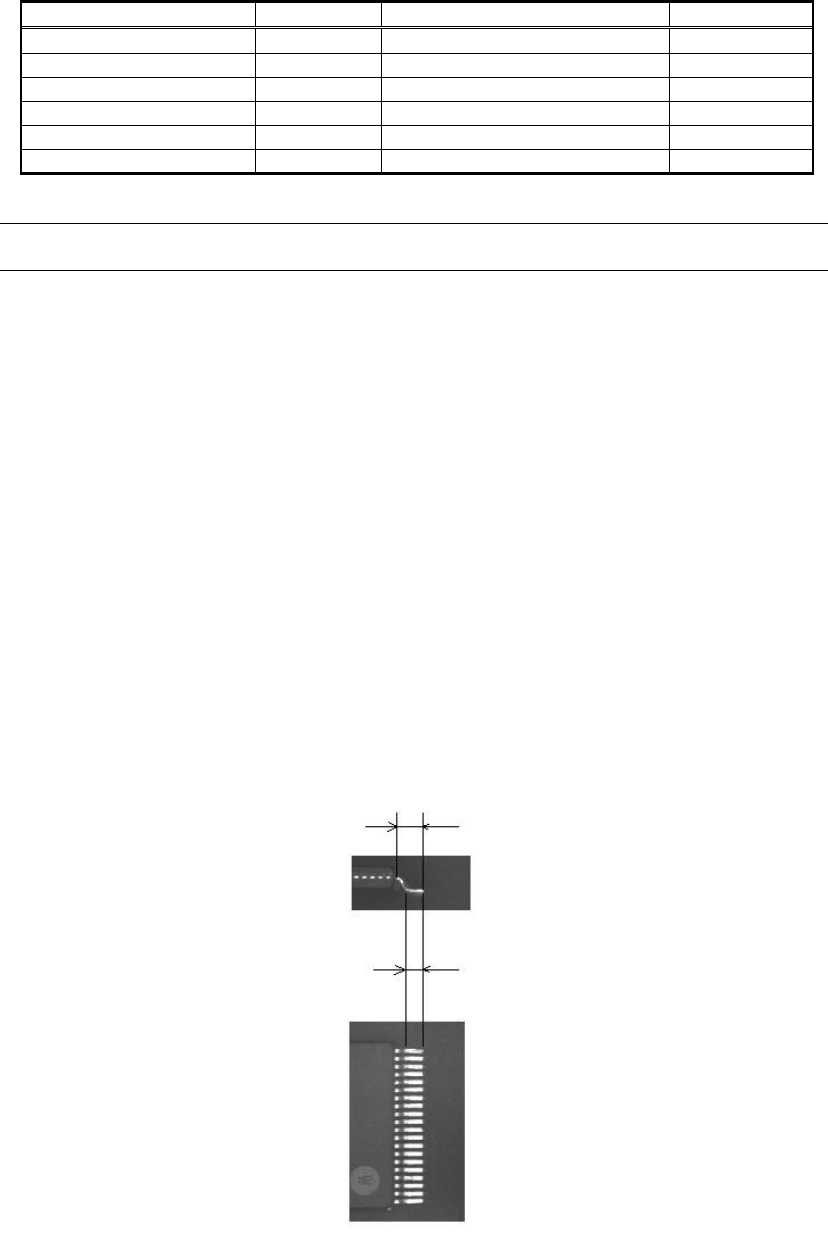
1.4.1. ReflectLL.
Caution is required in recognizing to the lead length. When the component is read as an
image, the lead may appear different in the image from the actual image.
The bent parts of the gull-wing shaped leads look black in the image and are hard to be
recognized.
In this case, it is necessary to specify the data using the shape that is visible on the image,
rather than the actual component shape. As can be expected from the item name “ReflectLL.”
on the data definition screen, the length of the portion that is visible in the image is supposed
to be set on the screen.
Figure 10
Actual lead length
Reflecting lead length
18/178
IM-SMT-VSNDIC-0002-000
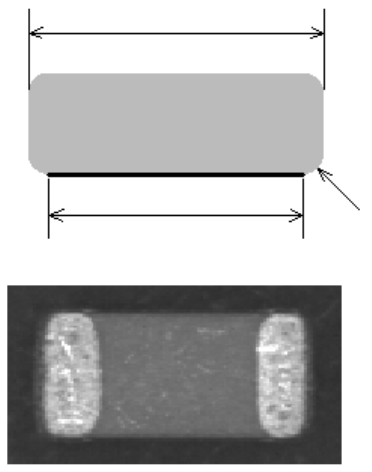
1.4.2. Component sizes (chip component)
When the chip component (capacitors) and other components whose tip is rounded, the
component size on the image may be different from the actual component size.
In this case, the size on the image should be set.
Figure 11
2. Details of the component data setting
As already mentioned, it is possible to create the data for the standard components with the
minimum necessary data.
In the component recognition mode, the components are divided into the groups shown below
and the data is created for each mode.
<IC components>
1) 2-pin components
2) Mini-mold transistors / SOTs
3) Power transistors
4) SOP Recognition mode
5) QFP Recognition mode
6) SOJ Recognition mode
7) PLCC Recognition mode
8) Off Lead
<Connector components>
1) Single-direction Connector recognition mode
Actual component size
Set component size
The fig
ure seen from the side of the component
This part looks dark
The image of the component seen from the bottom surface
19/178
IM-SMT-VSNDIC-0002-000
2) 4-direction Connector recognition mode
3) Odd-shape Connector recognition mode
<Ball components>
1) Simple BGA Recognition mode
2) BGA Recognition mode
3) Flip-chip Recognition mode
<Chip components>
1) Standard Chip Recognition mode
2) MELF Chip Recognition mode
3) Bare Chip Recognition mode
4) Circular Chip Recognition mode
5) Special Chip Recognition mode
6) Small Chip Recognition mode
<Special components>
1) Special Shape Recognition mode
2) Odd-shape Chip Recognition mode
3) Mark Recognition mode
4) Sp Quad Recognition mode
5) Center of Gravity Detection mode
The following section describes the items to be set and other information pertaining to the
individual recognition modes.
2.1. 2-pin components
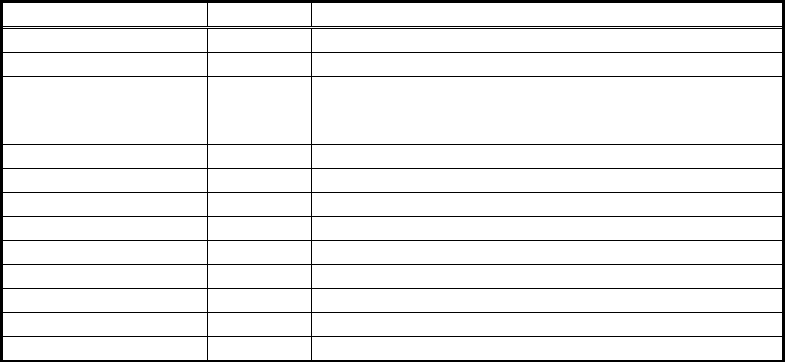
<Items to be set for 2-pin components>
Items to be set Set value
Explanation
AlignmentGroup IC Sets the component category.
Alignment Type 2Ends Sets the component type.
Comp. Threshold
Sets the detection level difference for lead
detection.
(See “Appendix 2. Detection level differences
used to detect leads (threshold value))”
Comp. Tolerance
Specifies the shape tolerance as a percentage.
Search Area (mm)
Sets the range for detection.
Body Size X (mm)
Sets the outer edge size.
Body Size Y (mm)
Sets the outer edge size.
Body Size Z (mm)
Sets the outer edge size.
Ruler Offset
Sets the offset amount for the detection line.
Ruler Width
Reflct LL
Sets the lead length on the image.
Lead Width (mm)
Sets the lead width.
Table 6
This mode is used for recognition of components that have two leads, and for diodes,
aluminum capacitors and other components.