OptimaUserManual.pdf - 第75页
OPTIMA PROM SOF TW AR E Opti ma User M anual 69 NOTE: The Fill m emory menu item accepts va lues in relation to the device to be processed. It i s often necessary t o know the block size o f the specific d evice bein g u…
OPTIMA PROM SOFTWARE
Optima User Manual
68
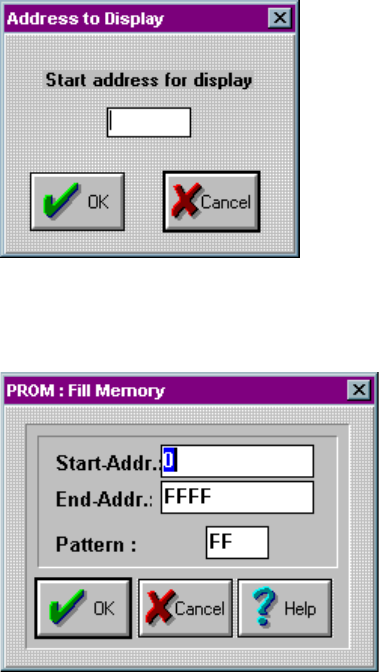
x Goto Address…—Allows you to jump to any address in the memory array, as
shown here:
Goto Address menu function allows you to jump to any memory location
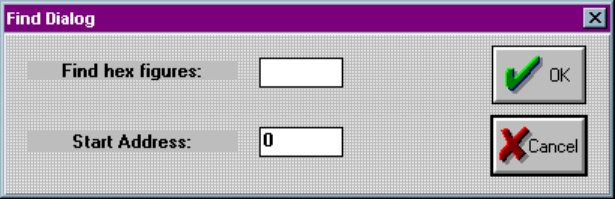
x Fill…—Allows you to fill the memory array with any data pattern, as shown
here:
Fill function allows you to fill the memory array with any data pattern
OPTIMA PROM SOFTWARE
Optima User Manual
69
NOTE: The Fill memory menu item accepts values in relation to the
device to be processed. It is often necessary to know the
block size of the specific device being used. Many devices
do not support partial programming operations. Therefore,
partially filling RAM with a data pattern is not supported
with those devices. Because of this, an error will occur if
you attempt to fill RAM with less data than the device
supports. Also, filling RAM beyond the block size of the
device will produce a similar error.
x Swap bytes—Allows you to transpose high and low order bytes within the data
file
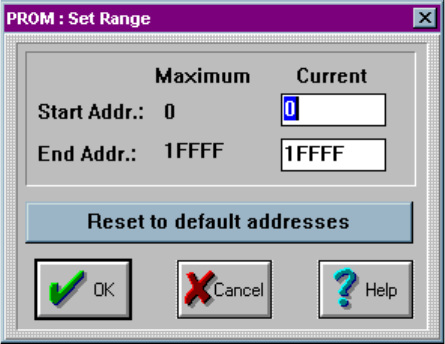
x Search for byte—Allows you to search the memory array for a specific data
string.
Selecting Search for Byte produces this window:
“Search for byte” allows you to locate a hex string within memory array
x Repeat search—Performs the Search for byte operation again with the
previously entered search data
You may also select Memory>Fill to fill memory with a hexadecimal data pattern.
Once selected, the following screen will appear:
Memory>Swap Bytes
In cases where the data bytes must be reversed in the data file to accommodate a
specific device, select Memory> Swap Bytes (or select Memory>Edit and right
click to select Swap Bytes). This function allows you to transpose odd and even order
bytes within the data file.
OPTIMA PROM SOFTWARE
Optima User Manual
70
Memory>Address Range
For devices that support partial operations, or if the data file is required to begin at a
specific location, the Address Range… menu item may be used to establish the
programming area of the device. Selecting the Memory>Address Range… produces
the following dialogue:
Setting the device address range