OptimaUserManual.pdf - 第81页
OPTIMA PROM SOF TW AR E Opti ma User M anual 75 other than *.sn, select A ll (*.* ) from the Li st files of type pull -dow n menu in the low er left of the window . 3. Sel ect < OK >. A S erialization O ptions scre…
OPTIMA PROM SOFTWARE
Optima User Manual
74
Memory>Device Serialization Options…
The Device Serialization Options…allows you to assign unique electronic serial
numbers to each device being programmed. When serializing devices, the serial
number is automatically incremented for the next device each time the Optima
software completes a programming operation. When serializing with Multisyte
programmers (Dual, Quad, and Octal) in gang mode, sequential serial numbers are
automatically generated for devices inserted into adjacent TOPs.
Note: Serialization is only supported with single-socket TOPs, such
as the TOP48, TOP84PLC, and other similar TOPs. It is not
supported on the TOP432
or Flash TOP.
To set up this feature, refer to the figures below and perform the following process:
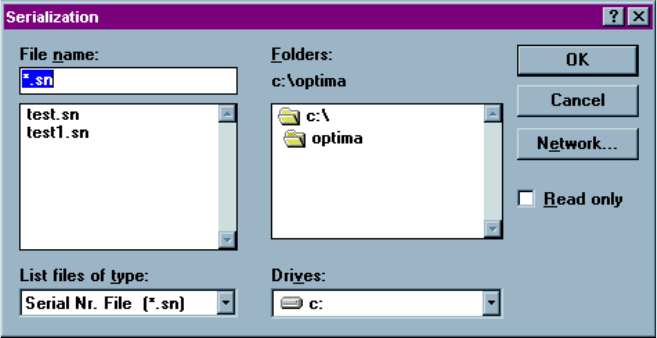
1. Select Memory > Device Serialization Options… The following screen will
appear:
Selecting the serial number file
2. Choose the path and serial number file you would like to use, or if creating a new
serial number file, type in the desired name of the file in the File name field. For
clarity, use DOS standard 8.3 file names. The default file extension for serial
number files is *.sn, but can be anything you like. To locate files with extensions
OPTIMA PROM SOFTWARE
Optima User Manual
75
other than *.sn, select All (*.*) from the List files of type pull-down menu in the
lower left of the window.
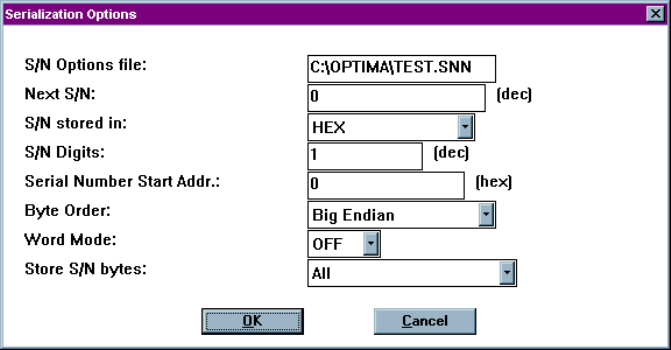
3. Select <OK>. A Serialization Options screen appears:
The Serialization Options screen
Editable fields include:
x S/N Options file—The name of the serial number file that was selected or
created from the previous screen.
x Next S/N—The starting serial number of the next device to be programmed; this
is a decimal number. Numbers entered here will automatically be converted to
the correct format when the device is programmed.
OPTIMA PROM SOFTWARE
Optima User Manual
76
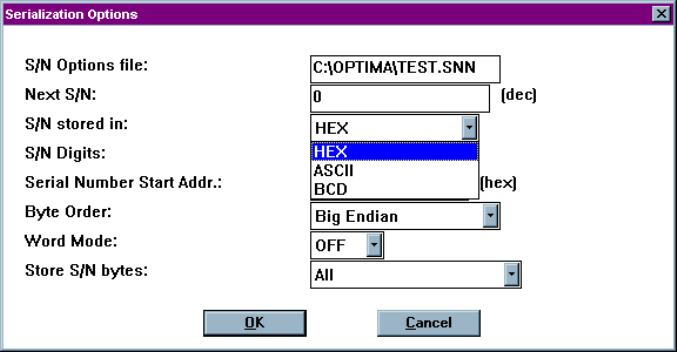
x S/N stored in—Selects the format that the serial number data will be written to
the device; choices are HEX (each digit from 0h to Fh), ASCII (each digit from
30h to 39h), and BCD (0000
2
to 1001
2
).
Selecting the format to store serial number data
x S/N Digits—Selects the number of characters, in decimal, used for the serial
number format. The maximum number of characters is:
q 8 for S/Ns stored in HEX (FFFFFFFFh); S/Ns 0 through 4,294,967,295
q 9 for S/Ns stored in ASCII (393939393939393939h); S/Ns 0 through
999,999,999
q 8 for S/Ns stored in BCD (99999999h); S/Ns 0 through 2,576,980,377
Note: The S/N Digits value indicates the number of hex characters
that are permitted to exist as a serial number in the memory
array. The exception to this rule is the ASCII format, in
which the number represents hex bytes. While this appears
complicated, as long as the serial number limits are not
exceeded, no errors will occur.
x Serial Number Start Addr.—The hexadecimal address in the memory array
where the first byte of the serial number will be placed. All characters of the
serial number must fit within the memory array of the device or serialization will
not take place.