MR8740T_Quick guide_eng_20191016H.pdf - 第22页
16 Operation Precautions Before connecting cords For detailed precautions and instructions on connections, refer to the instruction manuals of your connection cords. DANGER • If the insulation on a connecting cable melts…
15
Operation Precautions
Built-in battery
The instrument contains a battery (sealed lead acid battery) to shut down Windows
®
in case power
is cut (power outrage or turning off a breaker). Since the battery has a limited life expectancy,
it must regularly be replaced. When replacing batteries, please contact your authorized Hioki
distributor or reseller.
Expected lifetime: About 2 years (Operated at an ambient temperature of
25°, when the instrument is turned off once a day)
About 4 years (Operated at an ambient temperature of
25°, when the instrument is turned off ve times a year)
CAUTION
• You have to charge the battery periodically even if you do not use the instrument.
Periodically charge the battery every three months at a storage temperature of 35°C;
every six months at a storage temperature of 25°C. Failure to do so may reduce the
battery life expectancy.
• Do not install the instrument in a sealed space or near a re. Doing so may cause an
explosion or re.
• Do not use the instrument at high ambient temperature. Do not use the instrument
with the end-of-life battery. Doing so may cause electrolyte leakage, resulting in a bad
inuence that includes a re at a worst. Make sure that you use the instrument within
the operating temperature range and inspect and replace the battery periodically.
16
Operation Precautions
Before connecting cords
For detailed precautions and instructions on connections, refer to the instruction manuals of your
connection cords.
DANGER
• If the insulation on a connecting cable melts, the metal conductor may be
exposed. Do not use any cable whose metal conductor is exposed. Doing so
could result in an electric shock, burn, or other hazards.
When measuring power line voltage
• Only connect connection cords on the secondary side of a distribution panel. If
a short-circuit occurs on the secondary side of the distribution panel, the panel
will interrupt the short-circuit current. Do not connect the connection cords on
the primary side of the distribution panel because an unrestricted current ow
can damage the connection cords and facilities if a short-circuit occurs.
• To prevent an electrical shock and bodily injury, do not touch any input
terminals on the VT (PT), CT or the instrument when they are in operation.
• Do not leave the measurement cables connected to the instrument in an
environment where voltage may surge beyond the maximum input voltage.
Applying voltage may result in damage to the instrument, or serious accidents.
• Do not cause a short-circuit between another wire and the wire to be measured
with the metal tip of the connection cord. Arcs or such grave accidents are
likely to occur.
• To avoid a short-circuit or electric shock, do not touch the metal tip of the
connection cord.
WARNING
• To prevent an electric shock, conrm that the white or red portion (insulation
layer) inside the cable is not exposed. If a color inside the cable is exposed, do
not use the cable.
• Do not place a cable in contact with the lines to be measured. Any contact
can cause the instrument to malfunction and lead to a short-circuit or electric
shock, resulting in bodily injury.
• Be sure to connect the voltage input and current input terminals correctly. An
incorrect connection could damage or a short-circuit.
• Use only the specied connection cords. Using a non-specied cable may
result in unsafe measurements. Using a non-specied cable may also result in
incorrect measurements due to poor connection or other reasons.
• To avoid electric shock, do not exceed the lower of the ratings shown on the
modules and connection cords.
17
Operation Precautions
CAUTION
• To prevent cord damage, do not step on cords or pinch them between other objects.
Do not bend or pull on cords at their base.
• The cable is hardened in freezing temperatures. Do not bend or pull it to avoid tearing
its shield or cutting the cable.
• Do not use any cable terminated with a metal BNC connector for connecting cables
to the BNC jacks on modules. If you connect a metal BNC cable to insulated BNC
connector, the insulated BNC connector and instrument may be damaged.
• To prevent damage to the BNC connector, be sure to release the
locking mechanism, grip the head of the connector (not the cord),
and pull it out.
1
2
Before connecting a logic probe to a measuring object
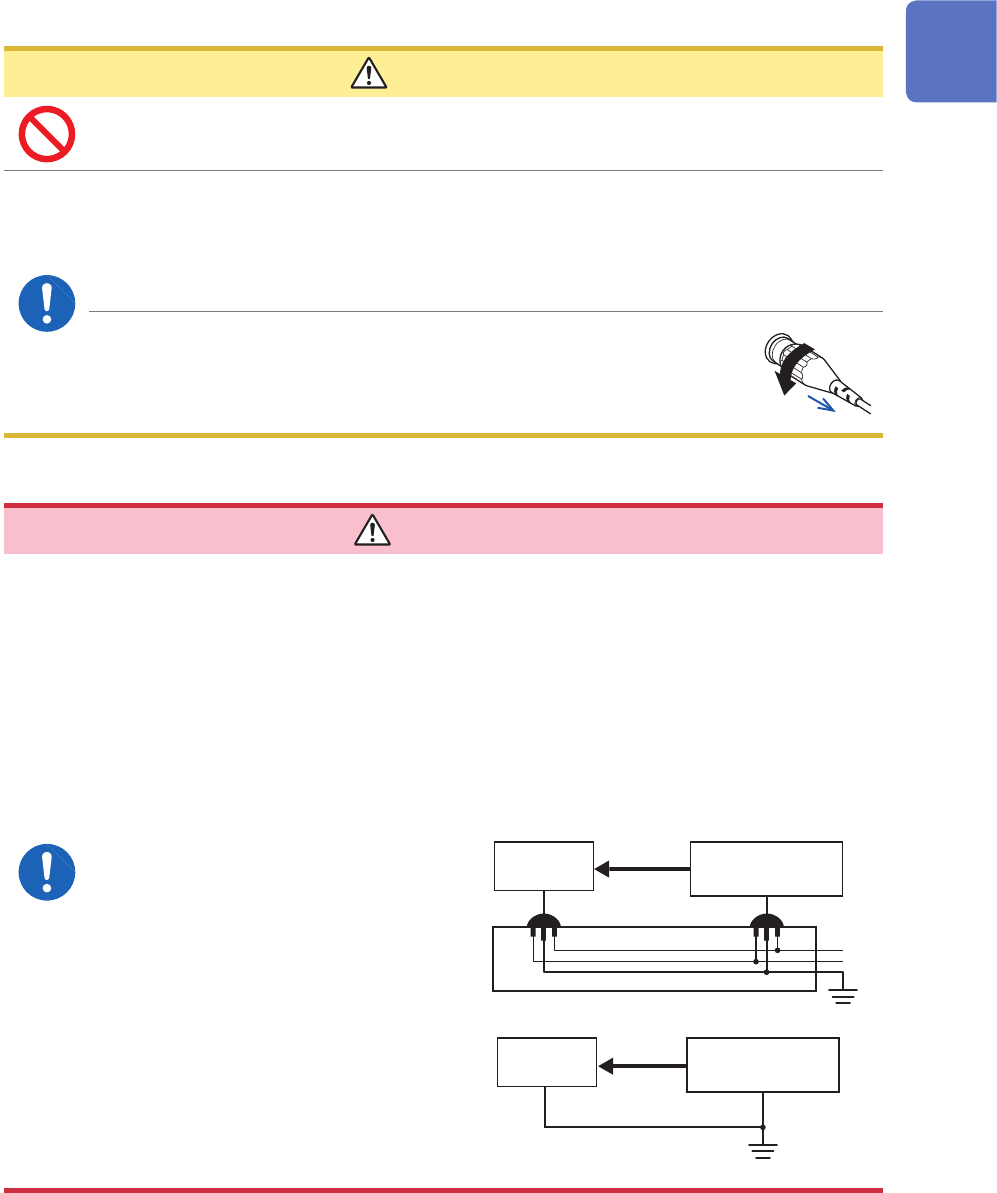
DANGER
To avoid an electric shock, a short-circuit and damage to the instrument, supply
power from a single main to the instrument and a measuring object with the
accompanying power cord.
The ground pin of logic terminal of Model 9320-01 Logic Probe (or Model 9327
Logic Probe) is not isolated from the instrument ground. The ground is shared.
If each of the terminals are supplied with power from separate mains or power
is supplied through a non-grounded power cord, the measuring object and the
instrument may be damaged because a current may ow through the logic probe
due to the resulting ground potential difference between the terminals. The
following connection procedure is recommended to avoid this problem:
• Connect the power cord provided
to the instrument and supply
power from the same outlet as the
measuring object.
• Connect the ground of the
measuring object to the GND
terminal (functional earth terminal)
of the instrument.
(Always supply power from a single
main.)
Refer to “2.6 Supplying Power to
the Instrument” (p. 60).
Functional ground terminal
GND
Logic
probe
Model MR8740T
Model MR8740T
Measuring
object
Measuring
object
Logic
Probe