MR8740T_Quick guide_eng_20191016H.pdf - 第24页
18 Operation Precautions Before turning on the instrument W ARNING • T o prevent electrical shock and to maintain the safety specications of this instrument, connect the accompanying power cord only to an inlet. • Befor…
17
Operation Precautions
CAUTION
• To prevent cord damage, do not step on cords or pinch them between other objects.
Do not bend or pull on cords at their base.
• The cable is hardened in freezing temperatures. Do not bend or pull it to avoid tearing
its shield or cutting the cable.
• Do not use any cable terminated with a metal BNC connector for connecting cables
to the BNC jacks on modules. If you connect a metal BNC cable to insulated BNC
connector, the insulated BNC connector and instrument may be damaged.
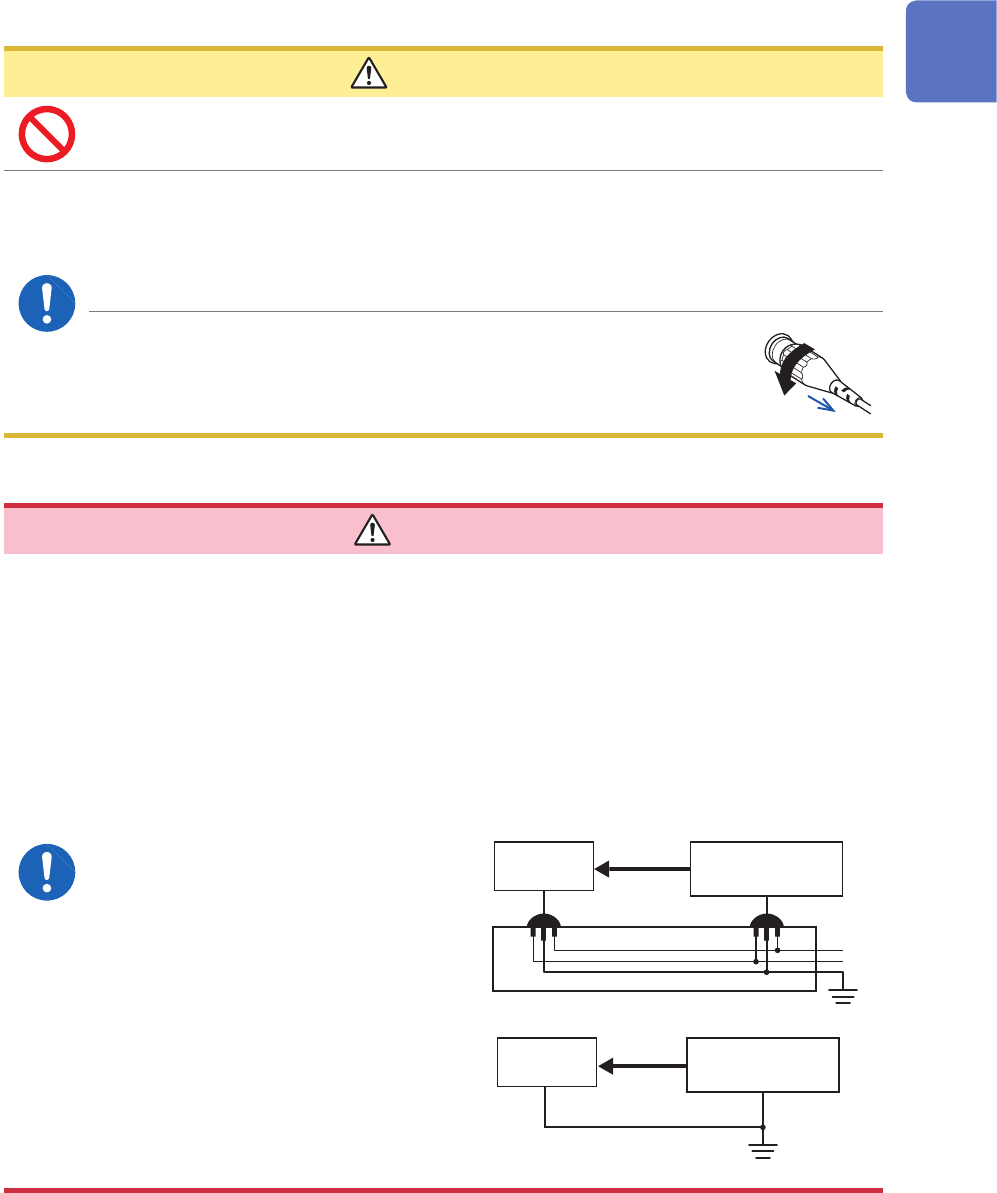
• To prevent damage to the BNC connector, be sure to release the
locking mechanism, grip the head of the connector (not the cord),
and pull it out.
1
2
Before connecting a logic probe to a measuring object
DANGER
To avoid an electric shock, a short-circuit and damage to the instrument, supply
power from a single main to the instrument and a measuring object with the
accompanying power cord.
The ground pin of logic terminal of Model 9320-01 Logic Probe (or Model 9327
Logic Probe) is not isolated from the instrument ground. The ground is shared.
If each of the terminals are supplied with power from separate mains or power
is supplied through a non-grounded power cord, the measuring object and the
instrument may be damaged because a current may ow through the logic probe
due to the resulting ground potential difference between the terminals. The
following connection procedure is recommended to avoid this problem:
• Connect the power cord provided
to the instrument and supply
power from the same outlet as the
measuring object.
• Connect the ground of the
measuring object to the GND
terminal (functional earth terminal)
of the instrument.
(Always supply power from a single
main.)
Refer to “2.6 Supplying Power to
the Instrument” (p. 60).
Functional ground terminal
GND
Logic
probe
Model MR8740T
Model MR8740T
Measuring
object
Measuring
object
Logic
Probe
18
Operation Precautions
Before turning on the instrument
WARNING
• To prevent electrical shock and to maintain the safety specications of this
instrument, connect the accompanying power cord only to an inlet.
• Before turning the instrument on, make sure the supply voltage matches that
indicated on its power connector. Connection to an improper supply voltage
may damage the instrument and present an electrical hazard.
CAUTION
Do not operate the instrument on any of the power sources (UPS or uninterruptible
power supply, DC/AC inverter) that provide rectangular-wave or pseudo-sine-wave
power. Doing so may damage the instrument.
19
Operation Precautions
Before connecting the instrument to external equipment
DANGER
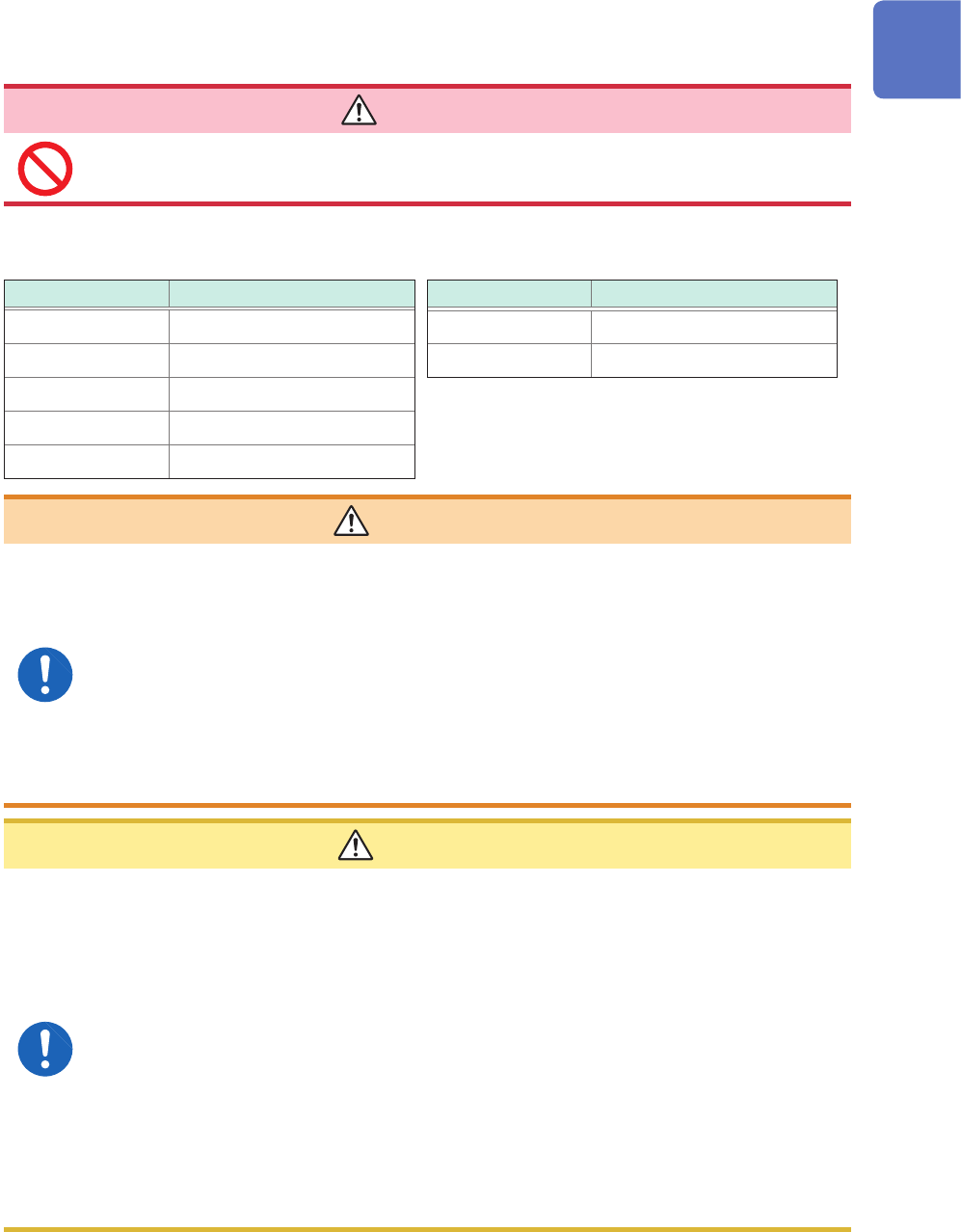
To avoid electrical hazards and damage to the instrument, do not apply voltage
exceeding the rated maximum to the external control terminals.
Model MR8740T
I/O terminal Maximum input voltage
IN1 10 V DC
IN2 10 V DC
OUT1 50 V DC, 50 mA, 200 mW
OUT2 50 V DC, 50 mA, 200 mW
TRIG.OUT 50 V DC, 50 mA, 200 mW
I/O terminals Maximum input voltage
EXT.TRIG 10 V DC
EXT.SMPL 10 V DC
WARNING
To avoid an electric shock or damage to the equipment, always observe the
following precautions when connecting your external equipment to external
control terminals.
• Always turn off the instrument and any equipment to be connected before
making connections.
• Be careful to avoid exceeding the ratings of the external control terminals.
• Properly isolate the devices and systems to be connected to the external
control terminals from one another.
Always turn both devices off before connecting and disconnecting an interface
connector. This may cause an electric shock.
CAUTION
• Use a common ground to both the instrument and the connected equipment. Using
different ground circuits will result in a ground potential difference between the
instrument and the connected equipment. If the communications cable is connected
while such a potential difference exists, it may result in equipment malfunction or
failure.
• Before connecting or disconnecting any communication cable, always turn off the
instrument and your device to be connected. Failure to do so could result in an
equipment malfunction or damage to the equipment.
• After inserting the connector, securely tighten the screws of the connector. Failure to
do so could result in an equipment malfunction or damage to the equipment.
• To prevent damage to the equipment, use the recommended type of wires to connect
your external equipment to the external control terminal, or otherwise ensure that the
wires have sufcient withstand voltage and current capacity.
Refer to “2.3 Connecting the External Control Terminals” (p. 53).