MR8740T_user_manual_eng_20191016H.pdf - 第119页
11 4 T riggering the Instrument With Logic Signals (Logic T rigger) 5.7 T riggering the Instrument With Logic Signals (Logic T rigger) This section explains how to congure the logic trigger settings. • Input signals acq…
113
Triggering the Instrument Using Analog Signals (Analog Trigger)
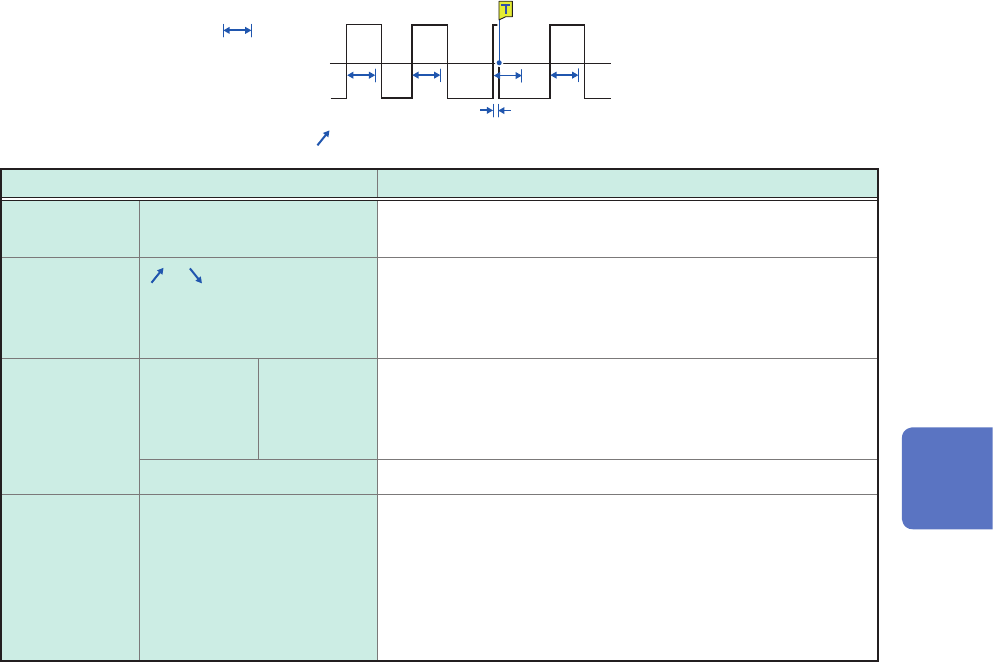
5. [Glitch] trigger
The glitch-trigger condition is satised when a pulse width of an input signal that has crossed the
specied level is shorter than the specied duration.
These triggers cannot be set either when Model MR8990 or Model U8991 is used.
Width
Level
Input waveform
Slope: [
]
Setting Description
Level –f.s. to +f.s.
Default: 0
Allows you to specify the level for detecting glitches.
Slope
, Allows you to choose which of the following points to use
to detect glitches: two consecutive points at which a signal
crosses the specied level in the positive direction; or those
in the negative direction.
Event With OR 1
to 4,000 Allows you to enter the number of events.
The instrument counts the number of times the glitch-trigger
condition is satised. An analog trigger is generated only
after the count reaches the specied number of events.
With AND Not available
Width 2 times to 4000 times of
the sampling period
Allows you to enter a pulse width (time), which is used to
determine a glitch.
The glitch-trigger condition is satised when a pulse width is
shorter than the specied width. (The available setting range
varies depending on the sampling periods. Lower limit: 2
times sampling period or longer; Upper limit: 4000 times
sampling period or shorter)
5
Conguring the Trigger Settings
114
Triggering the Instrument With Logic Signals (Logic Trigger)
5.7 Triggering the Instrument With Logic Signals
(Logic Trigger)
This section explains how to congure the logic trigger settings.
• Input signals acquired across the logic channels serve as a trigger source.
• You can set a trigger pattern and trigger logical-condition by choosing between logical AND and
OR operations. When the logic-trigger conditions are satised, a logic trigger is generated.
• With the trigger lter setting, no logic triggers are generated until the logic-trigger condition is
continuously satised during the specied lter width or more.
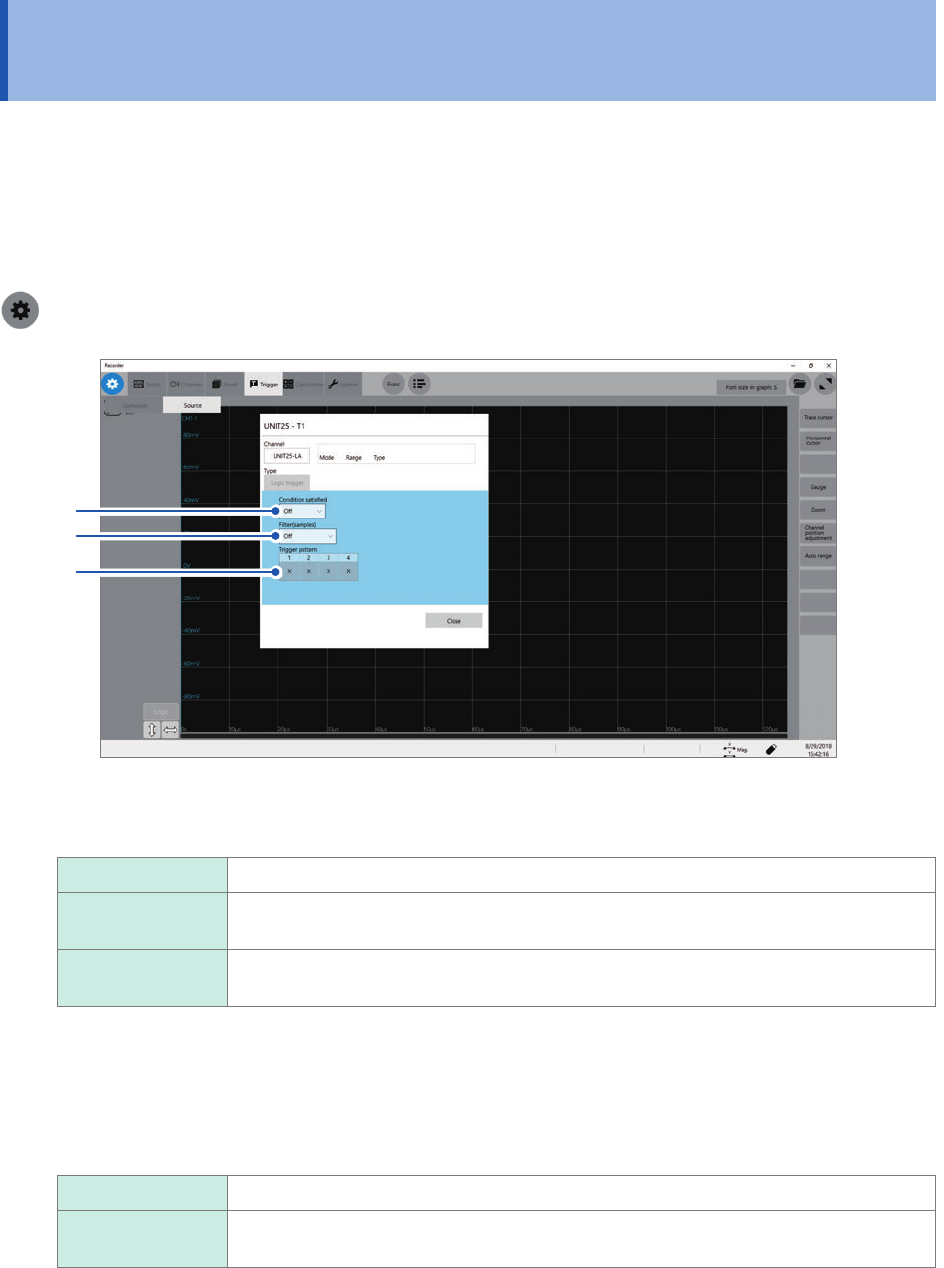
> [Trigger] > [Source]
2
3
1
1
Click the [Condition satised] box, and then choose a logic-trigger satisfaction condition
from the list.
Off
Disables the logic trigger.
OR The logic-trigger condition is satised when any one of logic input signals matches the
trigger pattern.
AND The logic-trigger condition is satised when all logic input signals match the trigger
pattern.
2
Click the [Filter] box, and then choose a sampling count of the lter from the list.
Only after the level-trigger condition is continuously satised during the specied period, an analog trigger is
generated.
Conguring the trigger lter setting prevents a logic trigger from being unintentionally generated due to noise.
(p. 107)
Off
Disables the trigger lter.
10 to 10000 Enables the trigger lter.
Allows you to enter a lter width in the number of samples.
115
Triggering the Instrument With Logic Signals (Logic Trigger)
3
Click each of the signals under [Trigger pattern] to set a logic-trigger pattern.
The logic-trigger pattern can be set.
X
Ignores a signal.
0 The logic-trigger condition of each logic signal is satised when the signal is at a low
level.
1 The logic-trigger condition of each logic signal is satised when the signal is at a high
level.
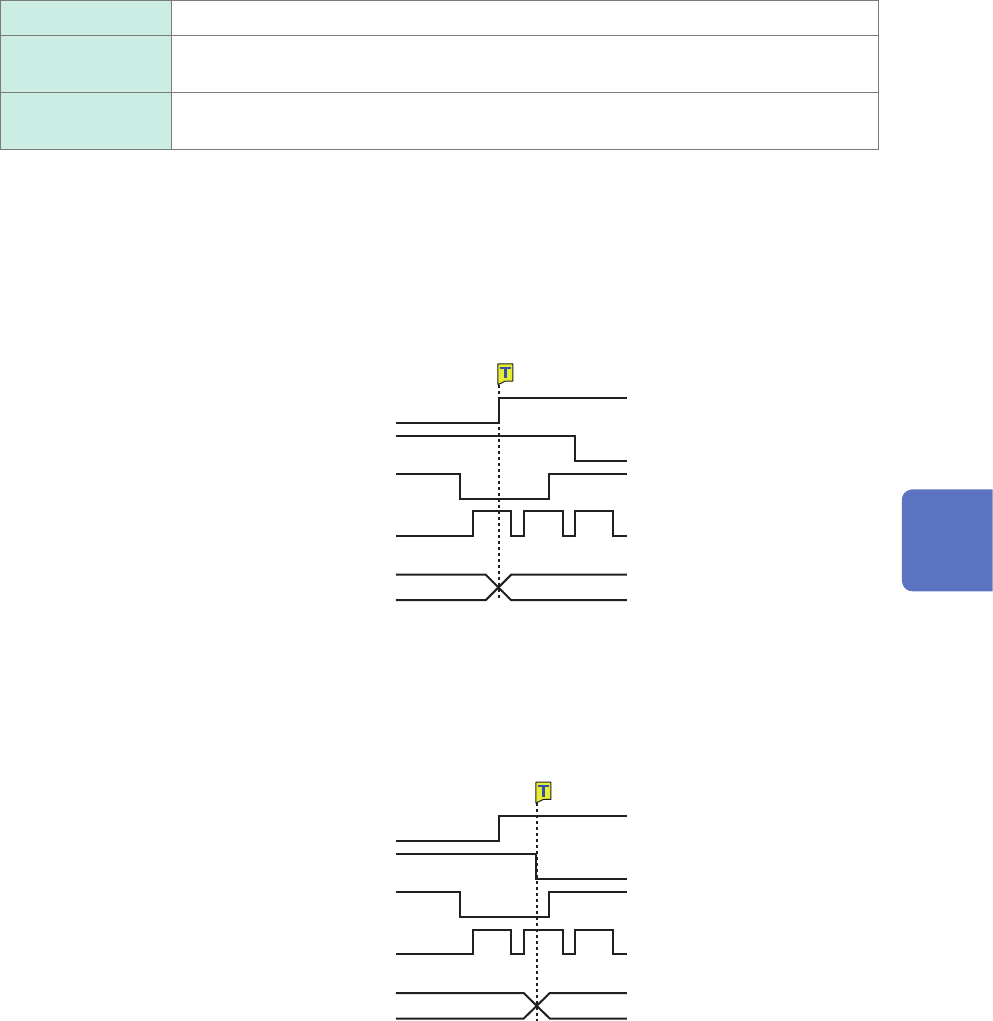
Setting example
The logic-trigger conditions differ depending on the combination of the [Condition satised]
setting (logical OR or AND operation) and the [Trigger pattern] setting as follows:
Lx1 [1]
Lx2 [0]
Lx3 [X]
Lx4 [X]
Lx1 [1]
Lx2 [0]
Lx3 [X]
Lx4 [X]
OR
AND
Trigger pattern
Trigger pattern
Not satised Satised
Not satised Satised
Logic-trigger condition
Logic-trigger condition
5
Conguring the Trigger Settings