MR8740T_user_manual_eng_20191016H.pdf - 第40页
35 3 Advanced Functions Advanced measurement and settings • Overlaying new waveforms with previously acquired waveforms (p. 36) Detailed module settings (p. 46) • Anti-aliasing lter • Thermocouple type • Reference junct…
34
Enlarging a Part of the Waveform (Zoom Function)
35
3
Advanced Functions
Advanced measurement and settings
• Overlaying new waveforms with previously
acquired waveforms (p. 36)
Detailed module settings (p. 46)
• Anti-aliasing lter
• Thermocouple type
• Reference junction compensation
• Wire break detection
• Data refresh
• Executing auto-balance
• Probe division ratio
• Response time
• Measurement mode
Converting input values (scaling) (p. 38)
Fine-adjusting input values (p. 43)
Inverting a waveform (p. 44)
Copying a setting to another channel
(p. 45)
3 Advanced Functions
3
Advanced Functions
36
Overlaying New Waveforms With Previously Acquired Waveforms
3.1 Overlaying New Waveforms With Previously
Acquired Waveforms
New waveforms can be overlaid with the presently displayed waveforms.
• You can compare the new waveforms with those recorded before. (When [Mode] is set to
[Repeat]) (p. 6)
• Two methods are available to overlay waveforms: the automatic overlaying during measurement
and the manual overlaying.
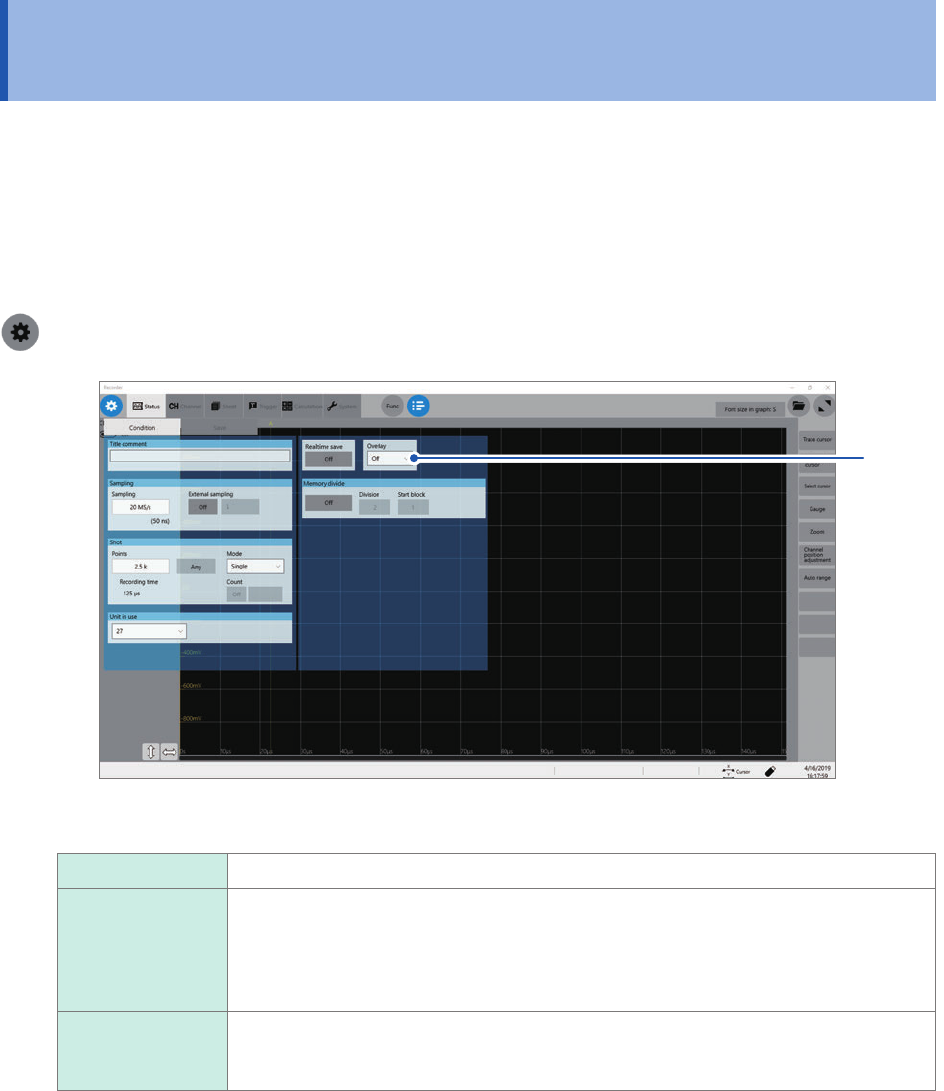
> [Status] > [Condition]
1
1
Click the [Overlay] box, and then choose an overlaying method from the list.
Off
Does not overlay any waveforms.
Auto Overlays waveforms newly acquired with the presently displayed waveforms every
time the instrument acquires new ones.
When [Mode] is set to [Repeat], the instrument overlays the new waveforms with
the presently displayed waveforms beginning from the start until the stop of the
measurement.
Manual Manually overlays the new waveforms with the presently displayed waveforms.
Refer to Step 3 “Overlay the waveforms manually (leaving any waveforms to be
displayed on the screen).” (p. 37).
Refer to “When the overlay function is enabled (When [Overlay] is set to [Auto] or [Manual])” (p. 37).