MR8740T_user_manual_eng_20191016H.pdf - 第160页
155 Numerical Calculation T ypes and Descriptions Calculation type Description Pulse count Counts the number of pulses that crossed the specied level in the positive (or negative) direction. For the pulse counts, it is …
154
Numerical Calculation Types and Descriptions
Calculation
type
Description
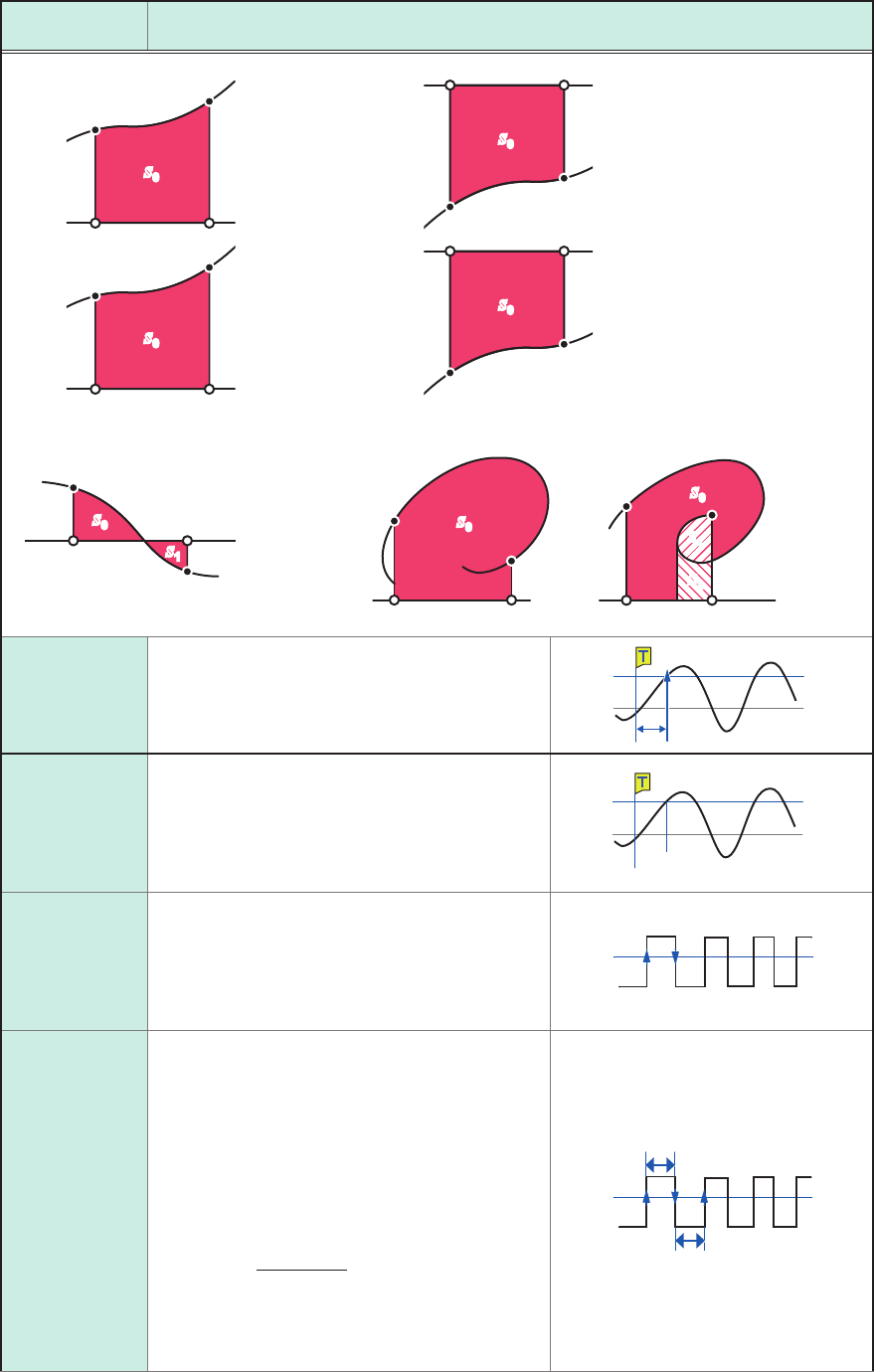
When a Y data point corresponds to an X data point
s
0
Start point
End point
X-axis (Y = 0)
Area
S
=
s
0
s
0
End point
Start point
X-axis (Y = 0)
Area
S
= −
s
0
s
0
Start point
End point
X-axis (Y = 0)
Area
S
= −
s
0
s
0
End point
Start point
X-axis (Y = 0)
Area
S
=
s
0
s
0
s
1
When a waveform includes negative
amplitude
Start point
End point
When multiple Y data points
correspond to an XY data point
X-axis (Y = 0)
Area
S
=
s
0
−
s
1
s
0
s
0
s
1
s
2
X-axis (Y = 0)
Area
S
=
s
0
X-axis (Y = 0)
Area
S
=
s
0
+
2
×
s
1
+
s
2
Time to level
Searches a calculation range from the beginning
for the time when a signal crossed the specied
level and calculates a period of time from a
trigger point to a point searched for.
Settings: Level, Slope, Filter
0
V
Level
Level at time
Calculates a level when the specied time has
elapsed from a trigger point.
You can also specify a time based on previously
calculated results.
Settings: Method (Time, Calc. No.), Time/
calculation number (No. 1 to No.107)
0 V
Level
T (Time)
Pulse width
Calculates a pulse width based on a time lag
between the time when a waveform crossed
the specied level in the positive (or negative)
direction and the time when it next crossed the
specied level in the opposite direction.
Settings: Level, Slope, Filter, Stat.
Level
Duty ratio
Calculates a duty ratio based on a time lag
between the time when a waveform crossed the
specied level in the positive direction and the
time when it next crossed the specied level in
the opposite direction, and a time lag between
the time when the waveform crossed the
specied level in the negative direction and the
time when it next crossed the specied level in
the opposite direction.
=
× 100 [%]
T
u-d
T
u-d
T
d-u
+
Duty ratio
T
u-d
: Time from rising edge to falling edge (unit: s)
T
d-u
: Time from falling edge to rising edge (unit: s)
Settings: Level, Filter, Stat.
Level
T
u-d
T
d-u
155
Numerical Calculation Types and Descriptions
Calculation
type
Description
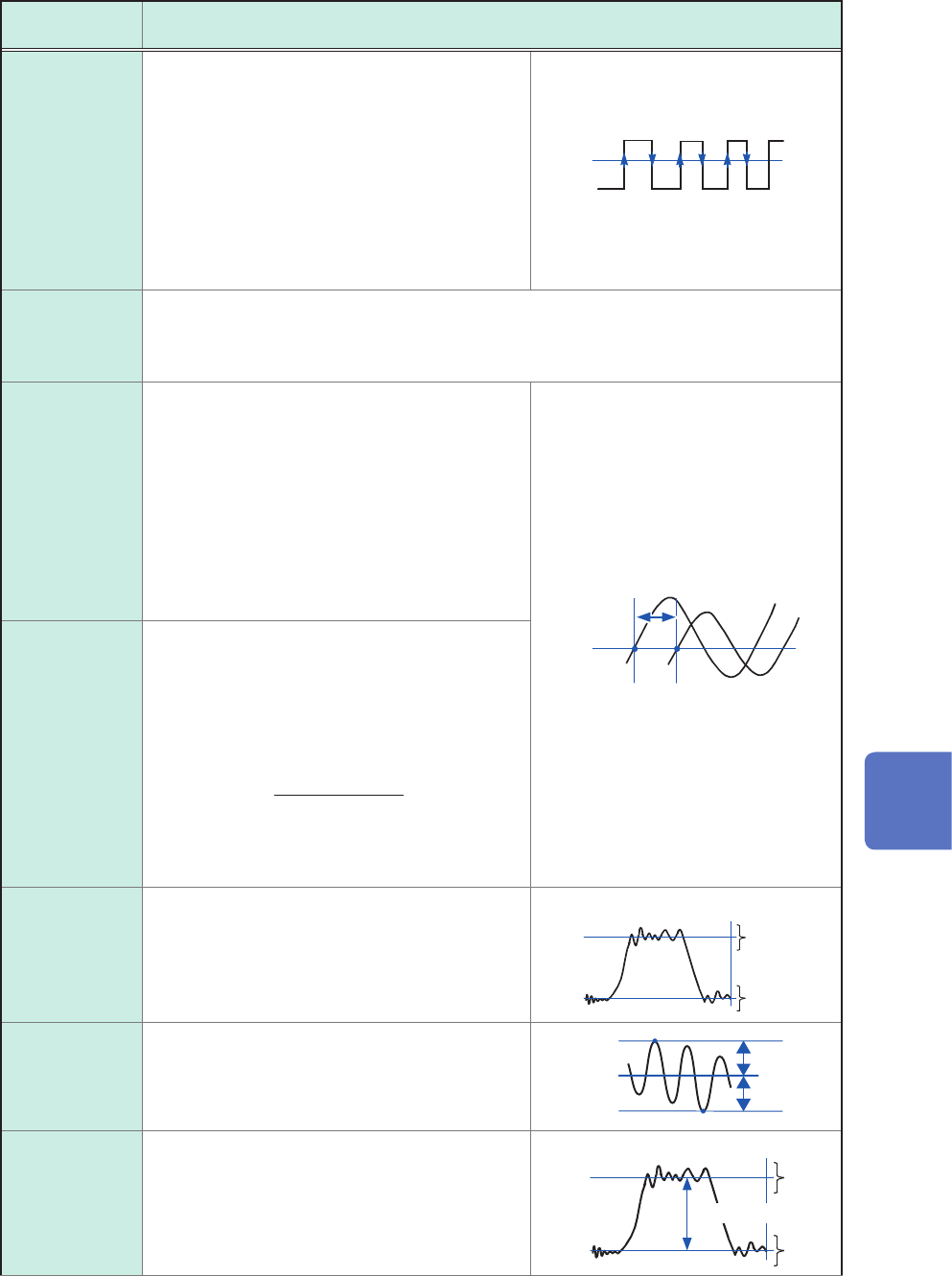
Pulse count
Counts the number of pulses that crossed the
specied level in the positive (or negative)
direction.
For the pulse counts, it is considered as one
count that a period between the point when a
pulse crossed the level in the positive direction
and the point when the pulse crossed the level
in the negative direction (otherwise, between
that in the negative direction and in the positive
direction).
Settings: Level, Slope, Filter
0
2 31
Level
Arithmetic
operations
Allows you to freely choose numerical calculation results and the instrument performs
arithmetic operations of the results of your choice.
Settings: Calculation number 1, Arithmetic operations (+, −, ×, ÷), Calculation number
2
Time difference
Calculates the time lag T (unit: s) between
when waveform A crossed the specied level
in the positive (or negative) direction and when
waveform B crossed it in the same direction.
(Time lag T) = (Time when waveform B crossed
the level) − (Time when waveform A crossed the
level)
(Time when waveform A crossed the level)
Settings: Waveform A (Reference channel,
Level, Slope, Filter); Waveform B
(Target channel, Level, Slope, Filter)
T
A B
Level
Phase contrast
Calculates a phase difference (unit: degree)
with reference to waveform A based on a time
lag between the time when waveform A crossed
the specied level in the positive (or negative)
direction and the time when waveform B crossed
it in the same direction.
Phase difference =
× 360 [°]
Time lag between
waveforms A and B
Period of Waveform A
Settings: Waveform A (Reference channel,
Level, Slope, Filter); Waveform B
(Target channel, Level, Slope, Filter)
High level
Low level
Calculates a low and high levels letting 0%
and 100% of acquired waveform data be them,
respectively, based on a histogram (frequency
distribution).
0%
100%
High
level
Low
level
Number of data points
Intermediate
value
Calculates the average of the maximum and
minimum values of waveform data.
[(Maximum value) + (Minimum value)] / 2
Maximum
Intermedi-
ate value
Minimum
Amplitude
Calculates a value (amplitude) between a low
and high levels letting 0% and 100% of acquired
waveform data be them, respectively, based on
a histogram (frequency distribution).
(High level) − (Low level)
0%
1
00%
High
level
Low
level
Number of data points
Amplitude
7
Numerical Calculation Function
156
Numerical Calculation Types and Descriptions
Calculation
type
Description
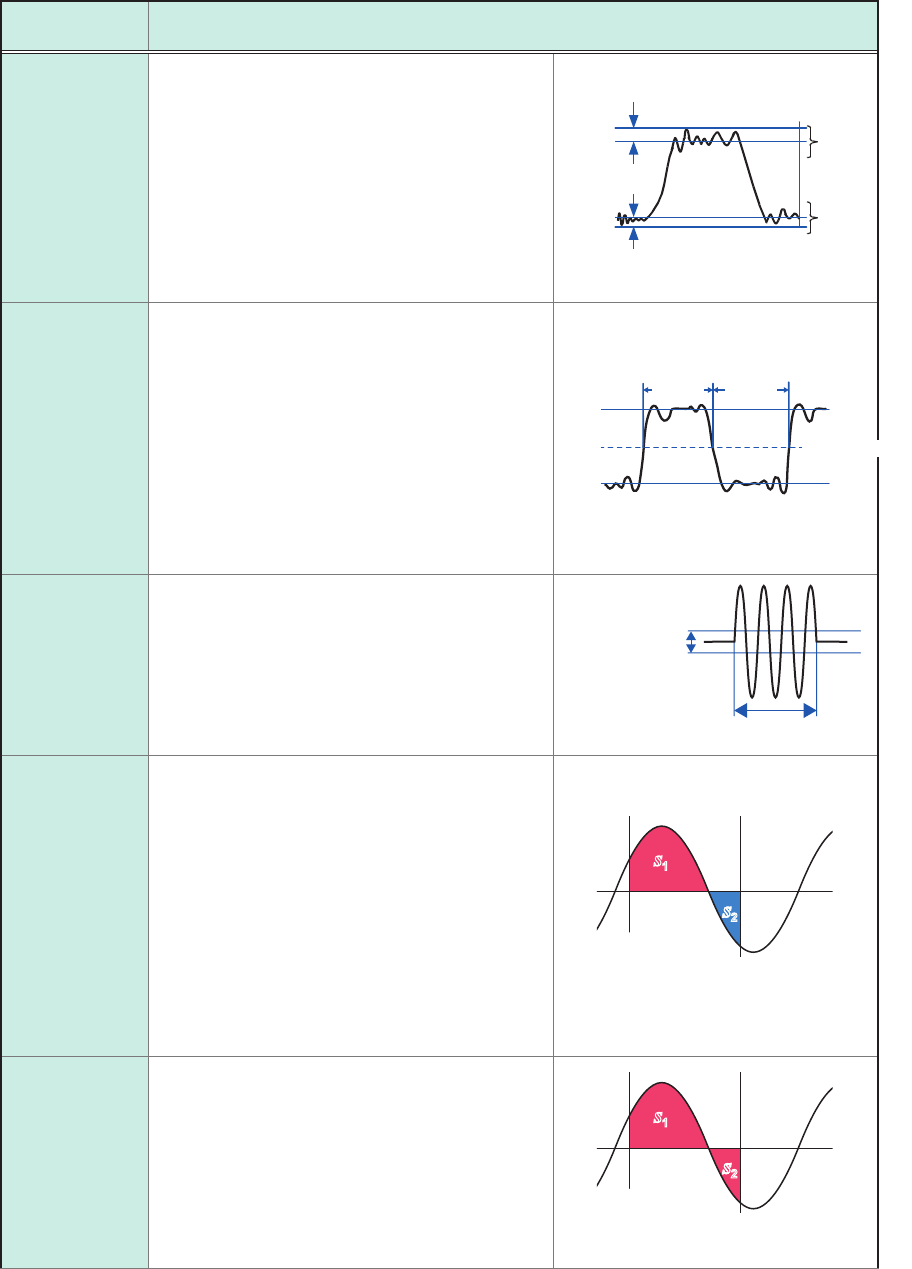
Overshoot
Undershoot
Calculates a ratio of a difference between the
maximum (or minimum) value and a high (or
low) level to a difference between a high and
low levels, which are calculated letting 0% and
100% of acquired waveform data be them,
respectively, based on a histogram (frequency
distribution).
[(Maximum value) − (High level)] / [(High level) −
(Low level)] × 100
[(Low level) − (Minimum value)] / [(High level) −
(Low level)] × 100
0%
1
00%
High
level
Low
level
Number of data points
Overshoot
Undershoot
+Width (Period
during which
a waveform
is above the
intermediate
level)
−Width (Period
during which
a waveform
is below the
intermediate
level)
Calculates a time lag between the time a
waveform crossed the intermediate line level
(50%) in the positive (or negative) direction and
the time it next crossed the intermediate level in
the opposite direction.
Settings: Filter, Stat.
+Width
High
−Width
Low
100%
0%
50%
Intermediate level
Burst width
Calculates a time during which a burst signal is
outputted.
Settings: Filter, Burst end lter, Window (Up,
Low), Stat.
T
Window-level range
Burst width
Accumulation
Method: Total
Calculates an accumulation by subtracting an
accumulation (V) enclosed by the zero-level
(zero-potential) line and the negative-amplitude
part of a signal waveform from an accumulation
(unit: V) enclosed by the zero-level (zero-
potential) line and the positive-amplitude part of
a signal waveform.
When the range is specied, calculates the
accumulation between the cursors.
S: Accumulation
n
: Number of data points
di
:
i
th data point acquired
across the channel
di
S =
∑
i = 1
n
s
1
sss
2
s
1
ss
2
Cursor A
Cursor B
S
=
s
1
−
s
2
Accumulation
Method:
Absolute value
Calculates an accumulation (unit: V) enclosed by
the zero-level (zero-potential) line and a signal
waveform.
When the range is specied, calculates the
accumulation between the cursors.
S: Accumulation
n
: Number of data points
di
:
i
th data point acquired
across the channel
|di|
S =
∑
i = 1
n
s
1
sss
2
s
1
ss
2
Cursor A
Cursor B
S
=
s
1
+
s
2