MR8740T_user_manual_eng_20191016H.pdf - 第94页
89 Saving Data > [Status] > [Save] 2 3 4 5 1 Congure the real-time save and sampling rate settings on the [Condition] screen Refer to “1.2 Setting Measurement Conditions” (p. 5). 2 Click the [Media] box, and then …
88
Saving Data
Real-time save
Since setting the real-time save to [On] allows data to be saved in a storage device simultaneously
with measurement, the instrument can perform measurement for a long period of time regardless of
the capacity of the internal memory.
The measurement condition settings are different between setting the real-time save to [On] and
[Off].
• When setting the real-time save to [On], you cannot use the following functions:
Auto-save, trigger function, waveform calculation function, and memory division function.
• No storage device can be removed or replaced during the real-time save.
• If displaying the message, Warning No. 235 [Real-time save could not be completed within
available time.], the instrument may record abnormal data in a waveform le saved in a storage
device.
• The operation may be automatically restricted or the magnication may be changed if there is a
risk that saving data cannot be completed in time during the real-time save.
• When any numerical calculation is set, only manual calculation can be executed.
After the measurement has been complete, select
> [Calculation] > [Numerical
calculation], and then click [Execute].
• When using a USB ash drive for real-time save, select Model Z4006 USB Drive (option).
• When using a ash drive for real-time save, connect it to the USB 3.0 connector on the rear side
of the instrument. Connecting the drive to the USB 2.0 connector cannot deliver the real-time
save speed specied in the product specications.
Maximum recording time
• When the real-time save is set to [On], the maximum recording time is determined based on the
recording interval, the remaining capacity of a storage device, and the number of channels to be
used.
• When the sampling rate is set at a slow rate, the recording time is set to a long period of time
(one year or more) depending on a condition. The operation cannot be guaranteed because the
warranty period or product life may disturb it.
• When the external sampling is used, the instrument calculates the maximum recording time
assuming a recording interval of 500 MS/s.
Refer to “Maximum recordable time when the real-time save is enabled (values for reference
purposes)” (p. 221).
Waveform data
When recording waveforms with the real-time save set to [On], the instrument directly saves
measured waveform data (.MEM) onto a storage device. If the le size is large, the instrument
automatically divides the le into several les each of which has 512 MB and saves them.
Deleting and saving les when saving data in real time
• If the capacity of the storage device becomes full while the instrument is storing les, it
automatically deletes waveform les created after the measurement has started beginning from
the oldest, securing free space in the storage device. When free space in a storage device is less
than the sum of the created le size and 512 MB before starting a measurement, however, the
instrument cannot overwrite any new les over the older les. Use a storage device with as much
free space as possible.
• The instrument does not delete waveform les saved in the past.
• When [Method] is set to [Delete], the recording length can be set at 10000 days at a maximum;
however, data the instrument retains after the measurement is limited to a free space size of a
storage device at the start of recording (recording time of the normal saving).
89
Saving Data
> [Status] > [Save]
2
3
4
5
1
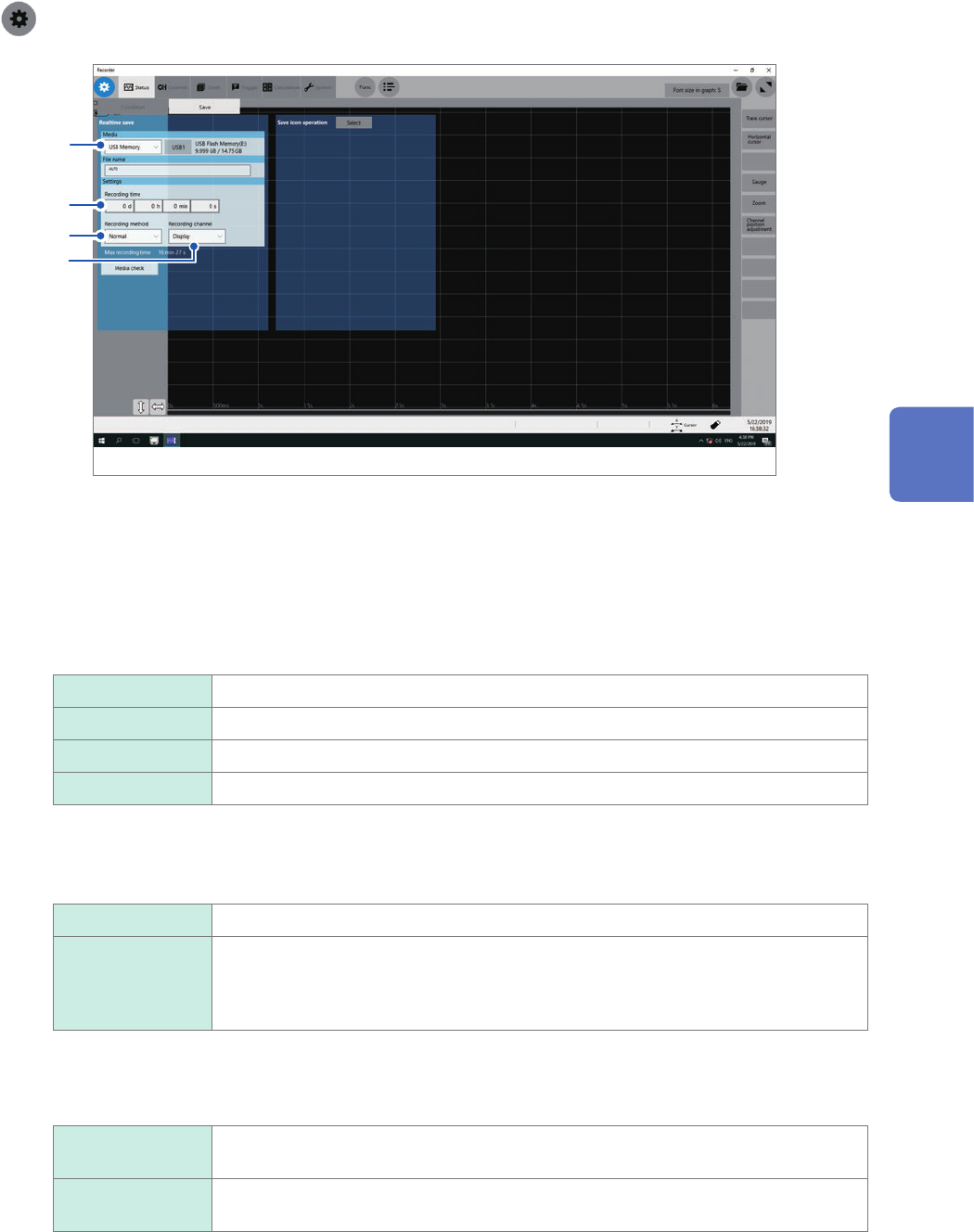
Congure the real-time save and sampling rate settings on the [Condition] screen
Refer to “1.2 Setting Measurement Conditions” (p. 5).
2
Click the [Media] box, and then choose a destination to save from the list.
3
Click the [Recording time] box, and then enter a recording time.
d 0 to 10000 (days)
h 0 to 23 (hours)
min 0 to 59 (minutes)
s 0 to 59 (seconds)
4
Click the [Method] box, and then from the list, choose a saving way if a space of a storage
device is insufcient.
Normal
Stops the real-time save and measurement if the storage device is full.
Delete Deletes older les and saves les in real time if the storage device is full (waveform
les only).
The instrument deletes les only created after the measurement has started. It does
not delete previously existing les.
Setting [Media] to [FTP] forces this setting into [Normal].
5
Click the [Channel] box, and then choose an option for channels to be recorded.
Display The instrument records data acquired across channels with the waveform display set
to [On].
All
Records data acquired across all measured channels. The instrument also records
data acquired across channels with the waveform display set to [Off].
6
Check settings that include the input channel settings, and then click the start icon.
The instrument saves data onto a storage device in real time during measurement.
4
Saving/Loading Data and Managing Files
90
Saving Data
Freely selecting data items to be saved and save les (save icon)
To save a le immediately by clicking the save icon, you need to specify items to be saved
beforehand.
You can save the following types of data: (Setting data, waveform data, screenshot, and numerical
calculation results)
> [Status] > [Save]
1
3
2
4
6
5
7
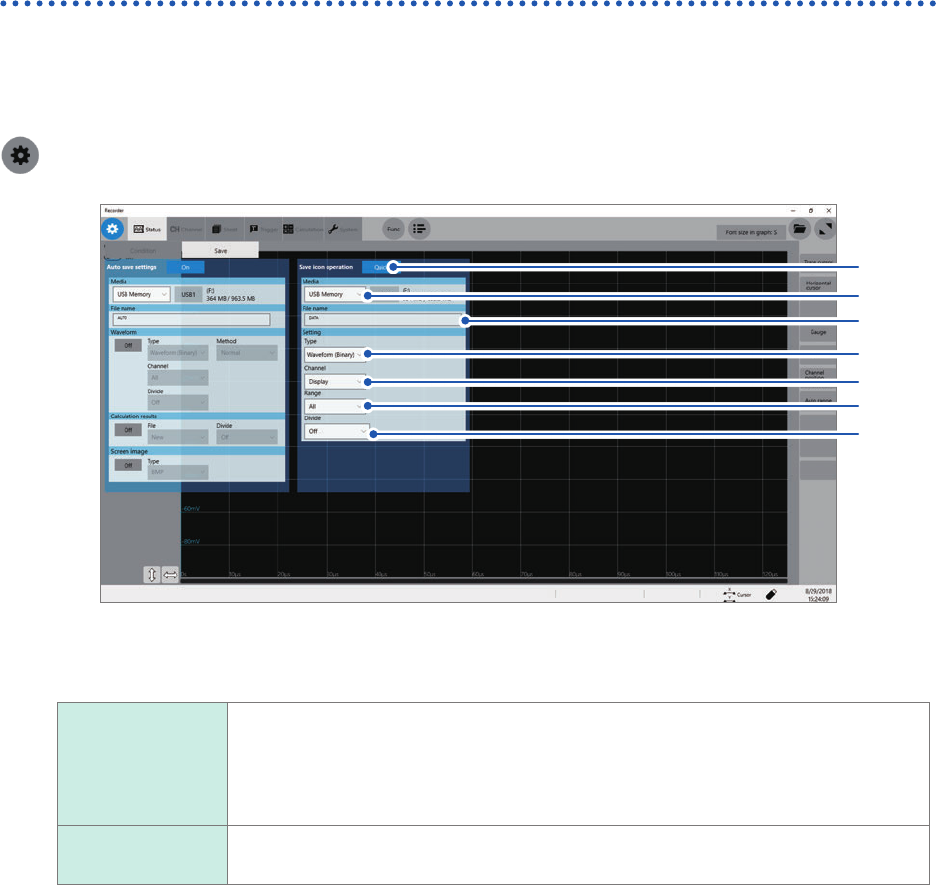
1
Click the [Save icon operation] button, and then choose a save method adopted when you
click the save icon.
Select
Displays the dialog box to allow you to choose items to be saved and saves them. You
can specify the subsequent settings in the dialog box that appears when you click the
save icon at the start of measurement. This operation cannot be executed if another
dialog box is open.
Refer to “Selective save” (p. 83).
Quick save Immediately saves data consisting of pre-specied items.
Refer to “Quick save” (p. 83).
2
Click the [Media] box, and then choose a destination to save from the list (Refer to p. 84).
3
Click the [File name] box, and then enter a le name.
• Number of characters for a le name: Up to 100 characters
• The maximum length of a le name that includes its path: Up to 255 characters