MR8740T_user_manual_eng_20191016H.pdf - 第46页
41 Converting Input V alues (Scaling Function) When using [Output rate] : Choose an output rate (ratio) of a current sensor or a division ratio of a voltage dividing probe. Click the [Output rate] box, and then from the …
40
Converting Input Values (Scaling Function)
When using [2-Point]: Specify two input values and those after scaling.
Enter two voltage values of an inputted signal in the [Input1] and [Input2] boxes.
Enter each of two scaled value in the [Scale1] and [Scale2] boxes.
−9.9999E+29 to 9.9999E+29
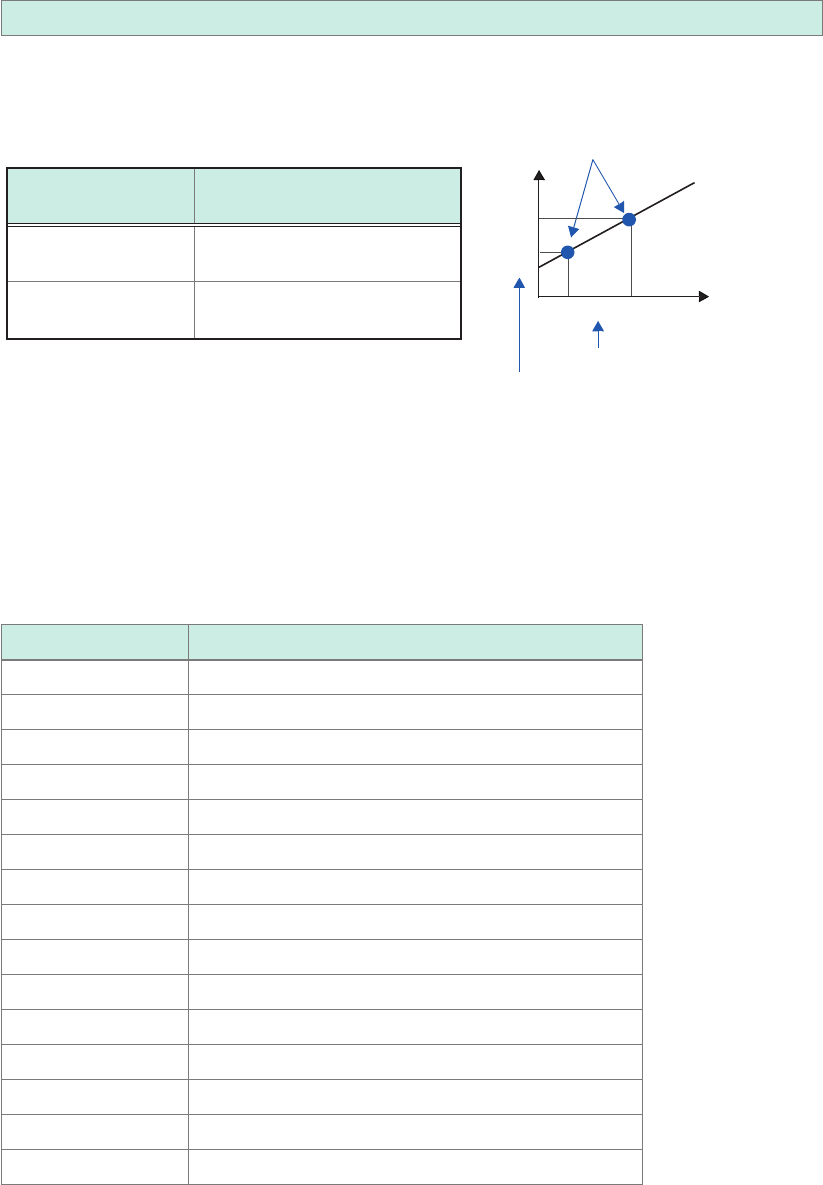
The instrument converts (scales) measured values in
volts into values in the specied measurement unit.
Example:
2 points of values
in volts
Values after scaled
V
H
: Higher potential
point
A
H
: Value for the higher
potential point
V
L
: Lower potential
point
A
L
: Value for the lower potential
point
Unit: A
[A]
A
H
A
L
V
L
V
H
Scaling values using a
conversion ratio and offset value,
both of which are calculated
using two points
Values after scaled
Actual measured values
[V]
When changing the value with the [Ratio] setting, the instrument does not change the values
for V
L
or V
H
, but the values for A
L
and A
H
, all of which have been specied with [Method] set
to [2-Point].
When using [Sensor]
• Click the [Sensor] box, and then choose a model name of a current sensor or differential probe from
the list.
• Click the [Range] box, and then choose a measurement range from the list.
Sensor Range
Model 3273-50 30 A
Model 3274 150 A
Model 3275 500 A
Model 3276 30 A
Model 3283
10 mA
, 100 mA, 1 A, 10 A, 200 A
Model 3284 20 A
, 200 A
Model 3285 200 A
, 2000 A
Model 9010-50 10 A
, 20 A, 50 A, 100 A, 200 A, 500 A
Model 9018-50 10 A
, 20 A, 50 A, 100 A, 200 A, 500 A
Model 9132-50 20 A
, 50 A, 100 A, 200 A, 500 A, 1000 A
Model 9322 –
Model 9657-10 10 A
Model 9675 10 A
CT6700, CT6701 5 A
CT6710, CT6711 500 mA, 5 A, 30 A
Setting example:
To display values measured with Model 9018-50 Clamp on Probe using the 10 A range as values in
amperes (A)
Sensor: Model 9018-50
Range: 10 A
Unit A
41
Converting Input Values (Scaling Function)
When using [Output rate]: Choose an output rate (ratio) of a current sensor or a division
ratio of a voltage dividing probe.
Click the [Output rate] box, and then from the list, choose a current value per one volt the current
sensor outputs.
Otherwise, choose a voltage value per a one volt the differential probe outputs.
10 mA
, 100 mA, 1 A, 10 A, 20 A, 50 A, 100 A, 200 A, 250 A, 500 A, 1000 A, 2000 A,
2500 A, 5000 A, 1000 V
When using [dB]: Specify a physical quantity per input signal (ratio) in decibels.
• Click the [Input dB] box, and then enter an inputted signal value in decibels.
• Click the [Output dB] box, and then enter an scaled value in decibels.
-200 to +200
You can specify values to ve or less signicant gures.
Setting example:
Converting (scaling) an input value of 40 dB into 60 dB
Input dB: 40
Output
dB:
60
The conversion ratio corresponding to values entered in decibels is specied. (The offset becomes
zero.)
When using [Rating]
(For Model U8969 Strain Unit only)
• Click the [Capacity] box, and then enter the rated capacity of a strain gauge converter to be used.
• Click the [Output] box, and then enter a rated output of a strain gauge converter to be used.
+1.0000E-9 to +9.9999E+9
You can specify values to ve or less signicant gures.
Specify the parameters such that the quotient of the rated capacity divided by two times the rated
output is less than or equal to 9.9999E+9.
For the rated capacity and rated output, see an inspection record of a strain gauge converter to be
used.
Setting example: To display results measured with a strain gauge converter that has a rated capacity of
20 G and rated output of 1000 μV/V as gures in gravities (G)
Unit: G
Rated capacity: 20
Rated output: 1000
The upper and lower display values of a waveform also automatically change according to the
changes made in the scaling settings.
4
Click the [Units] box, and then enter a unit used for scaled values.
Enter the unit into which you wish to convert the values. (Number of characters: up to 7)
To copy the scaling setting to another channel
Refer to “3.5 Copying Settings (Copy Function)” (p. 45).
3
Advanced Functions
42
Converting Input Values (Scaling Function)
When using Model U8969 Strain Unit
When an inspection record of a strain gauge converter provides a calibration
factor
Example: To display data measured with the strain gauge converter having a calibration
factor of 0.001442 G/1 × 10
−6
strain* as values in terms of gravities (G)
(*: 10
−6
strain =
me
)
Scaling On (ENG)
Method Ratio
Units G
Ratio 0.001442 [G] (Displayed as “1.4420 m”)
When an inspection record of a strain gauge converter provides the rated
capacity and rated output
Refer to “When using the [Rating] setting” in “3.2 Converting Input Values (Scaling
Function)”(p. 41).
When using a strain gauge that has a gauge factor of other than 2.0
Model U8969 Strain Unit measures outputs of the gauge supposing that the gauge factor stands at
2.0.
When a strain gauge that has a gauge factor of other than 2.0 is used, you need to convert its
gauge factor into a conversion ratio.
For example, if the gauge factor stands at 2.1, the conversion ratio will be 0.952 (≈ 2 / 2.1).
Example: To display data measured with a strain gauge (gauge factor: 2.1) as values in terms
of gravities (G)
Two scaling (conversion ratio) calculations are required: a gauge ratio and conversion ratio that
converts output into physical quantities. In this case, enter the product of the conversion ratios of
the gauge factor and the scaling conversion ratio as the conversion ratio.
Where the conversion ratio of the gauge factor is 0.952, and the conversion ratio to convert data
into physical quantities is 0.001442*.
Conversion ratio = 0.952 × 0.001442 = 0.0013728
Enter [0.0013728] as the conversion ratio.
*: To convert values measured with a strain gauge into physical quantities, calculate the conversion ratio
based on Young’s modulus or Poisson’s ratio of a measuring object. The conversion method varies
depending on the conditions the strain gauge is used in.
Refer to “Scaling method for strain gauges” (p. 223).