MR8740T_user_manual_eng_20191016H.pdf - 第70页
65 Conguring Measuring-Module-Specic Settings Conguring Model U8991 Digital V oltmeter Unit settings > [Channel] > [U8991] to 1 4 1 Click the area that includes [Notch frequency] . The setting dialog box appears…
64
Conguring Measuring-Module-Specic Settings
When using an out-of-setting-range current sensor
You can use an out-of-setting-range current sensor using the scaling function.
Refer to “Automatically saving waveform data” (p. 84).
1
Click the area that includes [Sensitivity].
The setting dialog box appears.
2
Click [Sensitivity] box, and then enter sensor sensitivity.
Multiply the sensor sensitivity of a sensor to be used by a certain value to allow a product to fall within the
setting range (0.1 to 10), and enter the product.
3
Click [Close].
The setting dialog box closes.
4
Click the [Scaling] box, and then congure the scaling setting.
Congure the scaling setting so that a scaling ratio is the same value as the number you multiplied the sensor
sensitivity by.
Example 1
For sensor sensitivity of 23.4 pC/(m/s
2
)
Specify 10 pC/(m/s
2
), which results from multiplying the sensor sensitivity by 1/2.34, as the sensor sensitivity.
To display measured values after multiplying them by 1/2.34, congure the scaling setting as follows:
To congure the scaling setting using the conversion ratio method
Ratio 0.4274E+00 (= 10/23.4)
Offset 0.0000E+00
Units m/s
2
To congure the scaling setting using the 2-point method
Input1 2.3400E+00 Scale1 1.0000E+00
Input2 0.0000E+00 Scale2 0.0000E+00
Units m/s
2
Example 2
For sensor sensitivity of 0.05 pC/(m/s
2
)
Specify 0.1 pC/(m/s
2
), which results from multiplying the sensor sensitivity by two, as the sensor sensitivity.
To display measured values after multiplying them by two, congure the scaling setting as follows:
To congure the scaling setting using the conversion ratio method
Ratio 2.0000E+00 (= 0.1/0.05)
Offset 0.0000E+00
Units m/s
2
To congure the scaling setting using the 2-point method
Input1 0.0500E+00 Scale1 1.0000E+00
Input2 0.0000E+00 Scale2 0.0000E+00
Units m/s
2
65
Conguring Measuring-Module-Specic Settings
Conguring Model U8991 Digital Voltmeter Unit settings
> [Channel] > [U8991]
to
1
4
1
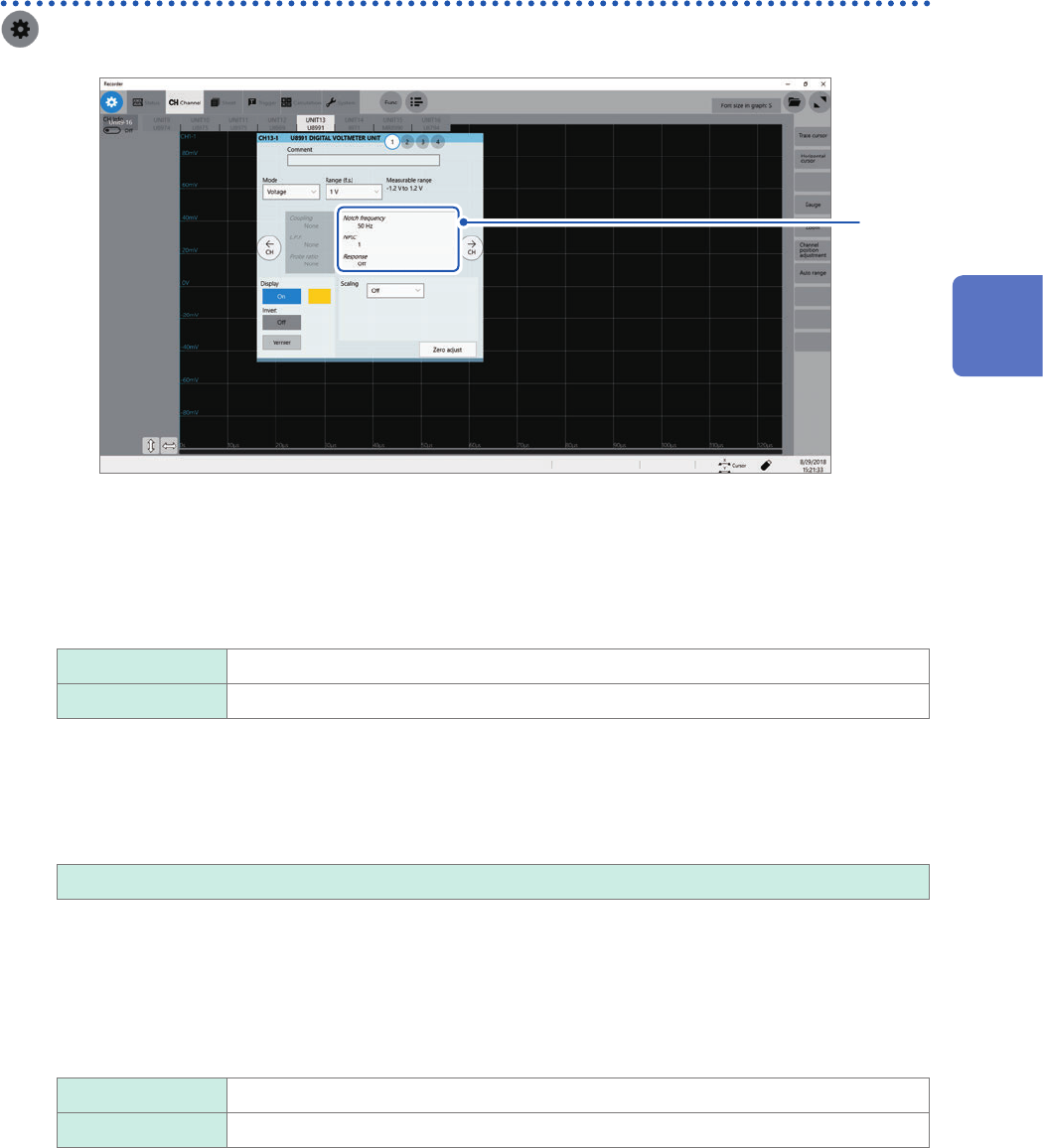
Click the area that includes [Notch frequency].
The setting dialog box appears.
2
Click the [Notch frequency] box, and then choose a power frequency from the list.
Choose a power frequency of your region.
50 Hz
Sets the period at 20 ms.
60 Hz Sets the period at 16.67 ms.
An incorrect power frequency setting causes measured values to be unstable.
3
Click the [NLPC] box, and then enter an integration time.
Dene an integration time based on the power line cycle (PLC), which is the time equivalent to one period of
the power frequency.
1
, 10, 100
Example: When the power frequency is 50 Hz and NPLC is set at 10, then 20 ms × 10 = 200 ms is obtained.
The instrument updates measured data every 200 ms.
(Increasing NPLC may reduce uctuation in measured values caused due to exogenous noise or an EMC
environment.
4
Click the [Response] box, and then choose a data update interval from the list.
Off
Updates data at intervals the time entered in the [NPLC] box.
On Calculates moving averages every 1 PLC and updates the data.
5
Click [Close].
The setting dialog box closes.
3
Advanced Functions
66
Conguring Generator-Module-Specic Settings
3.7 Conguring Generator-Module-Specic Settings
You can congure generator module settings on the dedicated setting screen.
You can congure settings of MR8790 Waveform Generator Unit, MR8791 Pulse Generator Unit,
and U8794 VIR Generator Unit using the instrument.
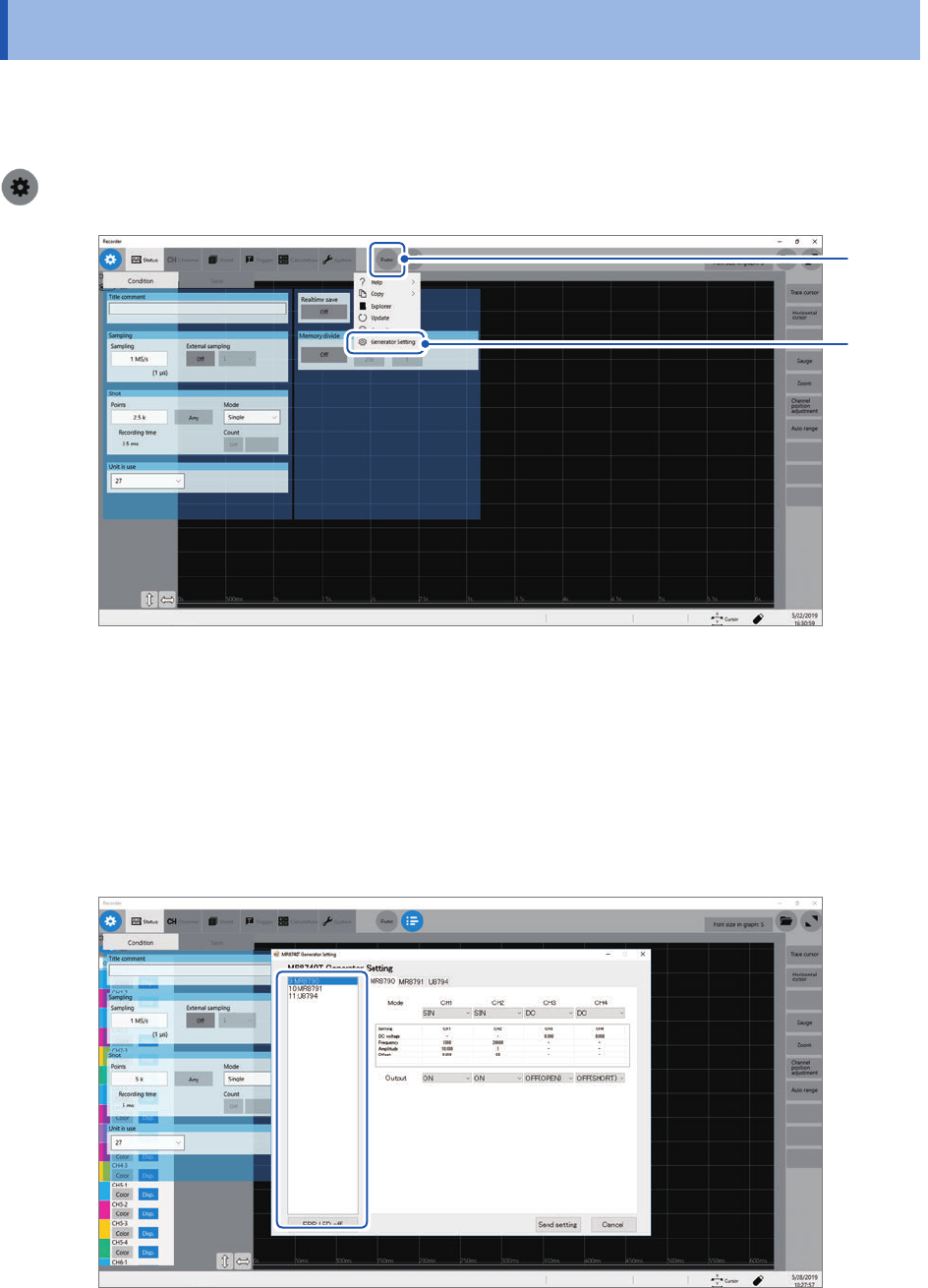
>[Func]> [Generator Setting].
2
1
1
Click [Func].
2
Click [Generator Setting].
The setting screen dedicated for the generator modules.
The slots generator modules are installed in and model names are displayed in the left-hand side of
the setting screen
Slots in which generator modules are installed cannot be used for measurement.