MR8740T_user_manual_eng_20191016H.pdf - 第156页
151 Numerical Calculation T ypes and Descriptions 7.4 Numerical Calculation T ypes and Descriptions Calculation type Description A verage value Calculates an average value of waveform data. AV E : Average value n : Numbe…
150
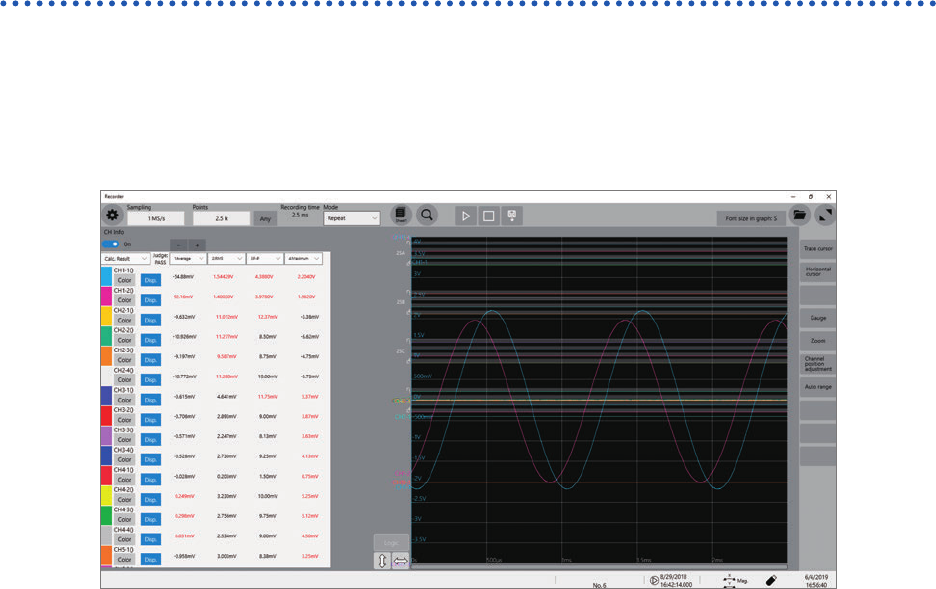
Evaluating Calculation Results on a Pass/Fail Basis
Displaying evaluation results and externally outputting signals
The numerical calculation result screen of the waveform screen displays numerical calculation
evaluation results.
Values that fall within an evaluation criteria range: Pass judgment
Values outside an evaluation criteria range: Fail judgment (highlighted in red)
When a pass judgment is given
When the external output terminals (OUT 1, OUT 2) are set to [Judge(Pass)], a PASS signal is
output from the external output terminals (OUT 1, OUT 2).
When a fail judgment is given
When the external output terminals (OUT 1, OUT 2) are set to [Judge(Fail)], a FAIL signal is output
from the external output terminals (OUT 1, OUT 2). A fail judgment is given when any one of the
channels is judged to be a fail.
151
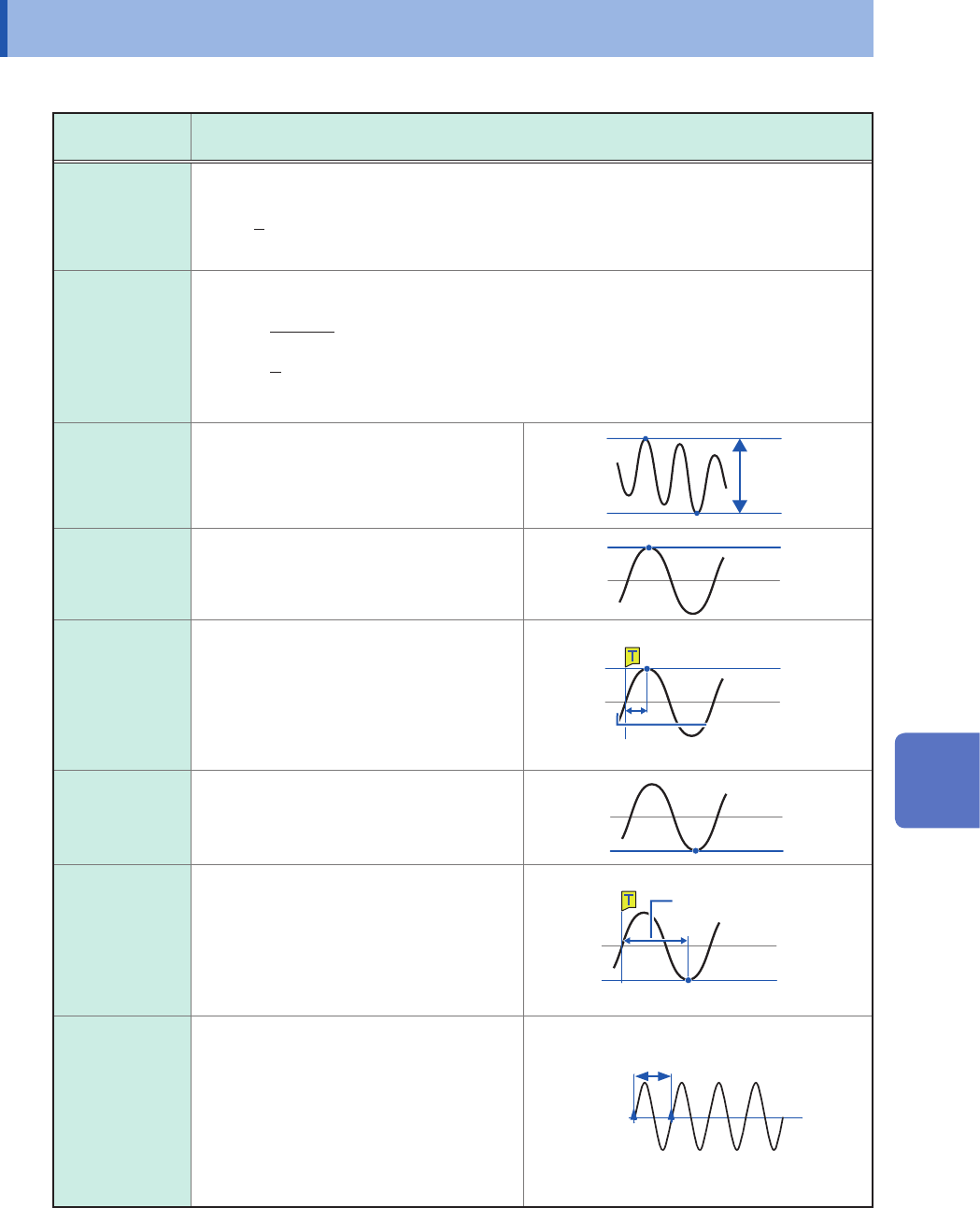
Numerical Calculation Types and Descriptions
7.4 Numerical Calculation Types and Descriptions
Calculation
type
Description
Average value
Calculates an average value of waveform data.
AV E
: Average value
n
: Number of data points
di
:
i
th data point acquired across the channel
RMS
Calculates an RMS value of waveform data. When the scaling is enabled, the instrument
scales waveform data before calculation.
RMS
: Root-mean-square value
n
: Number of data points
di
:
i
th data point acquired across the channel
P-P
Calculates a difference (peak-to-peak
value) between the maximum and
minimum values of waveform data.
Maximum
P-P
Minimum
Maximum
Calculates the maximum value of
waveform data.
Maximum
Time to
maximum
Calculates a period of time (unit: s) from a
trigger point to the maximum value.
When waveform has two or more points
of the maximum value, the instrument
determines the rst of them in the
waveform used for a calculation to be the
maximum value.
Maximum
Time to maximum
Minimum
Calculates the minimum value of
waveform data.
Minimum
Time to
minimum
Calculates a period of time (unit: s) from a
trigger point to the minimum value.
When waveform has two or more points
of the minimum value, the instrument
determines the rst of them in the
waveform used for a calculation to be the
minimum value.
Minimum
Time to minimum
Period
Frequency
Displays a period (unit: s) and frequency
(unit: Hz) of a signal waveform.
The instrument calculates a period and
frequency based on a time lag between
the time when a waveform crossed the
specied level in the positive (or negative)
direction the rst time and the time when it
next crossed the specied level.
Settings: Level, Slope, Filter, Stat.
Level at time
7
Numerical Calculation Function
152
Numerical Calculation Types and Descriptions
Calculation
type
Description
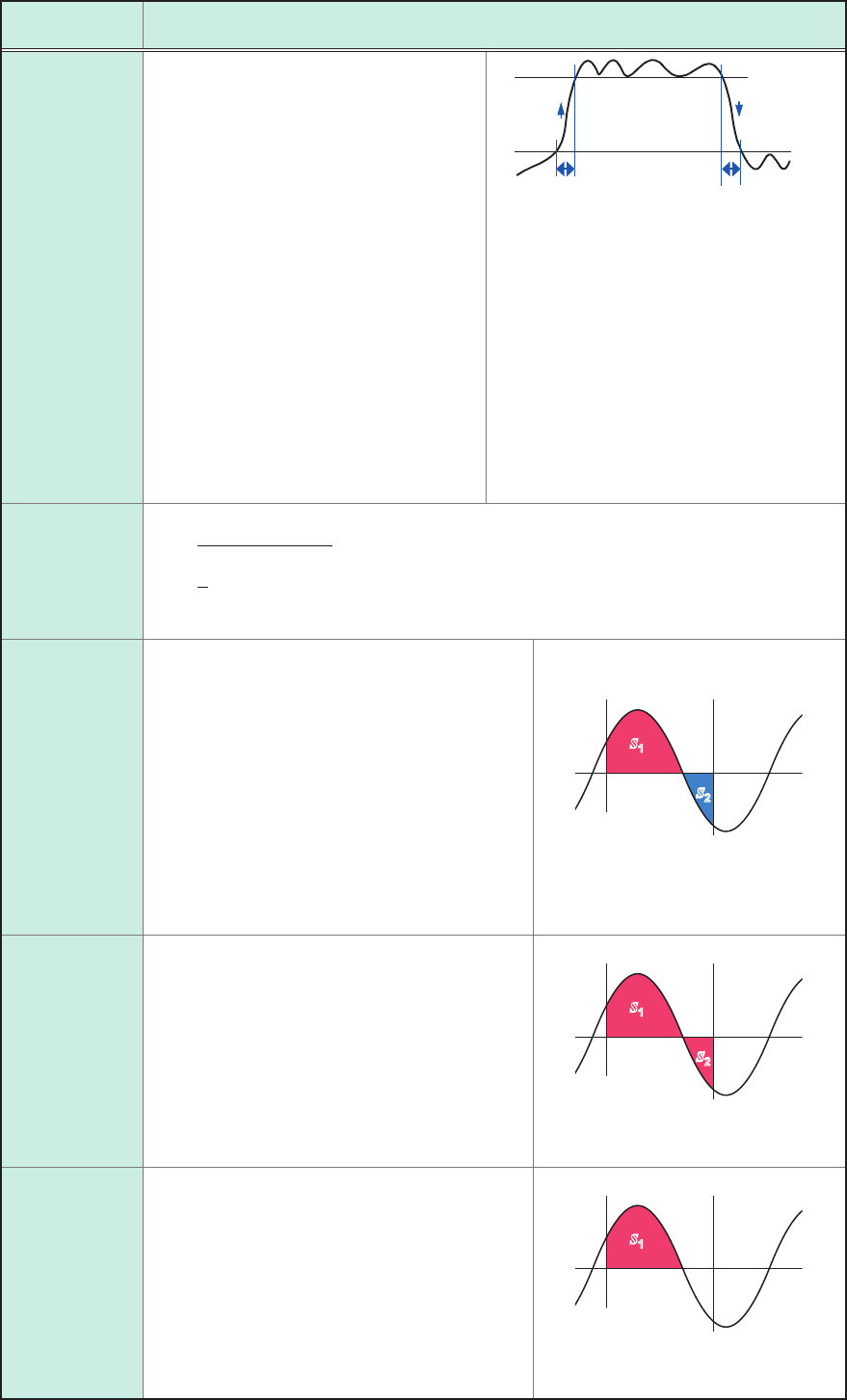
Rise time
Fall time
Calculates a A%-to-B% rise time (or a B%-
to-A% fall time; unit: s) based on the 0%
and 100% levels based on a histogram
(frequency distribution) of acquired
waveform data.
The instrument calculates a rise time (or
fall time) of the rst rising (or falling) slope
that appears in acquired waveform data.
When the range is specied, the
instrument calculates the rise time (or fall
time) of the rst rising (or falling) slope that
appears between the cursors.
The values of A and B can be specied
(unit: percent). The values of A and B
varies along with each other. When the
value of A is 5%, the value of B is specied
at 95%; when the value of A is 30%, the
value of B is specied at 70%.
Settings: Rise time (A% to B%) and Fall
time (B% to A%) values (%),
Stat.
B%
A%
Rise time Fall time
A: 5% to 30%
B: 95% to 70%
Standard
deviation
Calculates a standard deviation of waveform data.
σ
: Standard deviation
AV E
: Average value
n
: Number of data points
di
:
i
th data point acquired across the channel
Area
Method: Total
Calculates an area by subtracting an area (unit:
V·s) enclosed by the zero-level (zero-potential)
line and the negative-amplitude part of a signal
waveform from an area (unit: V·s) enclosed
by the zero-level (zero-potential) line and the
positive-amplitude part of the signal waveform.
When the range is specied, calculates the area
between the cursors.
S
: Area
n
: Number of data points
di
:
i
th data point acquired
across the channel
h
=
Δt
: Sampling interval
di • h
S =
∑
i = 1
n
s
1
sss
2
s
1
ss
2
Cursor A
Cursor B
S
=
s
1
−
s
2
Area
Method:
Absolute value
Calculates an area value (unit: V·s) enclosed by
the zero-level (zero-potential) line and a signal
waveform.
When the range is specied, calculates the area
between the cursors.
S
: Area
n
: Number of data points
di
:
i
th data point acquired
across the channel
h
=
Δt
: Sampling interval
|di| • h
S =
∑
i = 1
n
s
1
sss
2
s
1
ss
2
Cursor A
Cursor B
S
=
s
1
+
s
2
Area
Method:
Positive
(Only the
positive-
amplitude part)
Calculates an area enclosed by the zero-level
(zero-potential) line and the positive-amplitude
part of a signal waveform.
When the range is specied, calculates the area
between the cursors.
S
: Area
n
: Number of data points
di
:
i
th data point acquired
across the channel
h
=
Δt
: Sampling interval
di • h
S =
∑
i = 1, di > 0
n
s
1
s
1
Cursor A
Cursor B
S
=
s
1