3OM-996-005.pdf - 第147页
3 .8 Multi-Model Repetitive Patterns (1) Information on Pattern Program Creation • Example of Patterns The following multi-unit P .C.B. consists of three unit P .C.B.’s for Mod- els A, B, and C. Fig. 3B136 (2) Creation o…
3.7 Repetitive Patterns (Polar Coordinate
Conversion Function)
Follow the same procedure as described in "3.4 Repetitive Patterns
(Unit P.C.B. B.B.R. Enabled)" except for "Placement Data (O-data)".
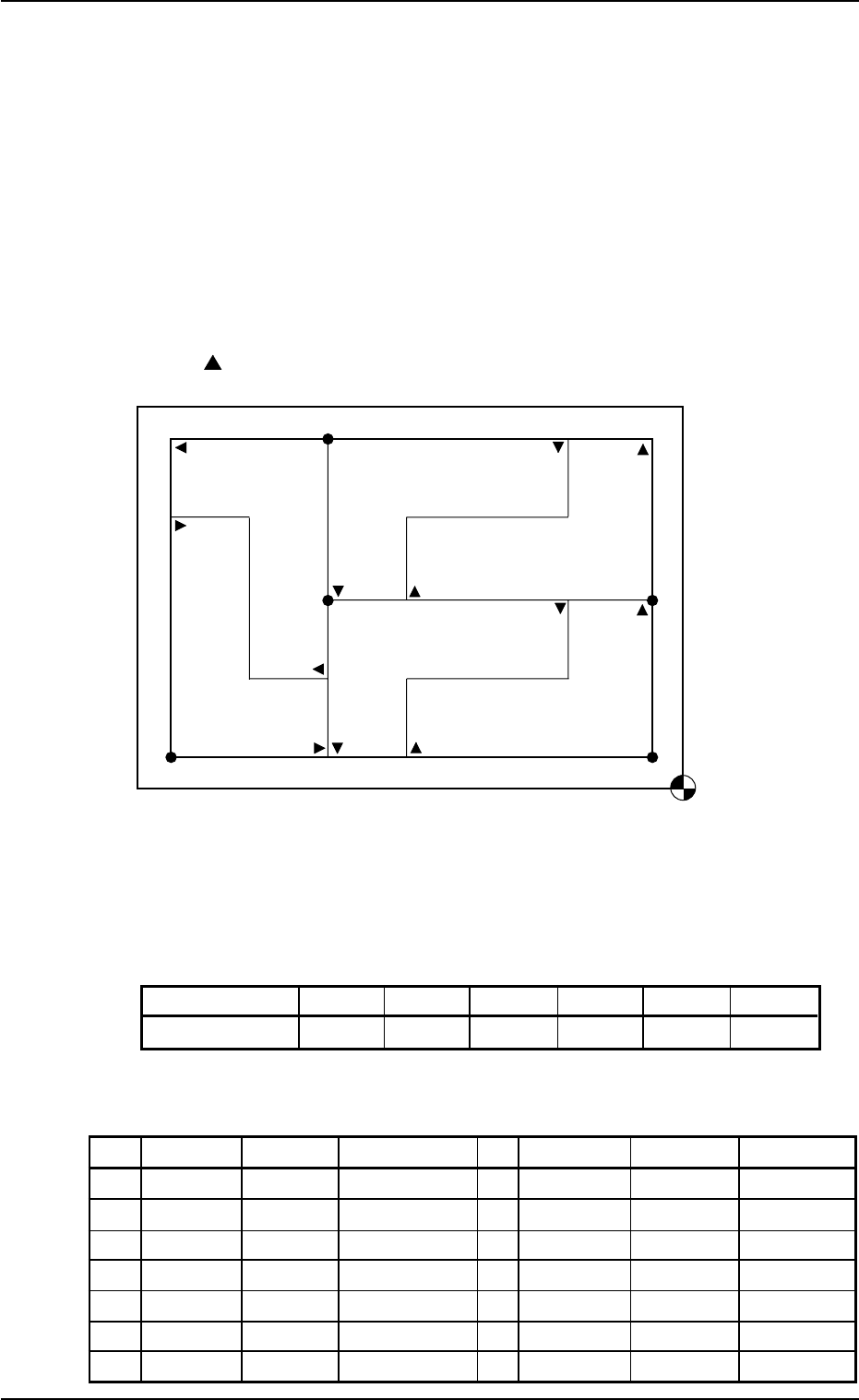
(1) Information on Pattern Program Creation
• Example of Patterns
Fig. 3B135
• Coordinates of Each Pattern Origin
Table 3B35
Pattern Origins O
1
O
2
O
3
O
4
O
5
O
6
Coordinates (X
1
,Y
1
)(X
2
,Y
2
)(X
1
,Y
2
)(X
2
,Y
3
)(X
2
,Y
3
)(X
3
,Y
1
)
(2) Creation of Placement Data (O-data)
Table 3B36
O-No. X [mm] Y [mm] Z = theta [deg] C Comment B-X [mm] B-Y [mm]
1
X
1
Y
1
+000.00 - +000.000 +000.000
2 X
2
Y
2
+180.00 - +000.000 +000.000
3 X
1
Y
2
+000.00 - +000.000 +000.000
4 X
2
Y
3
+180.00 - +000.000 +000.000
5 X
2
Y
3
+090.00 - +000.000 +000.000
6 X
3
Y
1
+270.00 - +000.000 +000.000
7 +000.000 +000.000 +000.00 E +000.000 +000.000
0305-001 2-77 AIM01EDTP
Placement Coordinate
Reference Point
O
4
O
1
O
3
O
2
O
6
Pattern 4 (180°)
Pattern 2 (180°)
Pattern 6
(270°)
Pattern 5
(90°)
Pattern 3 (0°)
Pattern 1 (0°)
O
5
is a fiducial mark.
Assume that Pattern 1 is "0°".
3.7 Repetitive Patterns (Polar Coordinate Conversion Function)
3.8 Multi-Model Repetitive Patterns
(1) Information on Pattern Program Creation
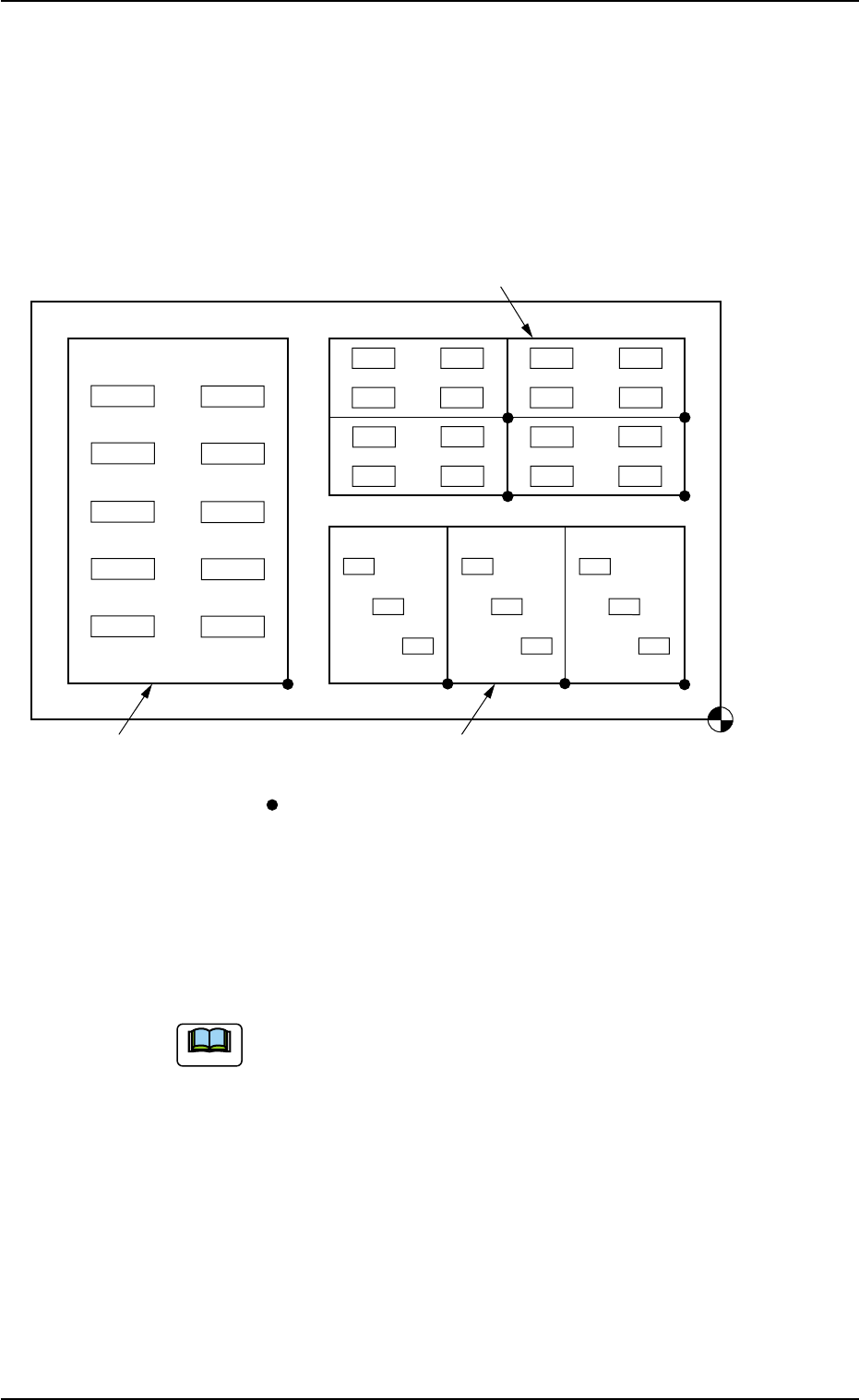
• Example of Patterns
The following multi-unit P.C.B. consists of three unit P.C.B.’s for Mod-
els A, B, and C.
Fig. 3B136
(2) Creation of Operation Data
Follow the same procedure as described in "3.1 Single Pattern".
Note: The created data is commonly used for Models A, B, and C.
When the P.C.B. B.B.R. detection function (option) and the
P.E.C. recognition function are used, be sure to set correct
parameters for each function.
(3) Creation of Placement Feeder Location Data
Follow the same procedure as described in "3.1 Single Pattern".
Note: The created data is commonly used for Models A, B, and C.
0305-001 2-78
AIM01EDTP
Placement Coordinate
Reference Point
Model C Model A
Model B
(OX
1
,OY
1
)
( signs are pattern origins.)
3.8 Multi-Model Repetitive Patterns
Note
(4) Creation of Placement Data
• Model A
A program must be created such that the machine places compo-
nents repeatedly on three identical patterns.
Follow the same procedure as described in "3.3 Repetitive Patterns".
(a) It is required to create the following placement data.
• Placement Data (P-data) U01
• Placement Data (O-data) U01
(b) Each pattern origin (coordinates) must be based on the
placement coordinate reference point.
• Model B
A program must be created such that the machine places compo-
nents repeatedly on four identical patterns.
Follow the same procedure as described in "3.3 Repetitive Patterns".
(a) It is required to create the following placement data.
• Placement Data (P-data) U02
• Placement Data (O-data) U02
(b) Each pattern origin (coordinates) must be based on the
placement coordinate reference point.
• Model C
Although this is a single pattern, follow the same procedure as de-
scribed in "3.3 Repetitive Patterns" to create placement data in place
of a single pattern program.
It is required to create the following placement data.
• Placement Data (P-data) U03
• Placement Data (O-data) U03
Refer to the following example.
Example of Placement Data (O-data) U03
Table 3B37
O-No. X [mm] Y [mm] Z = theta [deg] C Comment B-X [mm] B-Y [mm]
1 OX
1
OY
1
+000.00 - +000.000 +000.000
2 +000.000 +000.000 +000.00 E +000.000 +000.000
0305-001 2-79 AIM01EDTP
3.8 Multi-Model Repetitive Patterns
Note
Note
Note