3OM-996-005.pdf - 第332页
0510-001 5-47-2 AIM01EDTP 3.3 "Auto Operation" T ab Sampling Bias Compared with "Standard", it is possible to set larger follow-up and sensitivity coefficients of the first and second corrections (fix…
3.3 "Auto Operation" Tab
Mode
"Standard", "Bias", or "Sampling Bias" can be selected.
Standard
Only the normal auto feeder axis adjustment is performed.
Bias
Compared with "Standard", it is possible to set larger follow-up
sensitivity coefficients of the first and second corrections made
after component replacement.
First Follow-Up
Mean of Deviations (Corrected Values) as Results of n-Time Component Recognitions ×
(((X)
adjustment [%] , (Y) adjustment [%]) + (Bias coefficient (X) [%], Bias coefficient (Y) [%]))
Second Follow-Up
Mean of Deviations (Corrected Values) as Results of n-Time Component Recognitions ×
(((X) adjustment [%] , (Y) adjustment [%]) + (Bias coefficient (X) [%], Bias coefficient (Y) [%])/2)
(a) As for the third and subsequent follow-ups, the de-
viations are the same as those in the standard
specifications.
(b) The result of the 1-time component recognition is
adopted only when "n" is set as "1" (n = 1).
(c) When the coefficients "((X) adjustment [%] , (Y) ad-
justment [%]) + (Bias coefficient (X) [%], Bias coef-
ficient (Y) [%])" or "((X) adjustment [%] , (Y) ad-
justment [%]) + (Bias coefficient (X) [%], Bias coef-
ficient (Y) [%])/2" are calculated to be "more than
100%", they are regarded as "100%".
Note
0510-001 5-47-1 AIM01EDTP
0510-001 5-47-2 AIM01EDTP
3.3 "Auto Operation" Tab
Sampling Bias
Compared with "Standard", it is possible to set larger follow-up
and sensitivity coefficients of the first and second corrections
(fixed) made after component replacement.
The follow-ups can be set more sensitive than "Bias".
First Follow-Up
Deviation (Corrected Values) as Result of 1-time Component Recognition ×
(((X) adjustment [%] , (Y) adjustment [%]) + (Bias coefficient (X) [%], Bias coefficient (Y) [%]))
Second Follow-Up
Mean of Deviations (Corrected Value) as Results of 2-time Component Recognitions ×
(((X) adjustment [%] , (Y) adjustment [%]) + (Bias coefficient (X) [%], Bias coefficient (Y) [%])/2)
(a) As for the third and subsequent follow-ups, the de-
viations are the same as those in the standard
specifications.
(b) When the coefficients "((X) adjustment [%] , (Y) ad-
justment [%]) + (Bias coefficient (X) [%], Bias coef-
ficient (Y) [%])" or "((X) adjustment [%] , (Y) adjust-
ment [%]) + (Bias coefficient (X) [%], Bias coeffi-
cient (Y) [%])/2" are calculated to be "more than
100%", they are regarded as "100%".
Bias coefficient (X) [%]
Set the value of the follow-up bias coefficient (X).
Bias coefficient (Y) [%]
Set the value of the follow-up bias coefficient (Y).
Note
0510-001 5-47-3 AIM01EDTP
3.3 "Auto Operation" Tab
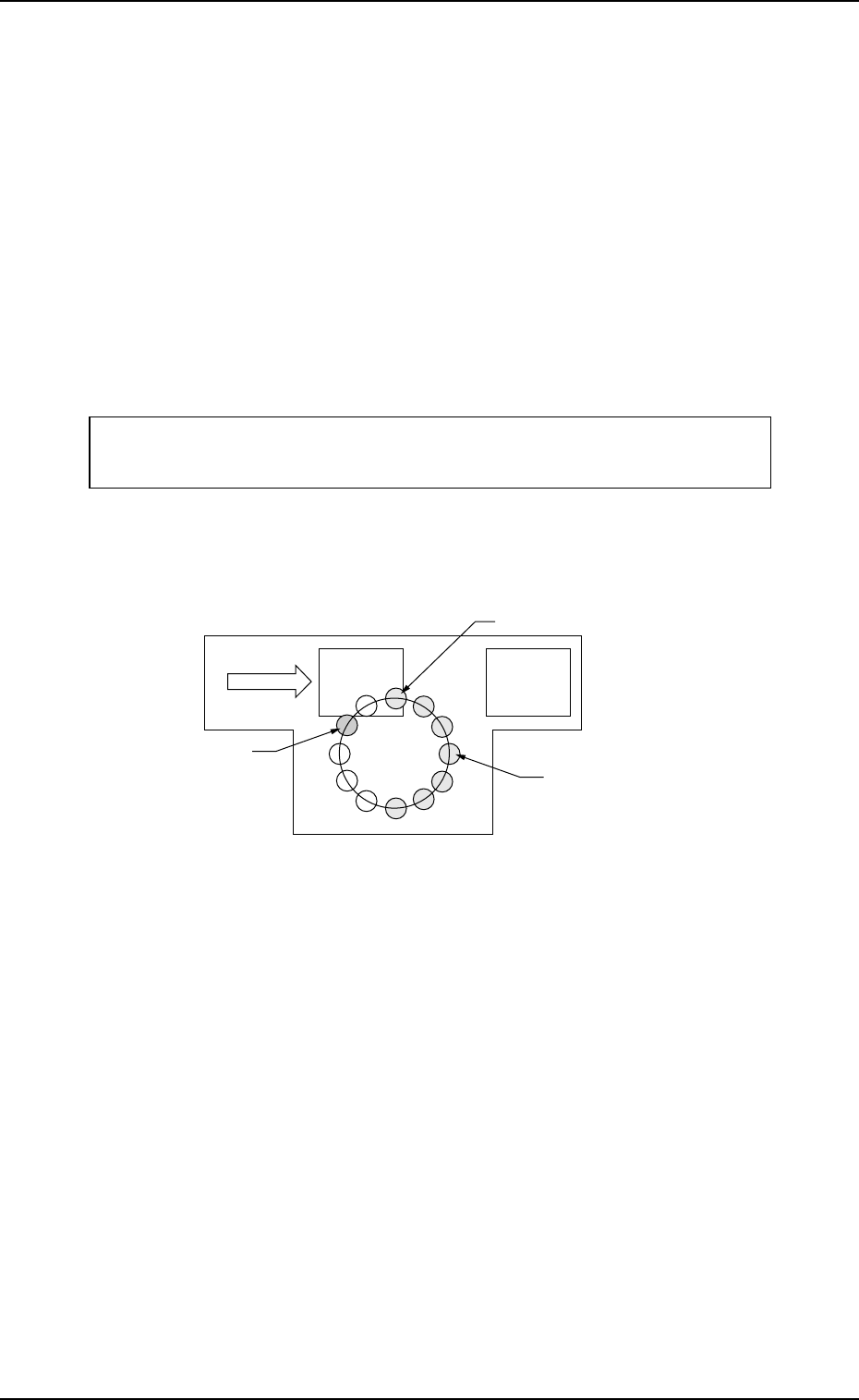
• Example of "Bias"
Setting of Operation Parameters
# of picks [times] = 3, (X) adjustment [%] = 50,
(Y) adjustment [%] = 50
Mode = Bias, Bias coefficient (X) [%] = 40,
Bias coefficient (Y) [%] = 40
First Follow-Up after Component Replacement
The deviations are measured based on the component recogni-
tions that were performed as frequently as the number of com-
ponent picks (3 times = number of samples) after component
replacement.
Mean of Deviations as Results of 3-time Recognitions ×
90% (50% + 40%) = Calculation of First Corrected Value
This "First Corrected Value" is reflected on the pickup motions
taken subsequently after "Next" in the figure.
1
2
3
Next
Fig. 3E44-1
Component
Recognition
Component Pickup