OperationInstruction_Vsision XP.pdf - 第26页
Page 18 Vision XP+ V AC 2 Opera ting Safety 2.7 Impo rtant Note Regarding Operation Safety Operating Instructions V ersion 1.5 2.7.3 Danger of high voltage Check for no voltage before working on ele ctrical parts of the …
Vision XP+ VAC Page 17
2 Operating Safety
2.7 Important Note Regarding Operation Safety
Operating Instructions
Version 1.5
2.7.1 Sources of danger and hazard zones
Potential sources of danger include:
• Mechanical hazards
• Electrical hazards
• Hazards of hot surfaces
• Hazards posed by gases and pressurised liquids
• Hazards posed by materials and substances, including explosive atmo-
spheres
These may occur predominantly inside of the plant.
Mechanical hazards will also occur during transportation and erection of
parts of the plant.
Hazards posed by evaporating and leaking substances may also occur in
the vicinity of the plant.
2.7.2 Hazards posed by mechanical energy
Danger!
Parts may fall or topple when subassemblies are moved during transporta-
tion. Risk exists of life-threatening injury or even death.
• Keep clear of suspended loads!
• Only trained staff are allowed to handle the transport. No other persons
are allowed in the danger zone.
• Use suitable measures to prevent loads from toppling over or falling
when in transport.
• Be sure that the load capacity of your lifting equipment and transport ve-
hicles will be adequate.
• Transport staff should be 18 years of age or older.
• Use safety apparel such as hardhats, gloves and safety shoes.
Warning!
When maintenance work is carried out when the doors on the front cabinet
are open, moving parts of the conveyor system present a risk of injuries.
• Switch off the plant first and secure against accidental switch-on.
• Do not reach into moving parts before switching off.
Page 18 Vision XP+ VAC
2 Operating Safety
2.7 Important Note Regarding Operation Safety
Operating Instructions
Version 1.5
2.7.3 Danger of high voltage
Check for no voltage before working on electrical parts of the plant. Be sure
to follow the five basic safety rules:
• Isolate.
• Secure against accidental switch-on.
• Check for no voltage.
• Earth and short.
• Cover or shield adjacent live parts.
2.7.4 Hazards from pneumatic energy
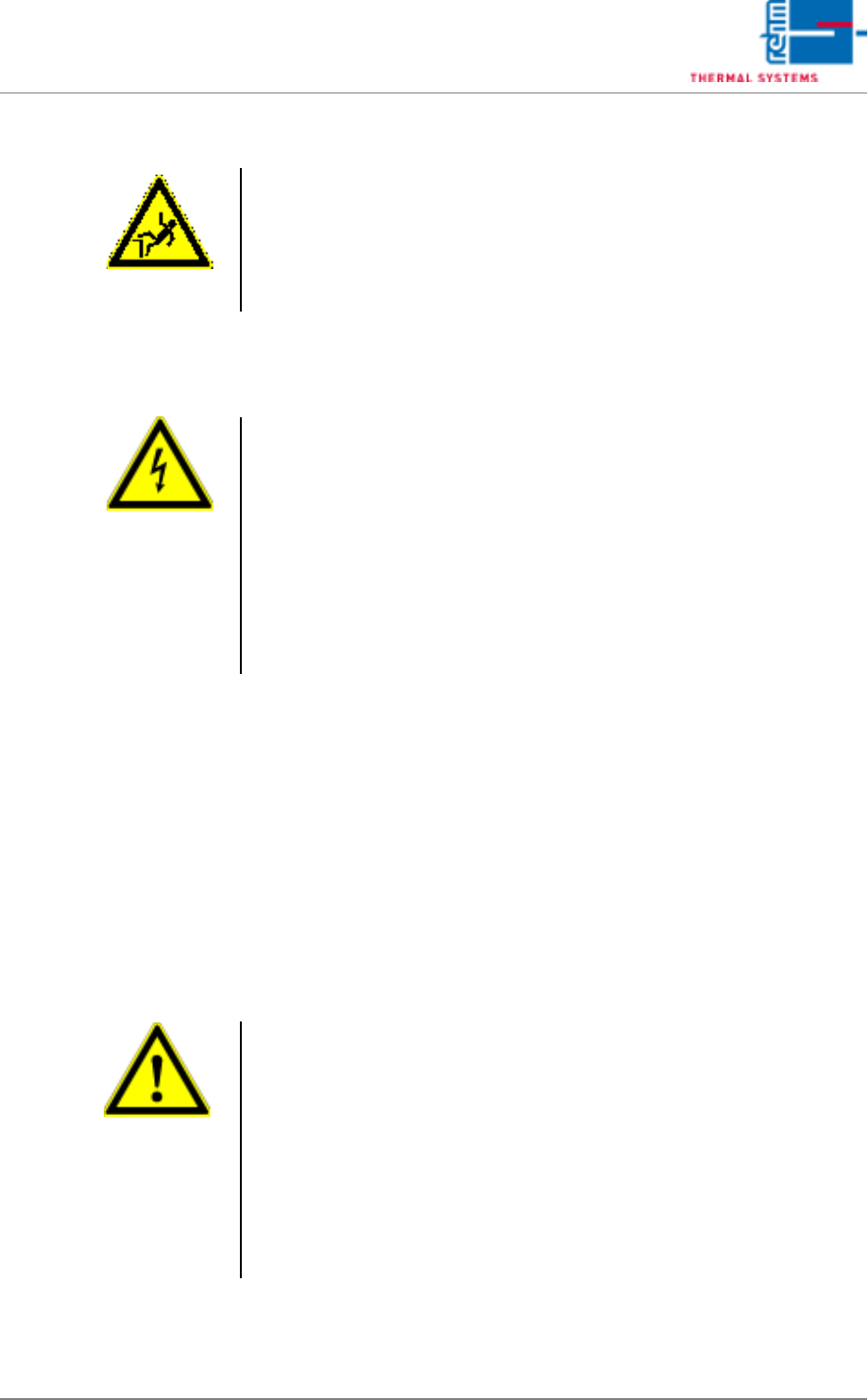
Warning!
There is a hazard of losing balance and falling when working in upper sec-
tions of the plant that cannot be reached from floor level.
• Use suitable climbing aids and fall protection. These must be provided by
the owner of the plant.
Danger!
The plant operates on electrical power. When operating electrical equip-
ment, certain parts will necessarily be at high voltage.
• Work on electrical equipment and the switchgear cabinet may only be
carried out by qualified technicians in cognisance of regulations and
guidelines applicable on site.
• Isolate the plant from mains supply before working on electrical compo-
nents!
• Switch off the plant first and secure against accidental switch-on.
Warning!
Pneumatic systems are pressurised. When used improperly, they can
break and cause serious accidents.
• Only those with specialist knowledge and experience in pneumatics may
work on pneumatic equipment.
• All pneumatic hoses must be checked for leaks and damage before work
is commenced on them.
• Do not undo or tighten any screwed connections with the system
switched on..
Vision XP+ VAC Page 19
2 Operating Safety
2.7 Important Note Regarding Operation Safety
Operating Instructions
Version 1.5
2.7.5 Danger due to pressurised liquids
2.7.6 Danger of high temperatures
Warning!
Excess pressure can cause the external or internal coolant circuit's lines to
leak or burst. Connectors can come loose.
• Only experienced staff may work on the cooling system.
• Coolant hoses and lines must be checked for leaks and damage before
work is commenced.
• External coolant connection pressure and internal coolant circuit pres-
sure must be checked before work is commenced.
• Do not undo or tighten any screwed connections with the system
switched on.
Warning!
Danger of burning by hot ambient and extracted air.
Danger of burns on hot surfaces such as electrical elements, hot materials,
hot PCBs and their carriers and hot pipes carrying ambient and waste air.
• Switch off the heater and allow the Vision XP+ VAC to cool down before
working on hot parts or pipes carrying ambient or waste air.
• When working on the conveyor system or at the cooling system, be
aware that the stacked racks or PCBs may be hot.
• Use protective gloves if necessary.