SIPLACE Station Software 7xx to 714 介绍.pdf - 第218页
Station Software 7xx to 714.0 (R20-2) / Feature Description 11/2020 Edition 218 Following settings are avail able for the special position evaluation: Setting Evaluation Default Default value, normal evalu ation (X, Y, a…
Station Software 7xx to 714.0 (R20-2) / Feature Description 11/2020 Edition
217
Stereo Measurements for pins
This option can be enabled if a multiple measurement is required for an OSC component. For each
measurement, two images are taken offset to each other in X-direction. Through stereo matching, a
height image will then be computed from these two images (i.e. the distance to the camera can be
computed for each pixel in the images).
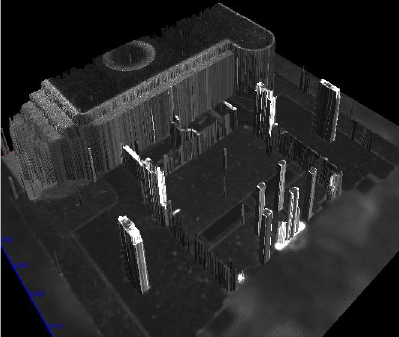
Example
Figure 11-3: 3D display of the stereo measurement height image
If stereo measurement is enabled or the Edit parameter button has been pressed, a dialog box
opens in which illumination and traversing path can be set.
The option can only be enabled for stationary cameras of the types 25 and 33 (and thus for Twin
and CPP placement heads only) with the following restrictions:
Camera type 25: minimum feature size = 75 µ
Camera type 33: minimum feature size = 200 µ
The measurement of THT components (Through Hole Technology) with 2 or 3 pins is handled as a
special case. If a component contains 2 or 3 connectors of the types THT round pin or THT
square pin and no other feature groups are available, an automatic measuring process will be
performed during the stereo measurement.
Special Position Evaluation
For OSC components it is often difficult to find the X-/Y-position and determine the rotation of a
component by using the same feature. Therefore, a new function has been introduced that allows
using one feature for the X-/Y-alignment and another one for the rotational alignment.
The new Alignment attribute is displayed as parameter of the respective feature group on the GUI.
The attribute is only visible in SIPLACE Vision.
Station Software 7xx to 714.0 (R20-2) / Feature Description 11/2020 Edition
218
Following settings are available for the special position evaluation:
Setting
Evaluation
Default
Default value, normal evaluation (X, Y, angle)
Do not use
Group is not used to determine the component position (but for inspection)
Angle
Group is only used to determine the angle
X and Y
Group is only used for X and Y, not for the angle
X
Group is only used for X, not for Y and angle
Y
Group is only used for Y, not for X and angle
X and angle
Group is only used for X and angle, not for Y
Y and angle
Group is only used for Y and angle, not for X
The X- and Y-coordinates always refer to the component coordinate system.
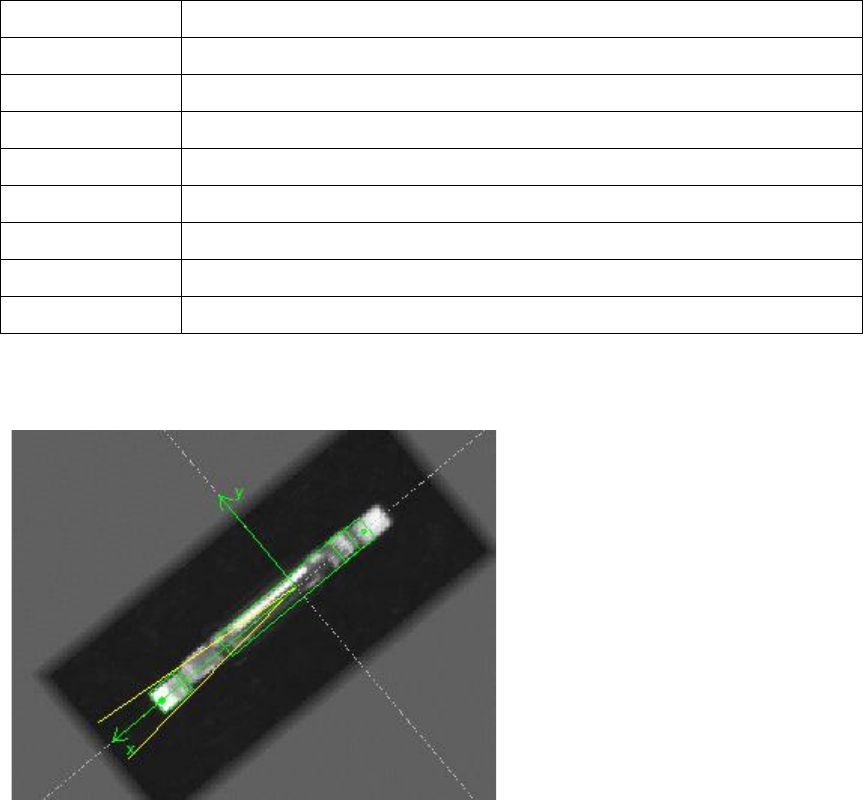
Example
Figure 11-4: Alignment of a twisted pin
The pin shall be placed so that the connector to the left is precisely positioned on the pad even if
the pin length differs from the target. The angle results from the angle between the two ends.
Model:
Alignment for the connector to the left is Default because it shall be used for X, Y and angle.
Alignment for the connector to the right is Angle because it shall only be used to determine the
angle.
Thus, the angle from the two connectors will be determined at first. Then the position will be
determined so that the component is only aligned by the connector to the left.
11.5.2 Increased Placement Force of Twin VHF
The placement force has been increased from 70 N to 100 N for the Twin VHF placement head
with item no. [03096701-03]. The cool down time calculation has been adapted for the new range
from 70 N up to 100 N.
Placements with a force greater than 70 N are not supported on stations with software versions
< 710 and Twin VHF placement heads with a functional status < [-03]. Such placements will be
forced onto stations with station software version >= 710 by SIPLACE Pro.
Station Software 7xx to 714.0 (R20-2) / Feature Description 11/2020 Edition
219
11.5.3 Improved Placement of Snap-In Components
The feature for placement of snap-in OSC components has been improved. With this feature, the
system can check whether the pins of such components are "snapped-in", i.e. completely inserted.
The actual Z-axis position of every snap-in placement will be compared with its corresponding
height reference value. These values must match each other. It is recommended to set support
pins close to the snap-in placement positions.
The snap-in placement process must be enabled for the component shape in SIPLACE Pro.
Additionally, the snap-in threshold that will be used for comparing the two values has to be
specified in mm.
After the first board has been completely produced, it will be transferred to the output section or the
configured inspection location and marked for manual inspection. The operator must inspect every
snap-in placement position and confirm whether the placement is correct or not. If correct, the
corresponding Z-axis position will be stored as reference position and used as placement position
for all subsequent boards. If not correct or if subsequent boards are already produced before the
height reference values have been taught, the measured height will be ignored, and the operator
must confirm the height whenever the next component is placed.
The height reference values are not uploaded to SIPLACE Pro. Thus, when the job at the
placement machine is changed or the machine is shut down, the height reference values must be
taught again.
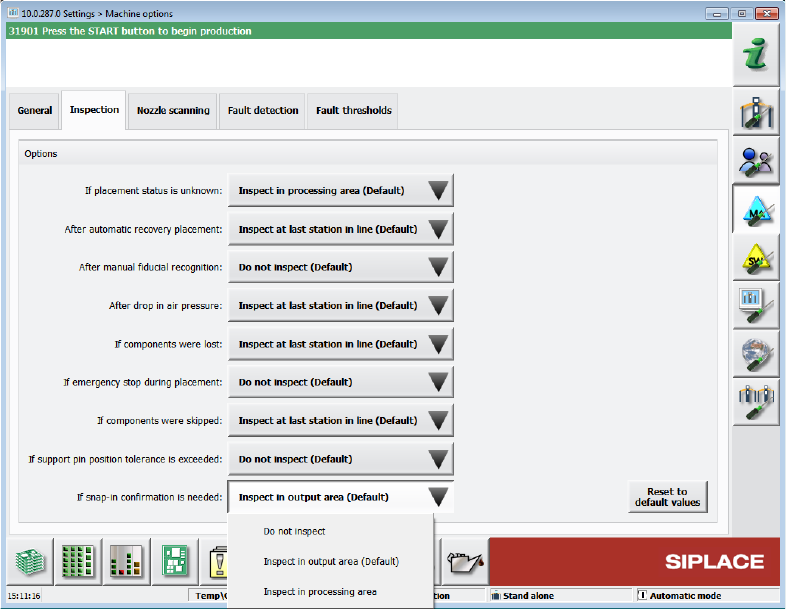
The position where the operator can inspect the board is configurable under Machine options –
Inspection – If snap-in confirmation is needed. Default option: Inspect in output section.
Figure 11-5: If snap-in confirmation is needed