SIPLACE Station Software 7xx to 714 介绍.pdf - 第59页
Station Software 7xx to 714.0 (R20-2) / Feature Description 11/2020 Edition 59 6.24 Machine Behavior at Cover Foil Torn In previous station software versions t he placement heads get sto pped when a cover foil torn occur…
Station Software 7xx to 714.0 (R20-2) / Feature Description 11/2020 Edition
58
6.22 Maintenance Due Status for C&P20A Placement Head and SX
Main Axes
As of this station software version, the maintenance due status can be calculated for the C&P20A
placement head and the SX main axes. The maintenance due status of the single components is
displayed in the Maintenance due status view on the GUI and informs about the maintenance due
date for the component.
6.23 Optimized Display and Format of Warnings / Alarms
The display and format of warnings / alarms have been optimized. Only the absolutely necessary
warnings are displayed in the status area on the GUI. Warnings / alarms are collected in a new
view. With this information problems that occurred on the machine in the last few days can be
specifically solved before a planned maintenance.
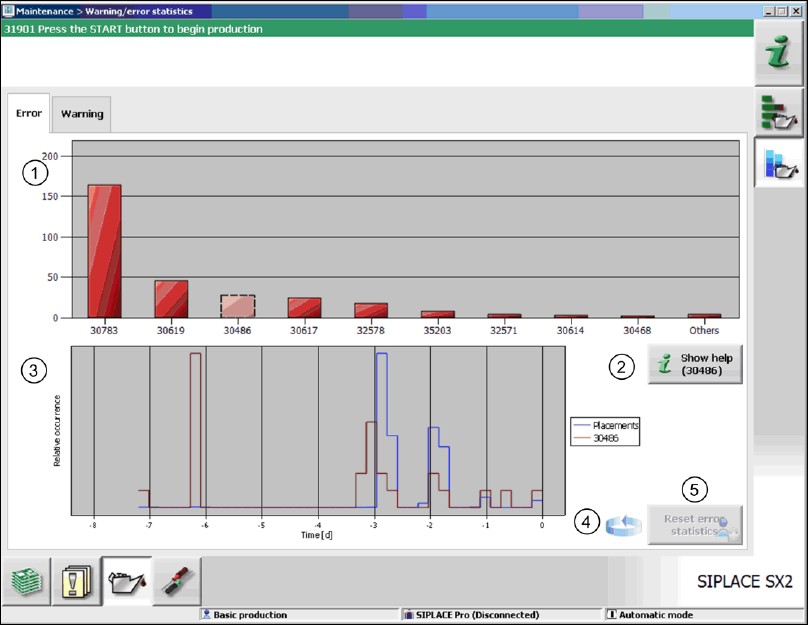
The collected warnings and alarms are displayed on the GUI in the Maintenance view.
Figure 6-7: Statistics for warnings / alarms
In the upper part of the view, the ten most frequently occurred alarms / warnings are displayed (1).
After an error number has been selected in the diagram, the corresponding online help can be
accessed via the Show help button (2).
In the lower part of the view, the characteristics for the occurrence of the selected error message
are roughly displayed (red graph) in relation to the placement performance (blue graph) for the
observation period (3).
By clicking on the rotating arrow (4) a table appears, in which the assignment of the selected
messages to the messaging sub-systems is displayed. Thus the operator can easily find out where
they arose.
Old entries are automatically removed from the statistics. If necessary, the operator can reset the
statistics explicitly via the Reset error statistics button (5) as of the Machine service activity
level.

Station Software 7xx to 714.0 (R20-2) / Feature Description 11/2020 Edition
59
6.24 Machine Behavior at Cover Foil Torn
In previous station software versions the placement heads get stopped when a cover foil torn
occurs and this always causes a machine stop. As of this station software version the machine
behavior has been specifically configured for the placement heads as follows:
C&P20A Machine stop
Twin Head No machine stop
CPP No machine stop
C&P12 No machine stop
Features for the DX-Series (V705.03)
The station software supports the new DX1/DX2 and DX4 placement machines that are based on
the corresponding SX1/SX2 and SX4 placement machines. The features of the 705.03 station
software version for the DX-series are listed in the sections 6.25 to 6.29.
6.25 General
The DX1/DX2 placement machines differ from the SX1/SX2 placement machines as follows:
– B C&P12 placement head instead of CPP placement head.
– The 27x27 reject bin and the left reject channel fail.
– If two C&P12 placement heads exist, there are two machine zero points.
– If the placement head shall be omitted via the configuration, it must be selected in the Auto-
configuration, whether the omitted placement head is a Twin Head/C&P20A or a C&P12.
– Support of DX-tables and changeover tables.
– The DX1/DX2 placement machines cannot be upgraded with regard to the number of gantries.
The number of gantries is already selected during the software installation and is not part of the
Auto-configuration.
During the first booting after installation of the station software, the following options must be
selected manually in the Auto-configuration fort he DX-series placement machines:
– For the C&P12 placement head: height position (altitude)
– Lamp indicator (two-colored or three-colored)
– Table positions:
60 slots (inner position)
60 slots (outer position)
30 slots (outer position) with 30 slots + free location for tray or WPC
NOTICE
– No upgrade from DX to SX!
– No head or gantry modularity, i.e. no remodeling is performed from one head or
gantry type to another in the field.
Station Software 7xx to 714.0 (R20-2) / Feature Description 11/2020 Edition
60
6.26 Supported Placement Heads
The station software supports the C&P12, C&P20A and Twin Head placement heads on the DX-
series placement machines. The DX1 placement machine is delivered with one of these placement
heads optionally. The DX2 placement machine is delivered with the optional placement head
configurations C&P12/C&P12, Twin Head/C&P12, C&P12/C&P20 or C&P20A/C&P20A. The DX4
placement machine is delivered with the C&P20A placement head (4x).
6.26.1 C&P12 Placement Head
Detailed information on the new C&P12 placement head (service positions, nozzle changer
configurations etc.) can be found in the User Manual to SX1/SX2 and DX1/DX2 (as of 705).
6.27 Conveyor Types for DX-Series
Analog to the conveyor for the SX1/SX2 placement machines, the conveyor for the DX1/DX2
placement machines consists of the following three sections: input section, placement section and
output section.
The conveyor for the DX4 placement machine consists of the following five sections: input section,
placement section 1, intermediate section, placement section 2 and output section.
For the DX-series placement machines solely the single lane conveyor is supported. The fixed rail
of the single lane conveyor can be mechanically mounted at several positions. Other features, such
as transporting boards, width adjustment, loading boards into the input section via the GUI are
identical to the conveyor types for the SX-series.
6.28 Support of Long Boards on DX4
The Long Board option is supported for the DX-series placement machines in the same way as for
the SX-series placement machines but up to 550mm length, see section 6.4.
6.29 DX-Table for DX-Series
The DX-table consists of a part that is fixed installed in the machine and has the same mechanical
interfaces as the changeover table and is screwed together with the machine frame as well. The
upper part of the table can be removed from the machine.
Just every second slot is equipped with an EDIF interface (EDIF = Electronic Design Interchange
Format). Thus, feeders may only be placed on the odd track numbers between 1 and 60 and no
even track numbers are displayed on the GUI.