SIPLACE Station Software 7xx to 714 介绍.pdf - 第94页
Station Software 7xx to 714.0 (R20-2) / Feature Description 11/2020 Edition 94 The input and output sectio ns are shorter than on previous SI PLACE conveyor systems and there is no space to buffer boards in these section…
Station Software 7xx to 714.0 (R20-2) / Feature Description 11/2020 Edition
93
7.28 SIPLACE X-Series S – X3 S, X4 S, X4i S Placement Machines
Compatible mode: Not supported
The station software supports the X3 S (with three gantries), X4 S and X4i S (with four gantries)
placement machines of the new SIPLACE X-series S. The X4i S resembles the X4i and the X4 S
resembles the X4 placement machine. The only difference between the X3 S and the X4 S
placement machines is that gantry 2 fails for the X3 S and consequently, it resembles an X3
placement machine.
For the X4i S it is necessary to define the table position (inner and outer) in the Auto Configuration.
For the X3 S and X4 S, only the outer table position is supported.
To minimize the distance between feeder and conveyor, the small calibration tool holder with a
small calibration tool device is used for the CPP placement head. However, if a stationary camera
is used simultaneously, the big calibration tool device with the corresponding calibration tool holder
still must be used.
Smart Pin Support is supported. Each gantry must be equipped with a pin picker if Smart Pin
Support is used.
The new conveyor system for the SIPLACE X-series S is supported.
7.29 New Conveyor System for SIPLACE X-Series S
Compatible mode: Not supported
A new conveyor system has been introduced for the SIPLACE X-series S placement machines.
The conveyor system consists of five sections: input section, processing section 1, intermediate
section, processing section 2, output section and supports single and dual conveyor lane mode.
Station Software 7xx to 714.0 (R20-2) / Feature Description 11/2020 Edition
94
The input and output sections are shorter than on previous SIPLACE conveyor systems and there
is no space to buffer boards in these sections. For this, the following solutions are possible:
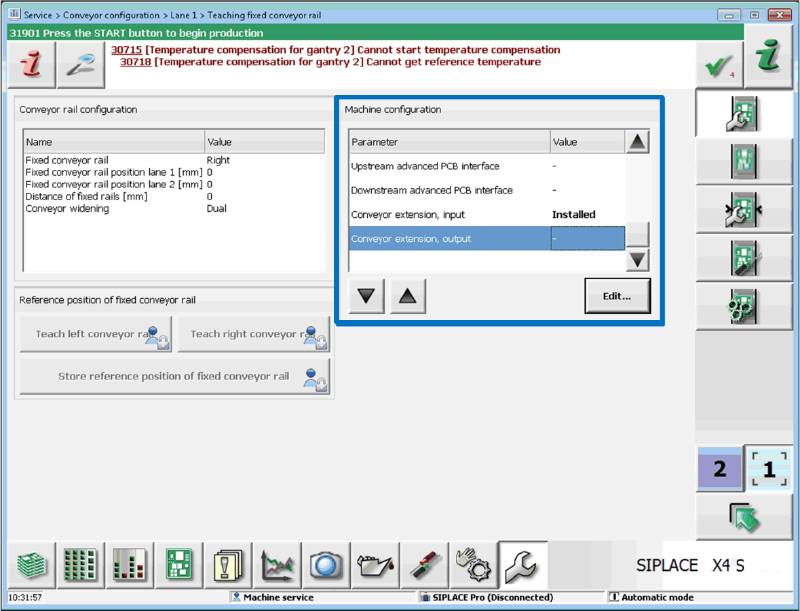
1. Input or output extensions can be optionally installed.
The behavior is then the same as for the SX4 conveyor system.
On the Machine Service activity level, the user must make the appropriate settings in the
hardware options, whether extensions are installed or not.
Figure 7-29: Setting pre-installed extensions
If necessary, the speed of the conveyor belts to hand over the boards from one machine to the
next one must be modified (under Conveyor speed parameters).
2. Using an overlapping buffer (possible for X3 S, X4 S and X4i S placement machines only).
If the placement machines stand in a line the input and output sections of both machines can
be used together as a buffer for a standard board.
For this, the new SIPLACE Interface must be installed (i.e., installing the corresponding cable).
A board that lies in the buffer area between two placement machines is displayed on the GUI in
the succeeding machine only.
3. Further line equipment (oven) can be installed behind the X3 S, X4 S or X4i S placement
machines.
In this case the board is treated like a long board. I.e., when the board enters the machine or is
moved to the output section, it occupies the placement area.
Belts in front of the placement machine do not have any special effect except that the board
does not enter the machine until the placement area is cleared.
In single conveyor lane mode there is one fixed and one flexible rail. The fixed rail can be installed
at different positions. In dual conveyor lane mode, all four rails are flexible, variable fixed rail
positions are possible.
The maximum board length is 450 mm without the Long Board option. The maximum board width
results from the fixed rail position and the conveyor mode (dual or dual as single). The maximum
board thickness is 6.5mm with the Thick Board option.

Station Software 7xx to 714.0 (R20-2) / Feature Description 11/2020 Edition
95
Light barriers are installed as stoppers for the board at fixed positions in the conveyor system: one
light barrier for each conveyor segment (input belt, processing areas, intermediate belt, output
belt). When the Long Board option is used, no additional light barrier is installed, but the offset is
configured/modified only. The board is then moved forward until it lies with the rear edge at the
stop position defined by the offset.
There is no mechanical stopper.
7.30 Placement of Tall Components with Very High Force Pick&Place
Head and WPC5 / WPC6
Compatible mode: Not supported
As of this station software version, components up to a height of 30mm can be placed with a force
of 70 N. The WPC5 can transport such components as of serial number 1485, the WPC6 as of
serial number C1486.
NOTICE
WPC6 – Tall Components as of Level 4 Only!
Due to the refill module, components > 25 mm cannot be positioned on the levels 1 – 3
and 27 – 28 on the WPC6. The levels 4 – 28 will be set up automatically by the SIPLACE
Pro Optimizer. The levels 1 – 3 must be blocked manually by the operator.
For this purpose, the new Very High Force Pick&Place Head (named VHF P&P head in the
following) has been developed. The VHF P&P head is derived from the existing Twin Head but has
one segment only.
The VHF P&P head is supported on the SX1/SX2 V2 placement machine. In addition, a PCB
camera is needed that is installed at another, higher position.
The VHF P&P head and the camera model (SST 34 H) are automatically detected in the Auto
Configuration.
For placement with the mentioned maximum values, there is a new short nozzle type: 508. It is
based on nozzle type 518 but is shorter. Nozzle type 508 can also be used by the Twin Head.