CP7 Series Level3 Tutorial Manual.pdf - 第97页
4.3 T raining Evaluation Circle the most appropriate answer from the list below. (1) Which of the following statements about RQ-axis is true? a. The RQ-motor is responsible for returning each nozzle head to their origina…
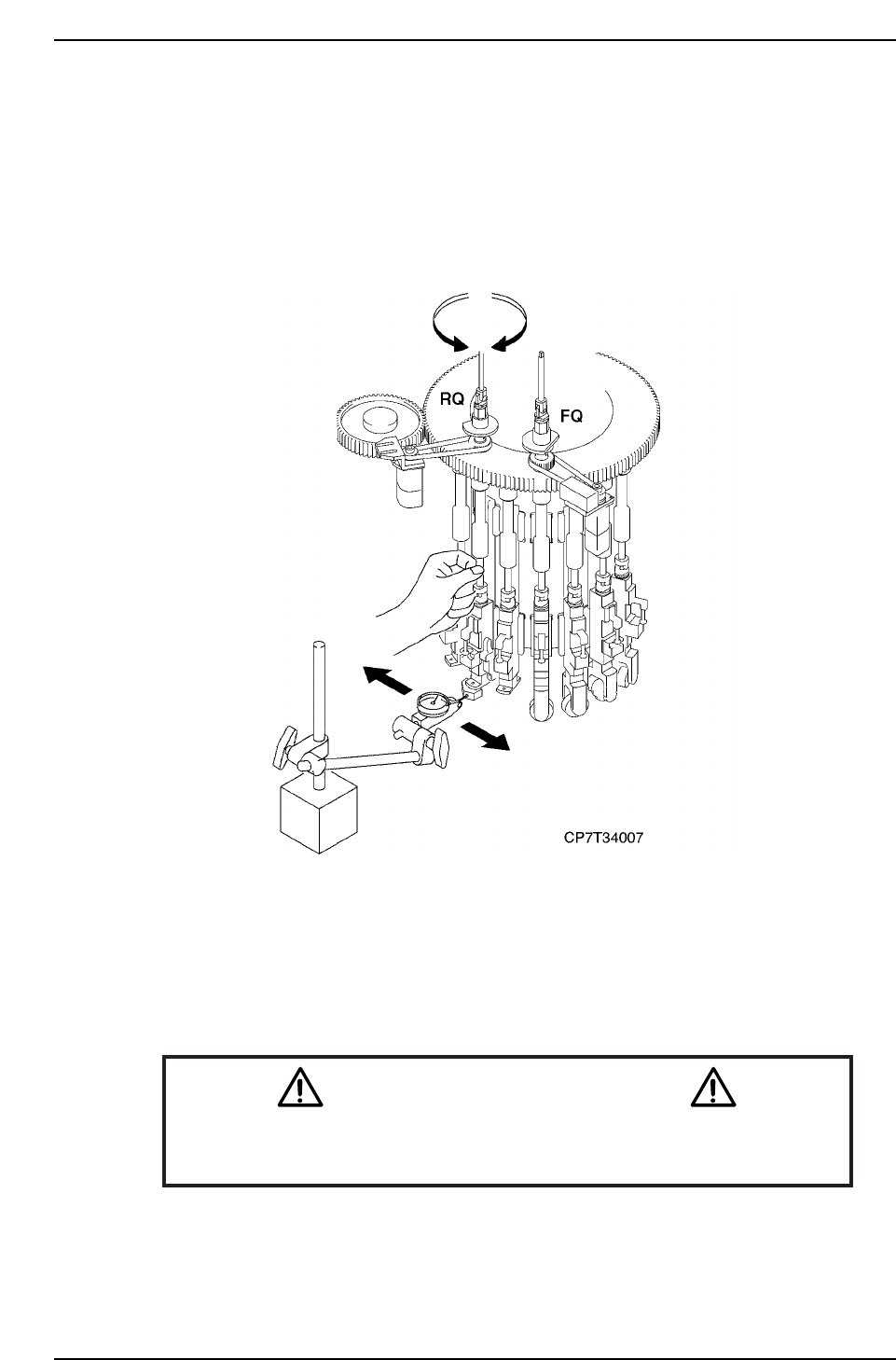
5. Reduce the inching speed and inch the dial needle across the surface of
the dial gauge as shown above. Inch the respective Q-axes at 1% speed
until there is no deflection on the dial gauge from one side of the jig
surface to the other.
Note: As the inching speed on the CP-7-series machines is faster than that of its predecessors, it
may be necessary to inch the axis manually by rotating the shaft until the jig surface is
perfectly parallel with the X-axis.
6. Once the jig is parallel to the X-axis, register the results in the machine’s
calibration data using the following commands:
[MAINTENANCE] → [CALIBRATION] → [ORIGIN POS. OFFSET] →
[SET (PQ/FQ/RQ)].
Note: The adjustment procedure is identical for each of the three Q-axes.
Caution
Ensure that new Calibration data is backed-up to the host computer
once the adjustment procedure is complete.
CN002
Chapter 4 4.2 Q-Axis Adjustments
Edition 2.0 4-6 CP-7-series Level 3 Tutorial

4.3 Training Evaluation
Circle the most appropriate answer from the list below.
(1) Which of the following statements about RQ-axis is true?
a. The RQ-motor is responsible for returning each nozzle head to
their original angle.
b. The RQ-motor is responsible for the fine rotation of the nozzle
heads to correct the angle of the part on the nozzle tip for
precision placement.
(2) What is the origin position RQ?
a. The value of the RQ-axi servo count required to return the placing
shaft to its original angle prior to placement.
b. The value of the RQ-axi servo count required to return the placing
shaft to its original angle prior to PQ.
(3) PQ rotation is activated using which of the following?
a. Cam.
b. Servo motor.
(4) What isthe sensor setting of the clutch origin sensor?
a. L-ON
b. D-ON
(5) What is the purpose of the meshing check sensor?
a. To confirm that the RQ-motor clutch and the placing head clutch
mesh properly.
b. To confirm that the RQ-motor clutch and the nozzle changer
clutch mesh properly.
(6) What is the correct tension for the FQ-axis timing belt?
a. 214 ± 5 Hz
b. 242 ± 5 Hz
Chapter 4 4.3 Training Evaluation
Edition 2.0 4-7 CP-7-series Level 3 Tutorial

Notes:
Chapter 4 4.3 Training Evaluation
Edition 2.0 4-8 CP-7-series Level 3 Tutorial