X3_X4_Series machine.pdf - 第55页
User manual SIPLAC E X-Series 2 Operational safety Software Vers ion SR.601.xx 11/2005 US Edition 2.5 Safety instructions for operating the m achine 55 Æ Always ho ld the gr ab handles when o pening or closing the protec…
2 Operational safety User manual SIPLACE X-Series
2.5 Safety instructions for operating the machine Software Version SR.601.xx 11/2005 US Edition
54
2.5 Safety instructions for operating the machine
2.5.1 Safety instructions for closing the protective covers
To prevent any risk of injury when the protective covers on automatic placement machines are
closed, the owner must instruct his operators to use the protective covers exactly as specified in
the following instructions.
CAUTION
RISK OF CRUSHING HANDS
IF THE PROTECTIVE COVERS ARE NOT CLOSED CORRECTLY 2
2
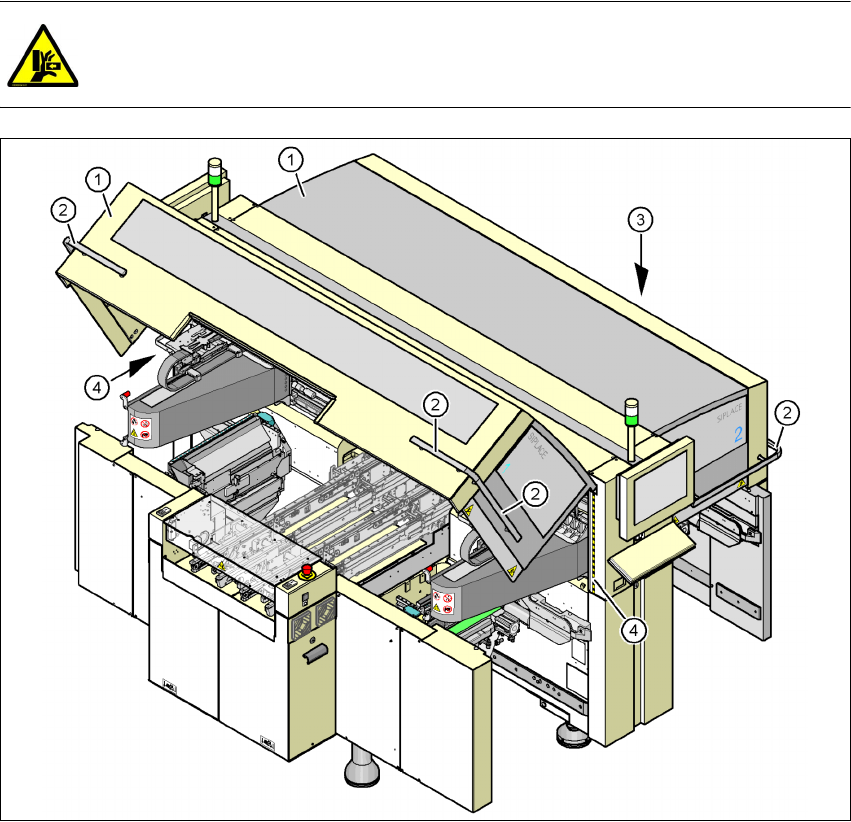
Fig. 2.5 - 1 Safety instructions for closing the protective covers
(1) Protective covers
(2) Grab handles
(3) Cover flaps over the PCB conveyor
(4) Warning strips

User manual SIPLACE X-Series 2 Operational safety
Software Version SR.601.xx 11/2005 US Edition 2.5 Safety instructions for operating the machine
55
Æ Always hold the grab handles when opening or closing the protective covers.
Æ When closing, do not reach into the gap between the protective cover and the machine panel.
The area is identified by a yellow-black warning strip (item 4 in Fig. 2.5 - 1
, page 54).
Æ When you close the covers, make sure that there is no-one else in the cover swiveling range.
Æ When you close the covers, make sure that there is no-one else in the vicinity of the opposite
component trolley location.
2.5.2 Safety instructions for processing capacitors based on powdered metal
There is a risk associated with processing capacitors based on powdered metal (e.g. tantalum).
The risk is that
– an exothermic reaction, i.e. a sudden build-up of heat, may occur, if these components are
damaged. If the ambient conditions are unfavorable, and depending on the capacitance, this
buildup of heat can cause damage.
– This effect can occur when these components are cut.
Please contact your suppliers to clarify whether the components that you handle are affected.
In extremely rare cases, this risk can occur in the tape cutter of SIPLACE machines, with the re-
mote possibility of causing a smoldering fire in the waste tape.
The ambient conditions are unfavorable if:
(1) The components remain on the tape while the set tape cycle is checked (since the operator
can cycle the feeder module onward without removing components during this check).
(2) The components remain on the tape, e.g. due to a tear in the cover foil.
(3) The components remain on the tape, and the components or tape do not conform to the spec-
ification, thus increasing the pickup error rate.
Please follow the instructions given below to minimize the risk when placing capacitors based on
powdered metal.
(1) If the component tape is cycled onward manually, the operator must remove any components
remaining in the tape pocket.
(2) If the cover foil tears, the operator must remove any components remaining on the tape.
PLEASE NOTE 2
The manual extraction by the operator of tantalum capacitors that have not been picked up is
described in section 6.6.1 on page 329.
2 Operational safety User manual SIPLACE X-Series
2.5 Safety instructions for operating the machine Software Version SR.601.xx 11/2005 US Edition
56
2.5.3 Safety instructions for removing nozzles from Collect&Place heads
CAUTION
RISK OF INJURY TO FINGERS BY SHARP NOZZLES 2
Do
not
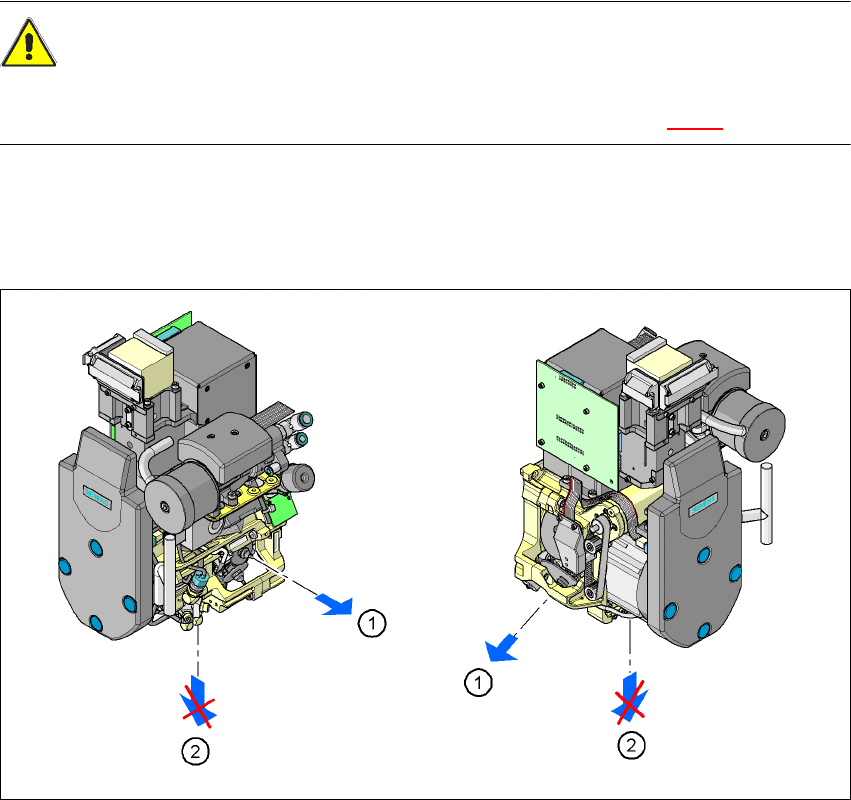
remove the nozzles in the pick-up/placement position (item 2 in Fig. 2.5 - 2).
The procedure for removing nozzles manually from the sleeve is as follows:
Æ Pace the sleeve from which the nozzle is to be removed to the removal point (item 1).
Æ Remove the nozzle from the sleeve here.
2
Fig. 2.5 - 2 Position of the sleeve during a manual nozzle change
2
(1) Removal position for sleeves and nozzles
(2) Pick-up and placement position