00195193-02 SG D4 FSE en (1).pdf - 第140页
Services to the machine Protective Combination Device (Relay K1) Power Supply Unit Student Guide SIPLACE D4 (FSE) EN 09/2006 Services to the machine 133 6.2.15 Protective Combinat ion Device (Relay K1) Legend 1. Input: 4…

Services to the machine
Power Supply Unit Safety and Signaling Circuit
Student Guide SIPLACE D4 (FSE)
Services to the machine EN 09/2006
132
6.2.14.2.7 How Does the Emergency Stop Circuit Work?
The SIPLACE placement machine can not be used for placement until all the relevant supply voltages
and safety devices have been released by the protective contactor combination.
The following conditions must be fulfilled:
All four component change-over tables must be docked.
All covers must be closed.
Both emergency stop pushbuttons must be released.
The minimum air pressure must be present.
The software release signal must be present when the start button is pressed (CAN I(/O output
x7qb_1)
The message
Safety loop OK
must be issued (CAN I/O output x5qb_1)
24 V must be present at the start button.
After pressing the start button, the protective contactor combination releases the following voltages:
Secondary circuit 200 VDC for X/Y axis servo (via SZ2, SZ3, SZ23).
Secondary circuit 150 V for star axis.
The servo unit receives
the servo release signal
for the servo amplifier. (SZ23)
The message
Ready
must be issued to the CAN I/O module (x4qb_3).
40 V operating voltage for the transport handling.
24 V operating voltage for the tape cutter.
Control ON for axis unit SZ23
Servo enable SZ23
Services to the machine
Protective Combination Device (Relay K1) Power Supply Unit
Student Guide SIPLACE D4 (FSE)
EN 09/2006 Services to the machine
133
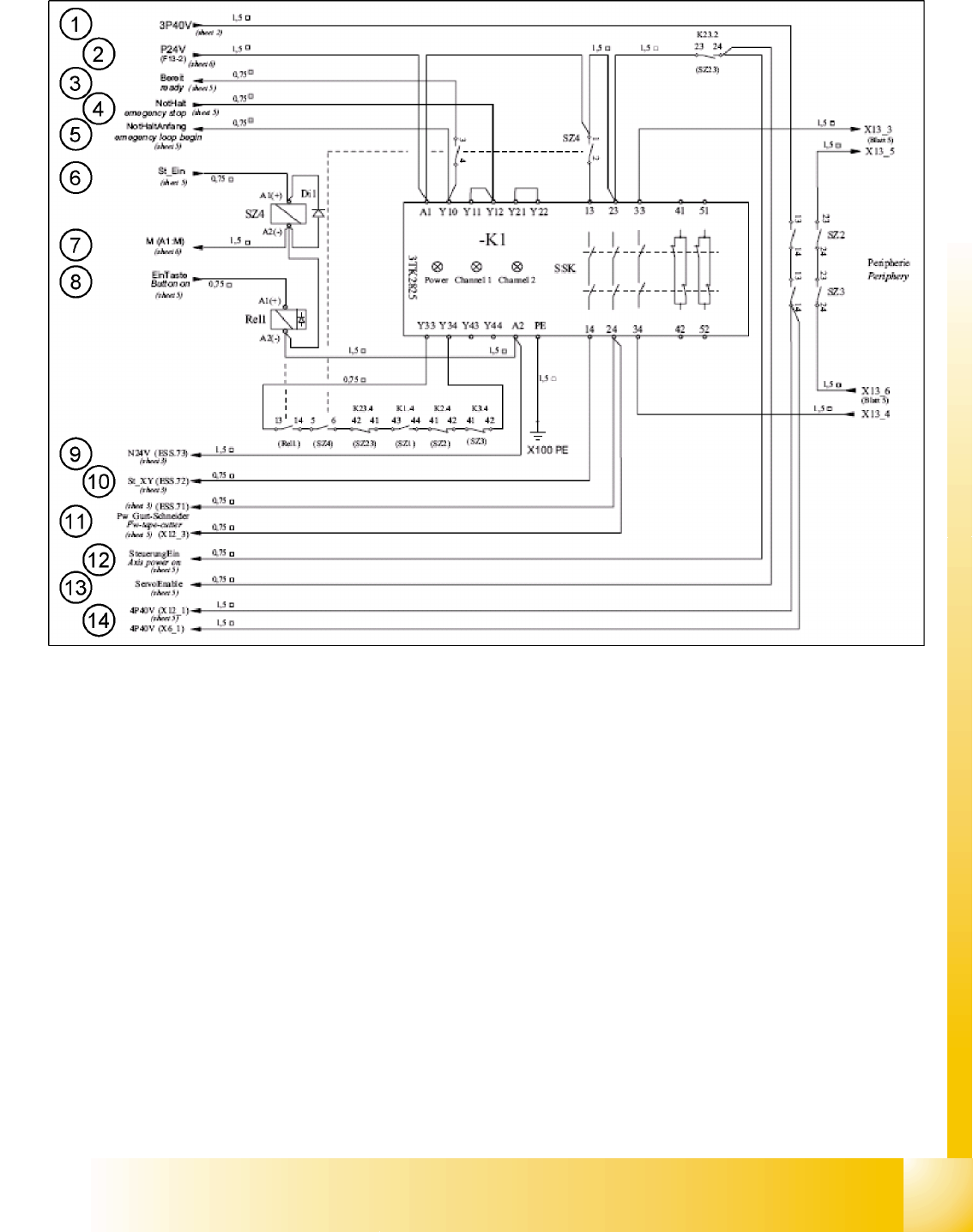
6.2.15 Protective Combination Device (Relay K1)
Legend
1. Input: 40 V DC switched from SZ2 and SZ3 for the conveyor and the component counter under the
traverse (not used)
2. Input: 24 V DC from F13 for A1 + relay K1
3. Output: Ready signal to input of CAN I/O module (signal K1 is OK)
4. Input: Emergency stop signal, safety loop OK
5. Output: Start safety loop
6. Input: (feedback) control ON – signal from axis units 1 and 2 (24 V SZ4 A1+)
7. GND signal from 24 V power pack
8. Input: Start button signal 24 V relay 1 A1(+)
9. Output: GND 24 V – signal for the inrush current limiter
10. Output: St_XY – (control_XY) - release signal 200 VDC for X and Y servo
11. Output: Tape cutter voltage – release signal 24 VDC for the tape cutter
12. Output: Axis voltage ON SZ23
13. Output: Servo release SZ23
14. Output: 40 V DC switched from SZ2 and SZ3 for the conveyor and the component counter under the
traverse (not used)

Services to the machine
Power Supply Unit Protective Combination Device (Relay K1)
Student Guide SIPLACE D4 (FSE)
Services to the machine EN 09/2006
134
6.2.15.1 Via PCC K1
The protective contactor combination (PCC) K1 is used as a standard combined protective device. Its
complex configuration, consisting of 3 relays, guarantees maximum protection and operation safety.
The contactor status is shown by LEDs (Power, Channel 1 and Channel 2).
The PCC can be operated via 1 or 2 channels (safety loops).
The D4 only uses one channel, while the other channel is bridged (terminal clamps Y21 and Y22). This
means that the LEDs for both channels shine when the PCC is switched on.
The protective contactor combination K1 switches the contacts 13 and 14, 23 and 24, 33 and 34, plus
the relays SZ2, SZ3 and SZ23.
When this has been completed, K1 is understood to be in the status
24 V supply ON
and the 3 LEDs
Power, Channel 1 and Channel 2 will shine.
6.2.15.2 How is the PCC K1 Enabled?
Precondition:
X The machine must be switched on. Voltage is then present at main contactor SZ1, which is supplied
with 34 V by the transformer and rectifier V7. After SZ1 has contacted, full voltage is present at
transformer T1.
The 24 V voltage supply is now active via fuse F13 and supplies PCC A1 with 24 V. Contactors 13
and 23 of the PCC are switched with relay SZ4.
X The safety loop must be closed, so that 24 V is present at contacts Y10, 11 and 12. That means, the
protective covers, the emergency stop button, the component tables and the feeder cover flaps all
need to be connected/closed.
X The ready signal informs the software that the PCC has triggered and that everything is OK.
6.2.15.3 Pressing the Start Button
Pressing the start button triggers the following actions:
The start signal pulse enables relay 1 and closes contacts 13 and 14.
The 24 V software release signal is sent via the I/O assembly output to relay SZ4, which then closes
contacts 5 and 6.
Contacts 13 and 14, 23 and 24, 33 and 34 of the PCC are now closed.
The
St_XY
signal is sent via contact 14 of the PCC to the inrush current limiter input. Relay 1 is
enabled via NTC thermistors. The relay 1 contacts simultaneously switch the ground A2 (-) of relays
SZ2 and SZ3. Voltage U/V/W_XY is now transmitted via the inrush current resistors until relay 2 of
the inrush current limiter is enabled.
Relay 2 switches SZ23 and full voltage is then present at the X and Y servos.
The voltage flows directly via the relays.