00195193-02 SG D4 FSE en (1).pdf - 第163页
Axis dynamic Axis control gantry Track signals and Zero pulse S tudent Guide SIPLACE D4 (FSE) Axis dynamic EN 09/2006 150 7.4 Axis control gantry 7.4.1 T rack signals and Zero pulse 7.4.1.1 Check the ze ro pulse signal T…
Axis dynamic
Servo amplifier TBS .. and SDS ... Axis dynamic basics
Student Guide SIPLACE D4 (FSE)
EN 09/2006 Axis dynamic
149
So there is nothing to adjust all this axes have a dynamic behavior. Each axis has friction to be
overcome. The higher the friction is, the higher the amplitudes will be at acceleration and constant
speed. The higher motor force at acceleration and constant speed can be detected at the uncommutated
motor current target signal. Higher friction reduces the required motor force during the deceleration
section, so that the amplitude is smaller for the uncommutated motor current target signal.
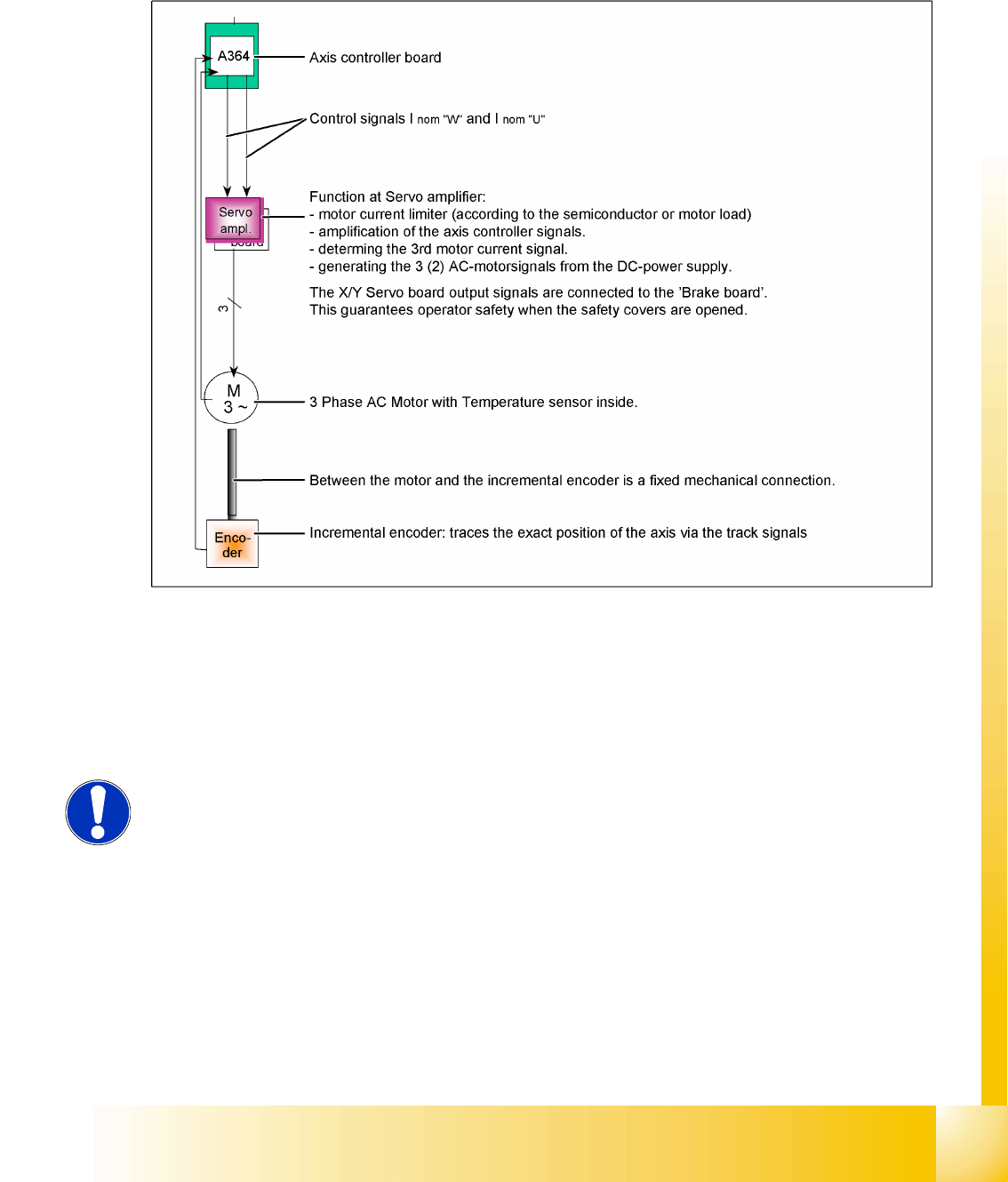
7.3 - 6: Axis block diagram example X or Y-axis of HF/Siplace X machine
Although the various axis types differ in details, all control tasks are handled by the axis controller. Two
control signals for 2 or 3 phase axis drive are transmitted to the servo. For DC drives, we use the same
hardware principle, with only one control signal to the servo amplifier. The only feedback is provided by
the track signals from the incremental encoder to the axis controller - a tacho (Z/DP axis) is not
connected to the axis system.
See also:
J 7.3 Axis dynamic basics [J 144]
NOTE:
Mechanical and electrical faults can be detected by analyzing the axis controller
signal paths.
Axis dynamic
Axis control gantry Track signals and Zero pulse
Student Guide SIPLACE D4 (FSE)
Axis dynamic EN 09/2006
150
7.4 Axis control gantry
7.4.1 Track signals and Zero pulse
7.4.1.1 Check the zero pulse signal
The zero pulse on the incremental scale must be recognized from the incremental encoder secure and
perfectly. To check the zero pulse you can check the analog or digital zero pulse. If the zero pulse is not
recognized correctly, the axis will reference to a spurious peak. Placement offsets will be the result.
Electrical settings can not be made in the incremental length measurement system.
7.4.1.1.1 Measurement of the analog zero pulse signal
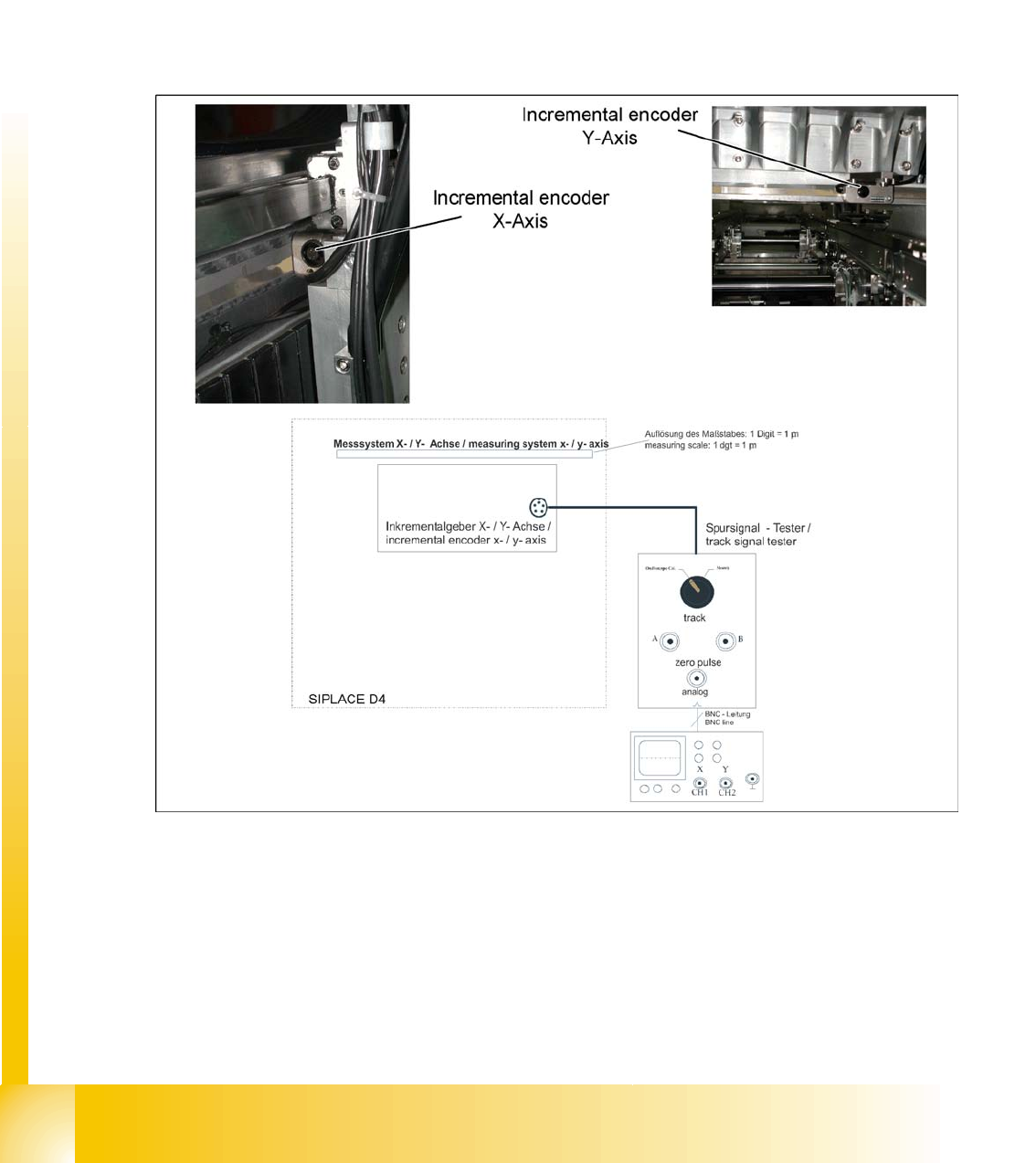
7.4 - 1: Measurement procedure for checking the analog zero pulse and the analog track signals
Test procedure
X Connect the measurement tester to the incremental encoder.
X Main switch
ON
X Connect the oscilloscope to the measurement tester.
X Set up the measurement adapter
Calibrate the oscilloscope
and position the signal at the top,
center of the screen.
Axis dynamic
Track signals and Zero pulse Axis control gantry
Student Guide SIPLACE D4 (FSE)
EN 09/2006 Axis dynamic
151
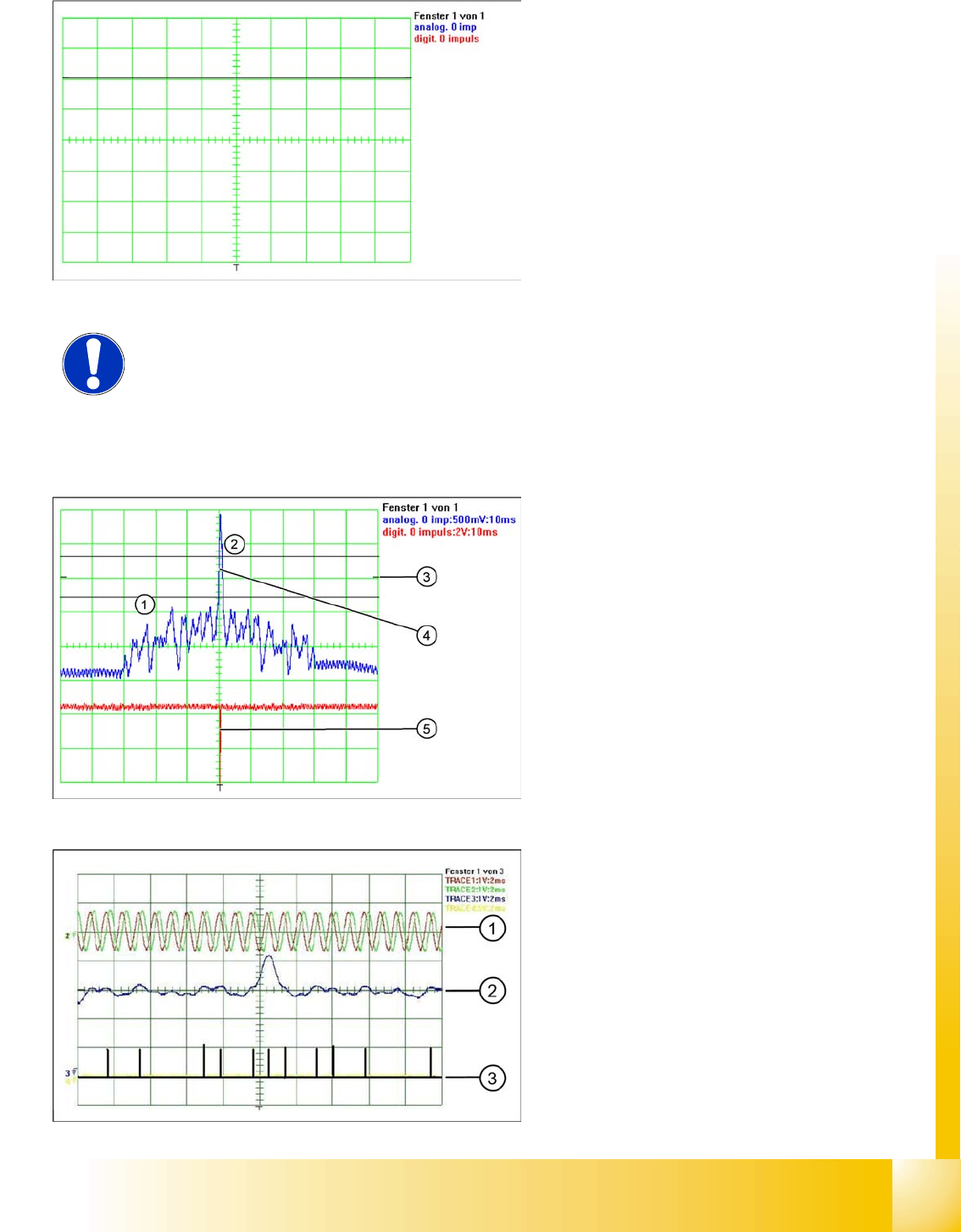
X Move by hand the gantry over the first zero pulse.
X The following picture should appear.
NOTE:
The first zero pulse is to be checked at a distance of 25 mm after the bumper.
Legend:
1. In the tolerance space of - 0.3 V there is no
interference pulse.
2. The analog zero pulse has to over the
tolerance space more then 0,3V
3. Initial start position
4. analog zero pulse
5. digital zero pulse
Legend:
1. analog track signal A and B
2. analog zero pulse
3. digital zero pulses