00195193-02 SG D4 FSE en (1).pdf - 第78页
Communication and Control CAN Bus in General CAN Bus Student Guide SIPLACE D4 (FSE) EN 09/2006 Communica tion and Control 77 4.3.1 CAN Bus in General CAN is a serial bus system especially suited for netw orking devices a…
Communication and Control
CAN Bus Machine Controller Communication
Student Guide SIPLACE D4 (FSE)
Communication and Control EN 09/2006
76
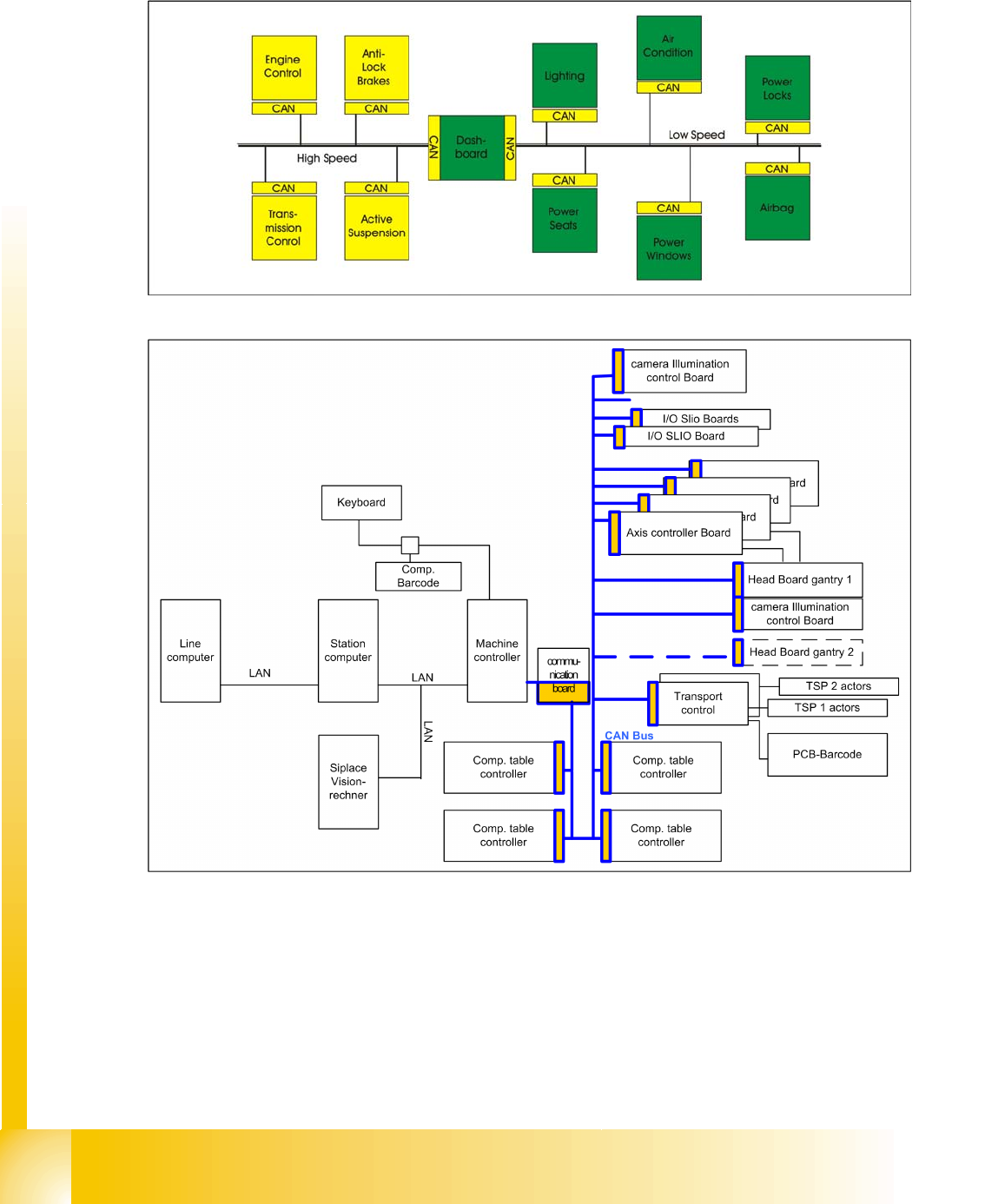
wiring is replaced by one serial bus Each module is given a CAN Bus connection. This is accomplished
by adding some CAN-specific hardware to each control unit that provides the ’rules’ or protocol for
transmitting- and receiving information via the bus.
4.3 - 3: Communication via CAN bus on example car controlling
4.3 - 4: Communication via CAN bus on example car controlling
Communication and Control
CAN Bus in General CAN Bus
Student Guide SIPLACE D4 (FSE)
EN 09/2006 Communication and Control
77
4.3.1 CAN Bus in General
CAN is a serial bus system especially suited for networking devices as well as sensors and actuators
within a system or subsystem. It has Multimaster features i.e. bus access can be started simultaneously
in multiple cases.
The CAN network does not consist of addressing individual components in the conventional sense but
instead involves sending prioritized messages to all subscribers (broadcasting). Each subscriber
decides on the basis of the identifier received whether it should process the message or not. The
identifier determines the priority that the message enjoys in competition for bus access. Programming is
comparatively easy, due to the simple CAN bus communication system.
Each CAN message can carry 0 to 8 Byte of user information. Of course, you can transmit longer data
information by using segmentation. The maximum transmission rate is specified as 1 Mbit/s. This value
applies to networks about 40 m. Greater distances reduce the transmission rate e.g. a length of 500 m
allows roughly 125 KBit/s or a length of 1 km would transport roughly 50 KBit/s.
The maximum bus speed is 1 MBit/s, which is achieved by a bus length of 40 m through the use of a
twisted-pair cable. For bus lengths longer than 40 meters the bus speed must be reduced. For a bus
length above 1000 meters special drivers should be used.
4.3.1.1 CAN Bus Structure
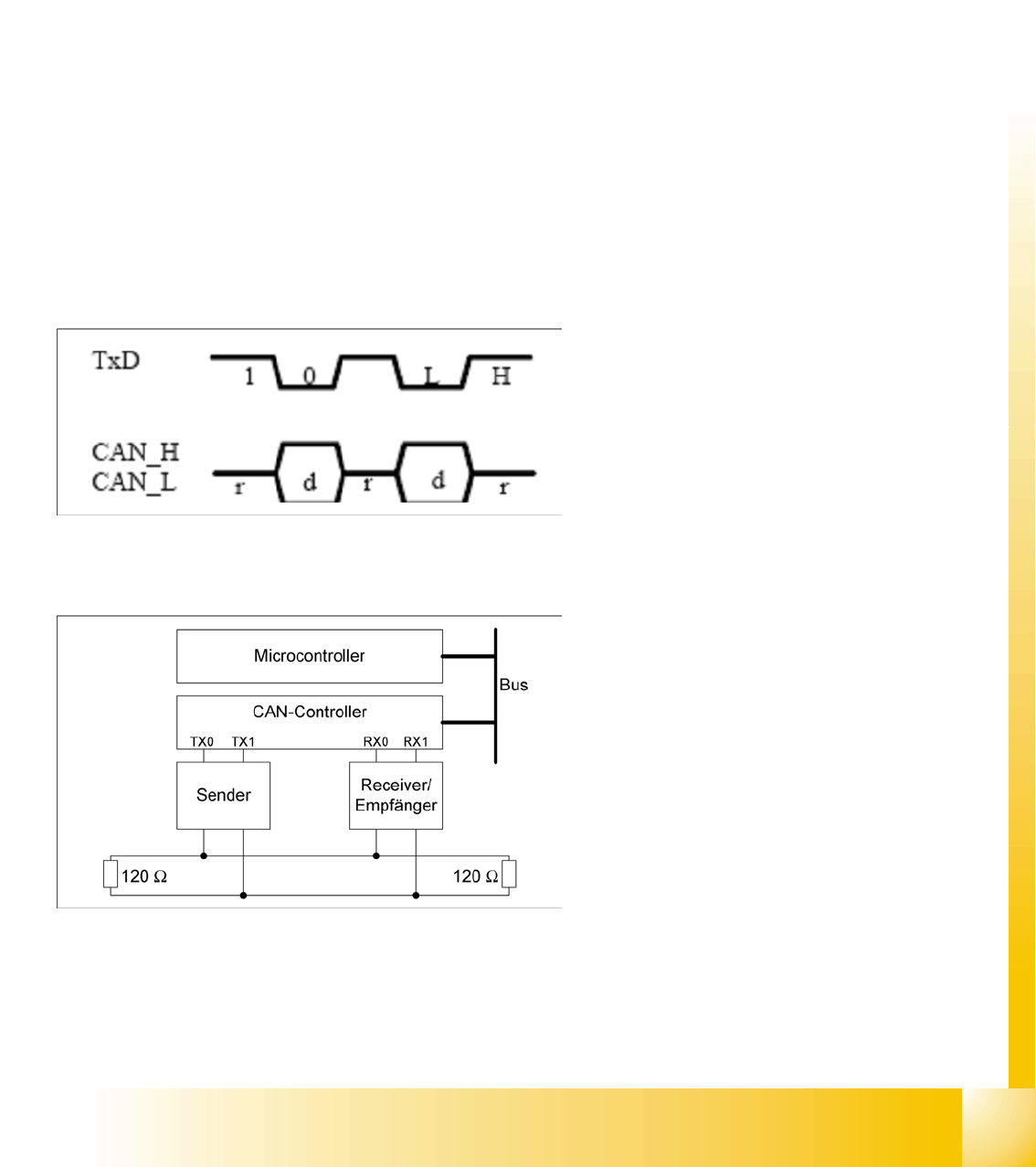
The CAN Bus consists of 2 lines (CAN_High,
CAN_Low). These are connected to a terminating
resistor with 120 Ohm at each end.
Each subscriber which is connected to the CAN
Bus, has a transmitter, a receiver and a CAN
controller.
This CAN controller communicates with the
microcontroller. Our SIPLACE machines use an 8
or 16 bit (TQM) processor.
Legend:
Microcontroller: exchanges data with the CAN
controller
CAN controller: adds the data frame,
establishes the connection, handles errors
and their corresponding solutions.
Transmitter/receiver: adjusts the level (driver
levels)
Communication and Control
CAN Bus CAN Bus protocol
Student Guide SIPLACE D4 (FSE)
Communication and Control EN 09/2006
78
4.3.2 CAN Bus protocol
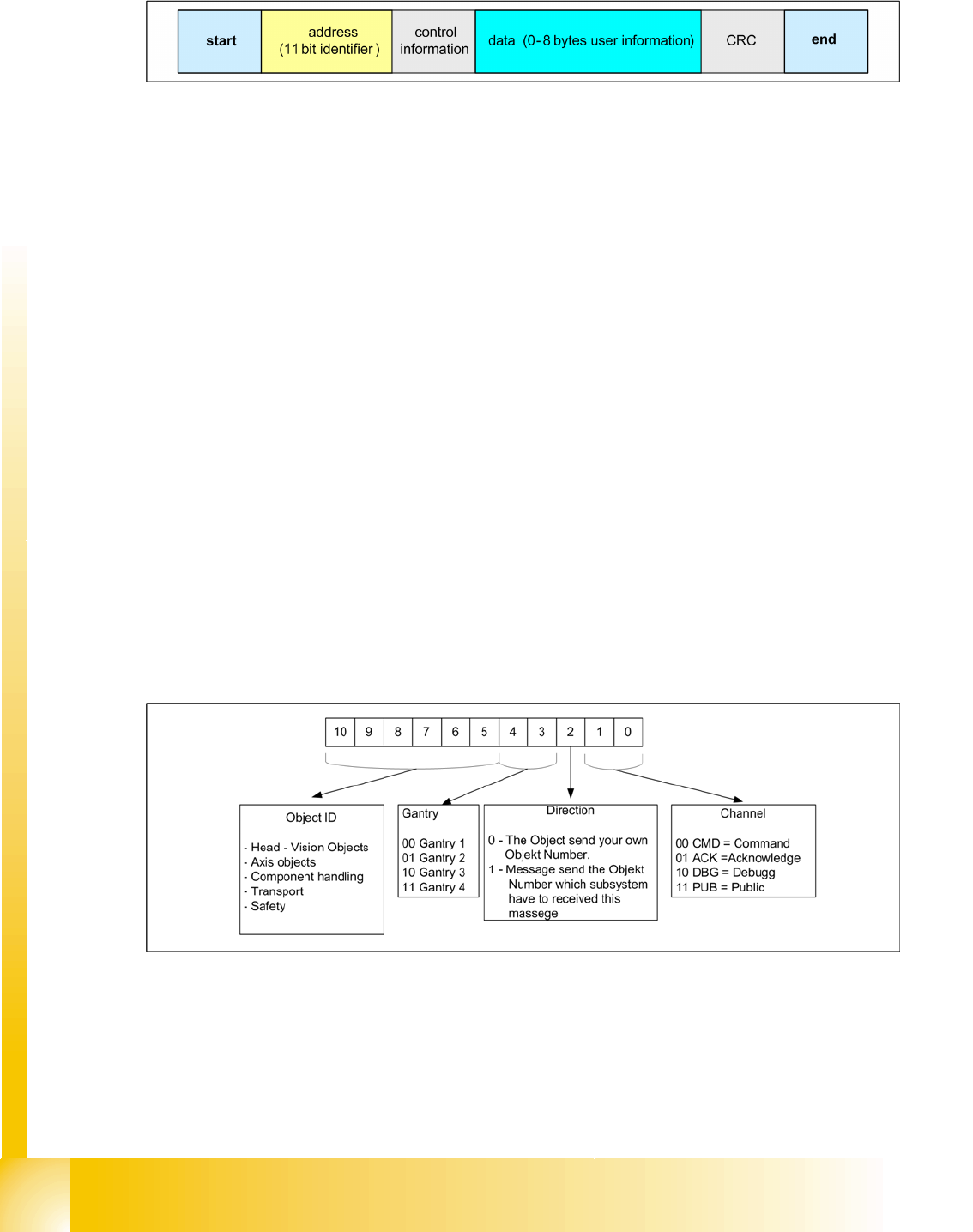
4.3 - 5: CAN-bus protocol
Start
This bit indicates the beginning of a telegram and consists of a dominant bit. After this bit is set, no
other user of the CAN bus is able to send.
Address field (11 bit identifier)
The 11 bit address identifier value determines the bus access . The value of this number is also the
priority for the bus access.
Control field
Contains reserved bits and 4 bit DLC: Data Length Code.
Data field
Contains the user information from 0 byte to maximum 8 byte. The transfer of a byte begins with the
most significant bit (the bit with the highest value).
Data control field CRC
Each message is combined with a CRC word. CRC sequence and CRC delimiter = CRC filed (cyclic
redundancy check): The redundant information in the control sequence allows the receiver to check
whether the message received has been falsified by interference.
End
The end of the length recognition is 7 bit.
4.3.2.1 11 Bit Identifier
The CAN bus system is using the 11 Bit identifier for addressing the different CAN objects
An 11 Bit identifier (address) identifies the type, priority, source and /or target of the message.
This identifier also controls the bus access (arbitration).
4.3 - 6: 11 bit identifier