YesAX V3.1.2 - Software User Manual.pdf - 第132页
10 - 38 General Inspecti on Methodolo gy Invert Image checkbox if checked will invert the pixel value of the image before performing the analysis. Check Void checkbox if checked will calculate a void percentage for each …
General Inspection Methodology 10-37
It is somewhat tricky if you want to change the FOV of an X-ray inspection (e.g. from 1” FOV to
0.5” FOV). Here are the steps to do so: First use the Move Z dialog to move the Z stage to the
desire FOV, point the mouse to the Region of Interest (ROI), and open the Edit Lead Bank
Parameters dialog. Press the X-ray button (the button is already depressed) in the Camera View
group again, and then press OK to close the dialog. Double click near the video cross hair to
refresh the screen display; you will see the ROI box change from blue to green indicating the
FOV has changed.
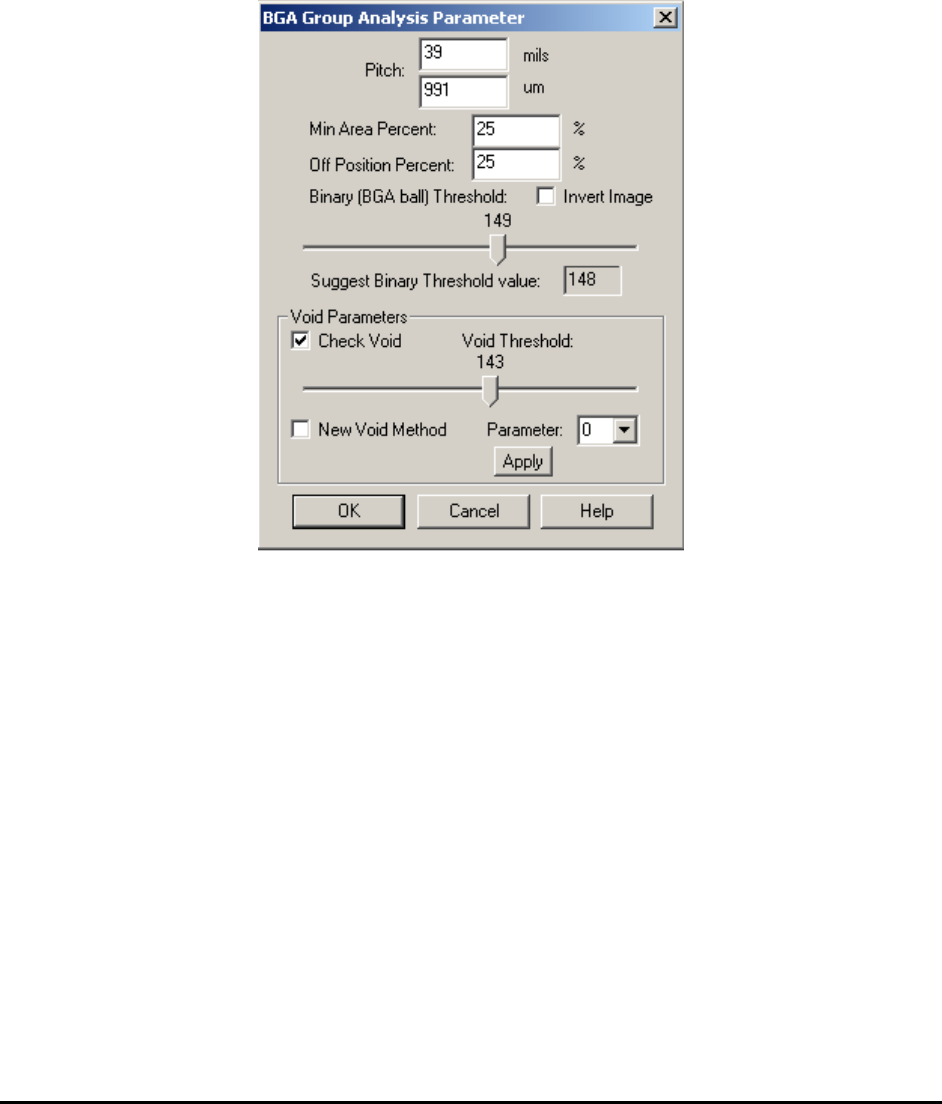
BGA Group Analysis Params launches the BGA Group Parameters dialog.
Pitch is the distance between each BGA balls, either in row or column. It can be in mils or
microns. (Typical values, 1500 um, 1270 um, 1000 um)
Min Area Percent sets up the threshold for detecting a BGA ball missing case. A BGA ball with
its area less than the minimum area will be caught as a missing ball. A value of 25% is typical
for this parameter. It can range from 5 to 40%.
Off Position Percent combined with pitch, defines the maximum distance (in the percentage of
pitch) that one BGA ball could be off from its original position. Set this parameter to detect off-
position solder balls. A value of 20% is typical for this parameter. It can range from 0 to 40%.
Binary (BGA ball) Threshold sets the binary threshold value which is used to convert gray
scale images into binary images. A good binary threshold value separates the majority of BGA
balls from their background and results in good measurement values. The Suggest Binary
Threshold Value is the pre-calculated value based on the current image. When the dialog is first
launched, the binary threshold value will be set equal to the suggested binary threshold value.
Later on you can select a different binary threshold value by moving the slider bar.
10-38 General Inspection Methodology
Invert Image checkbox if checked will invert the pixel value of the image before performing the
analysis.
Check Void checkbox if checked will calculate a void percentage for each BGA ball.
Void Threshold sets the binary threshold value which is used to convert gray scale images into
binary images and perform void calculations. Moving the slider bar will change the threshold
value and display a binary image instead of the original gray scale image.
New Void Method checkbox if checked will apply the new void detection algorithm instead of
the old one. Please make sure to select void threshold number less than the ball threshold number.
Moving the slider bar of void threshold will display a binary image. In this binary image only
pixels with gray scale between void threshold and ball threshold will be displayed. To fine tune
the shape of the void, user can select a number different than 0 in Parameter drop down box.
The available choices are 1 and 2. Bigger number will get rid of small unwanted voids but in the
mean time, change the shape of voids slightly. If the parameter number is set to a number
different than 0, the user can click the Apply button and see the actual void been detected on the
screen.
In addition to BGA Group, another algorithm for BGA inspection would be Image Subtraction.
This algorithm does not calculate numerical parameters of the BGA but instead uses a simple
image comparison principle. A reference image taken from a good part is subtracted from the test
image. The difference is the threshold to determine a pass or fail status.
Different Image = | Test Image – Reference Image |
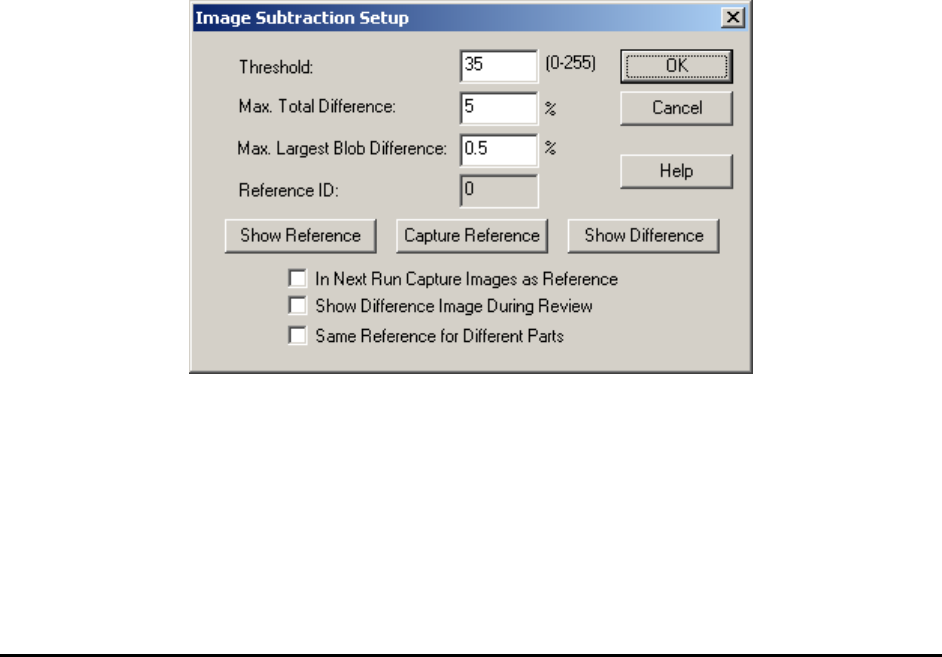
Image Subtraction Params.. launches the Image Subtraction Setup dialog for setting image
subtraction parameters.
The Threshold is the gray level difference between the corresponding pixels of the two images.
Pixels gray level difference below the threshold will be considered the same.
The Max. Total Difference is the maximum number of pixels that is different from the reference
image to be considered PASS, expressed in percentage. The Max. Largest Blob Difference is
the maximum numbers of pixels in the largest blob of the different image to be considered PASS.

General Inspection Methodology 10-39
The Show Reference button displays the reference image, the Capture Reference Button
capture the reference image from the camera. The Show Difference button displays the
Difference Image. The Reference ID shows a number which represent the ID of that reference
image. This number is similar to the template number in template match inspection. A Reference
ID shows 0 means the reference image haven’t been captured yet.
Because of the perspective distortion which is common in the X-ray images, the Reference
Image has to be captured exactly where the part is to be inspected. In other words, if the part is to
be tested near the top left corner of the screen, then the Reference Image should be captured at
that screen location. The In Next Run Capture Images as Reference checkbox switches on the
reference capture mode, in capture mode in the next inspection run the software will capture
reference images for all test boxes using image subtraction algorithm. User should make sure a
good board is put in before the inspection run. The checkbox is turned off at the end of the
inspection run, normal image subtraction will resume.
During review process the software always displays the Reference image; user can optionally
select to have the different image also displayed. To select the option check the Show Difference
Image During Review checkbox.
By default each lead inspection box with Image Subtraction algorithm setup will have one
unique reference image/ID. Sometimes it is convenient to have the same lead box of different
parts with same part number share the same reference image. To do that the user needs to check
the Same Reference for Different Parts checkbox.