YesAX V3.1.2 - Software User Manual.pdf - 第87页
Train Part without CAD data 8-5 The Quick Marking Check function is similar to the Auto repeat func tion in operation. It allows you to quick ly add template matching inspections without worrying about the part numbers o…
8-4 Train Part without CAD data
The Skip Flags group shows the three skip flags for the part. They are Marks, Leads and
Solders. The Type list box allows the user to select the part type for the part. The last edit box
shows the description of the part.
The Pin Type combo box shows the Pin type of a BGA which corresponds to the Pin Library
feature (See Section 13.6). The Get button extracts pin information from the Pin library and
updates the part’s solder inspection boxes. The Pin Type feature is only applicable to BGA
devices.
The Flip Side View checkbox is for side angle inspection. The LBO Page 2 checkbox is used
only with Large Board Option (LBO) to identify parts on page 2. The Is Through Hole Part
checkbox works with the Create Bottom Partlist feature in through-hole inspection. The Is
Bottom Side Part specifies whether the part is on top side or not. This concept is different from
top and bottom part list. Once specified, you can toggle the show top/bottom buttons inside the
toolbar and program the board with less confusion.
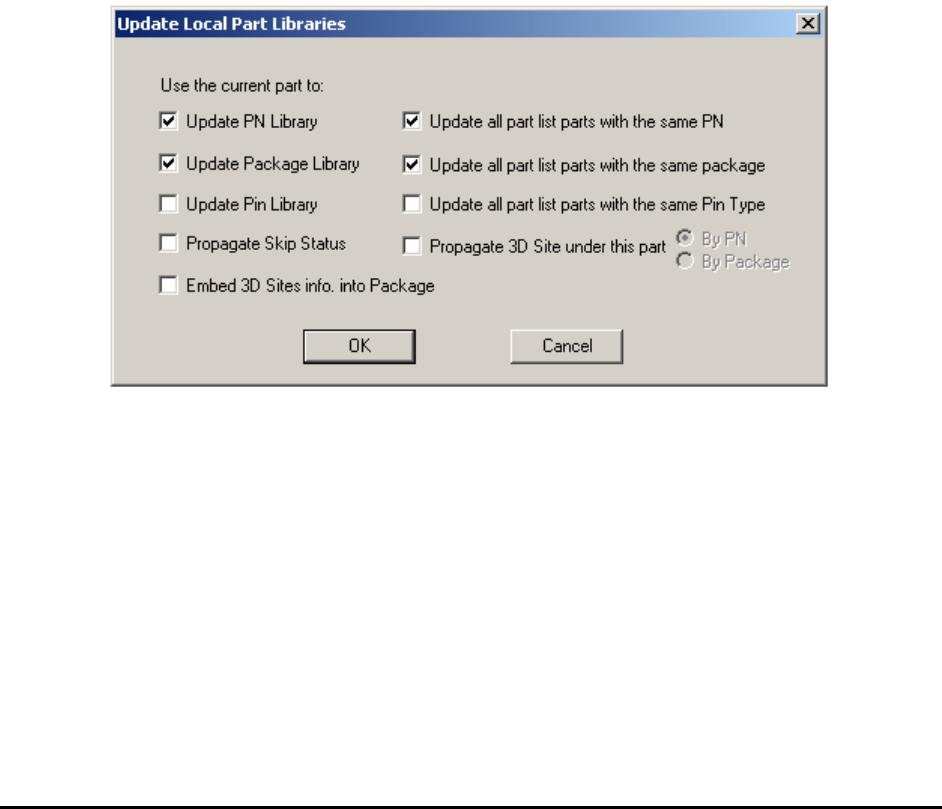
8.2 Update Local Parts Libraries
The Update Local Parts Libraries dialog allows you to update the part number, package or Pin
libraries using the current part as reference. The dialog can also be used to propagate Skip status.
For 3D systems, this dialog can also be used to propagate 3D site under the part.
8.3 Auto Repeat Mode and Quick Marking Check
A convenient way of adding multiple parts when there is no CAD data available is to utilize the
Auto Repeat Mode. In this mode, the Add Part function is repeated when you press the right
mouse button. In a scenario where you need to add many of the same part number all over a
board, the auto repeat mode saves a lot of mouse clicks.
During auto repeat mode, press the “R” key to rotate a part 90 degrees. Also in the auto repeat
mode, the Reference ID of a part increment each time a part is added.
For example, setup part R10 as the first part to add, then the second part added will be assigned
with a Reference ID of R11, and the third will be R12, etc.
Train Part without CAD data 8-5
The Quick Marking Check function is similar to the Auto repeat function in operation. It allows
you to quickly add template matching inspections without worrying about the part numbers or
reference IDs of the inspection. It also allows an inspection region to be set simply by drawing a
box on the screen.
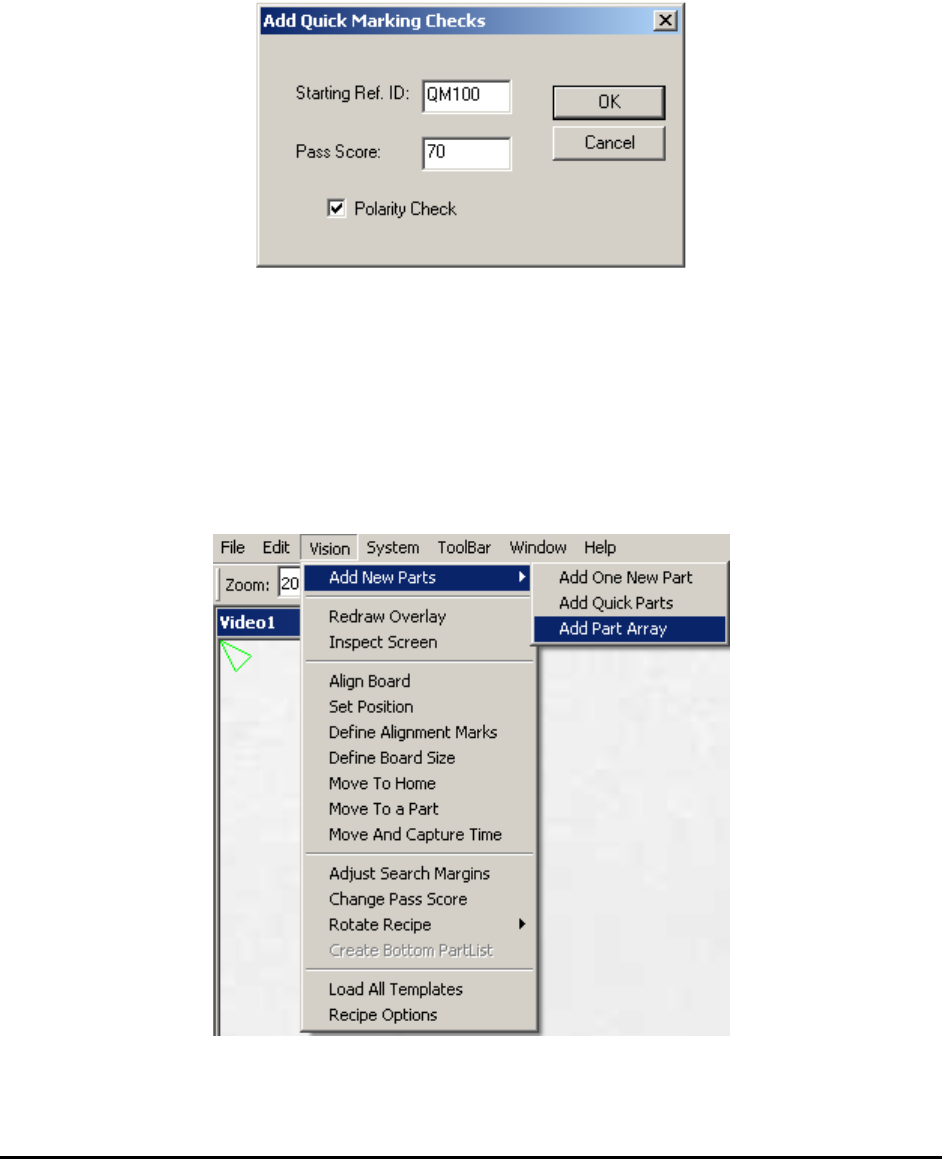
To start the Quick Marking Check function, select Vision>Add New Parts>Add Quick Parts
from the toolbar. The Add Quick Marking Checks dialog displays.
Enter the starting Reference ID, Pass Score and Polarity attribute.
Just like the auto repeat function, the Quick Mark Check function is repeated by pressing the
right mouse button.
8.4 Add Part Array
If parts of same kind are evenly located in an array, either in rectangle or circular area, it is
possible to add these parts all together by using the Add Part Array function. To start, select
Vision>Add New Parts>Add Part Array from the main menu.
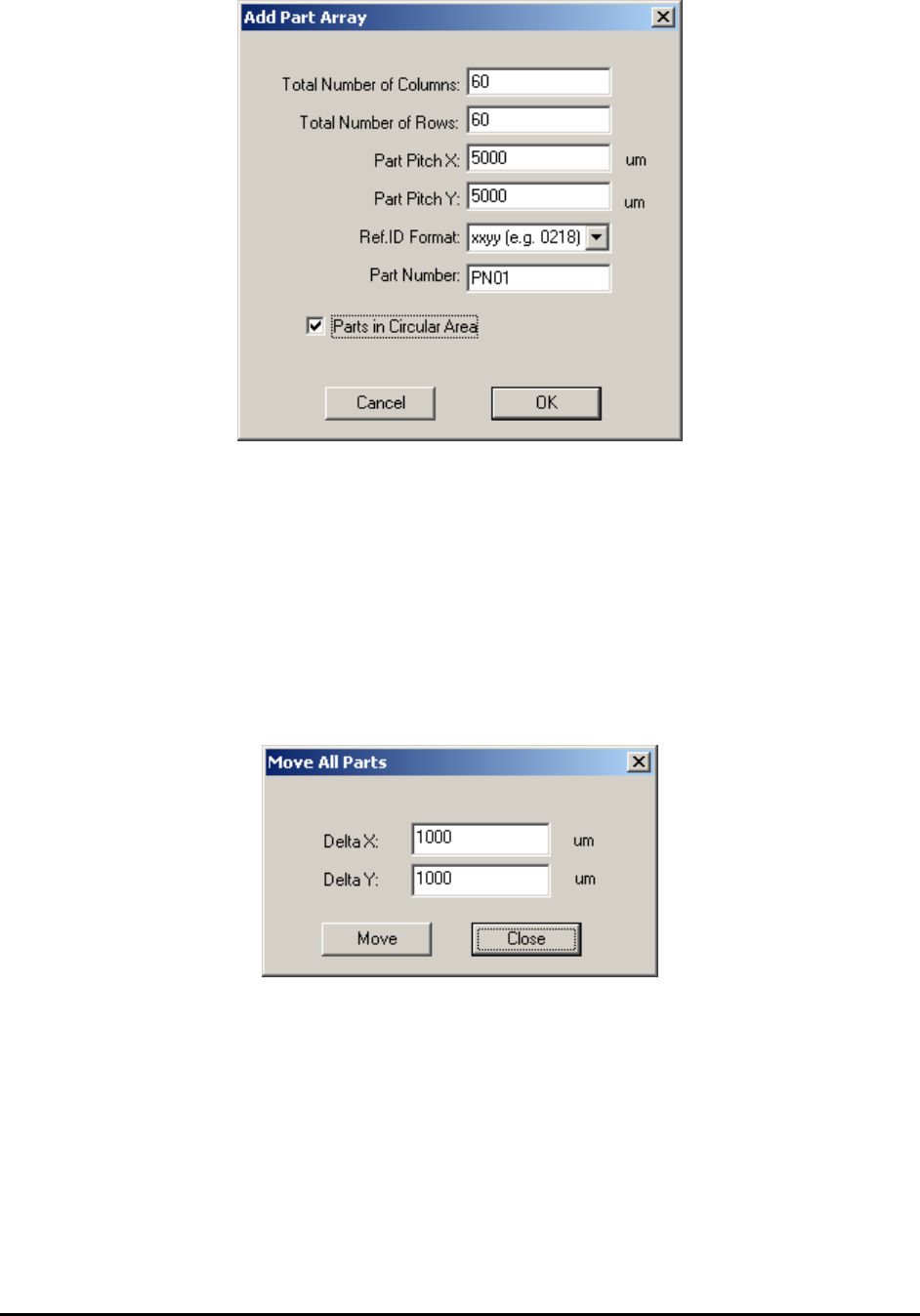
The Add Part Array dialog displays.
8-6 Train Part without CAD data
The number of columns, number of rows, pitch in X and Y direction, Ref ID format and part
number need to be specified in this dialog. The format of Ref ID is in the form of xxyy, which xx
represents column number and yy represents row number. The orders are from left to right and
from top to bottom. If all parts occupy a rectangle area, the total number of parts added will be
total number of columns multiple by total number of rows. It is ok to specify a circular area for
these parts. In this case the total number of parts added will be less than the previous case.
After creating the part array, the user may need to delete certain extra parts around the perimeter
of the area. To adjust position of part array, select File>CAD Data>Self Re-sync from the main
menu. The user can also select Edit>Move All Parts from the main menu. The Move All Parts
dialog displays.