YesAX V3.1.2 - Software User Manual.pdf - 第76页
7-6 3D Recipe Creatio n 7.3.4 Step4: Create Test 3D Sites and Verif y Board Th ickness This step is very important for complex boards when a lot of surface parts (resistors and capacitors) on both top and bottom sides ne…
3D Recipe Creation 7-5
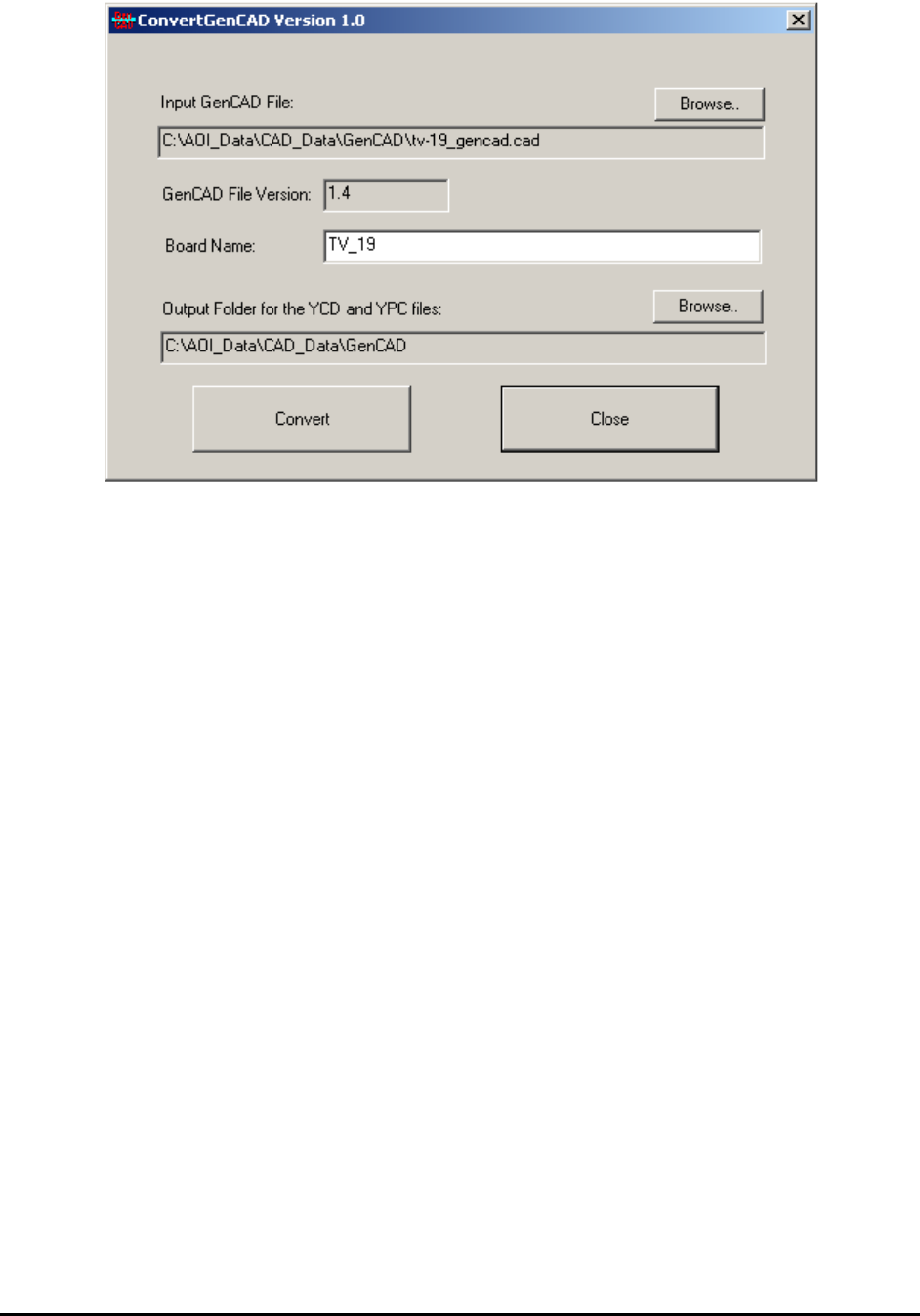
The conversion process for the ConvertGenCAD utility is similar to other conversion utility.
ConvertGenCAD generates a total of 2 YCD files and 1 YPC files.
BoardName_TOP.YCD and BoardName_BOT.YCD are YCD files for top and bottom side of
the board with all the parts in them.
The YPC file is BoardName.YPC.
7.3 Creation Process When Machine Time is Unlimited
7.3.1 Step1: Prepare CAD Data
CAD data can greatly speed up the recipe creation process. If the board to be inspected has more
than 20 parts, it is important to insist on getting the proper CAD data before starting the recipe
creation process. We currently have conversion utilities to automatically convert from 5DX NDF
format, GenCAD format, and FabMaster CAD format to the proper data formats (YCD and YPC)
for YesAx import. CAD data can also be manually converted using Excel or other text
formatting utilities.
7.3.2 Step2: Determine Which Side Faces Up
The side with the most critical components that require 3D inspection should face up.
7.3.3 Step3: File, New Board
In this step we define the board size and train the fiducials. Also capture a 5% visual image set to
create the board background image for the recipe. Do NOT import CAD data in this step.

7-6 3D Recipe Creation
7.3.4 Step4: Create Test 3D Sites and Verify Board Thickness
This step is very important for complex boards when a lot of surface parts (resistors and
capacitors) on both top and bottom sides need to be inspected. For some simple boards this step
is optional. Manually add one or more 3D sites and make sure the Bottom button in the Edit 3D
Site dialog brings you to the correct surface slice at the bottom side of the board. If not, adjust
the board thickness parameter in the Video Parameters dialog.
7.3.5 Step5: Import Centroid CAD for BGA parts
The CAD conversion utility creates two sets of YCD files, Full and BGA only. Import the BGA
only file. There is no need to set the proper part size for the BGA parts. The part size will be set
in the next step when YPC CAD is imported.
Press the “Skip Mark” button.
In this step all we need is to have small purple boxes to show the centroid of the BGA parts.
7.3.6 Step6: Import Pin CAD, and merge Pin library Data
The Pin CAD (YPC file) contains the position for each pin (solder joint) of every part. During
the process you can merge the Pin definition from the Pin library with the pin location and name
from the YPC file. Merging the Pin definition is highly recommended, even if you cannot find an
item in the pin library that matches your part exactly. This is because once a link is established
between the part and the pin library, future changes will be a lot easier.
NOTE
you CANNOT use any solder with the BGA Solder algorithm in any item in the
Pin library.
7.3.7 Step7: Walk Thru and Create 3D Sites for the BGA Parts
Assuming you completed step 6 accordingly, this step would create the 3D sites for BGA parts
almost automatically. Select Walk Thru Parts w/o Sites in the List View Selected pop-up menu.
At each part, select Create 3D Sites, From Parameter dialog.” to select the proper parameters.
Then press OK. After the sites are created, select Update from the part menu to propagate the
3D sites by PN or Package.
After finishing the walk through, select Re-Capture All Sites from the pop-up menu of the 3D
Control dialog to convert all the Future Sites to normal 3D sites.
7.3.8 Step8: Add Laser Height References
One laser height reference can be added with one mouse click.
Select Add Laser Reference.. from the pop-up menu of the 3D Control dialog.
After all the laser references are added, select “Profile Board Height” from the same pop-up
menu.

3D Recipe Creation 7-7
7.3.9 Step9: Adjust Offset for the 3D Sites
After board height is established, step through each of the 3D sites and use the Edit 3D Site
dialog to adjust the offset parameters for each site. You may be able to use the Sync. Site
Parameters function to speed the process by synchronizing the offset for all sites under one part.
7.3.10 Step10: Import Full Centroid CAD and train the rest of the parts
Select “Recipe Save As” prior to performing this step.
Nordson YESTECH does not recommend 100% inspection using AXI. Many parts can be more
effectively inspected using AOI.
Please be aware of two features specifically designed for AXI CAD import:
First you can now import part to be trained on 3D slice directly, provided the sites are
present before you start the import process. Secondly, please do not forget, you can add
Future Site while you are importing and training new parts. When importing and train
parts directly to 3D slice the software appends “_3dt” and “_3db” to the part numbers and
packages, this way they are separated from 2D parts during library updates.
Here is one strategy you can use, import and train all the parts that can be inspected in 2D, when
you see a part that cannot be inspected in 2D, press the “Skip Part” button to skip it. Finish
training all the 2D parts for both sides. Add Future Sites for parts not trained, capture image set
for the future sites, and then re-import the same YCD file (or files) and train parts to the 3D
slices.
7.3.11 Step11: Fine Tune the Recipe
From the Recipe Option dialog you can turn on and off 3D inspection, using this feature you can
focus on fine tuning the 2D inspection first. For 3D tuning, you can skip all parts and unskip only
one part at a time to work on. (ListView, Part List Page, pop-up menu). Also there is a feature to
re-sequent the 3D site to speed up the inspection. There is a similar feature to re-sequent laser
height reference as well.
7.4 Creation Process When There is a Need to Minimize Machine
Time
7.4.1 Step1: Prepare CAD Data
This is an offline step. Refer to 7.3.1 Step1: Prepare CAD Data.
7.4.2 Step2: Determine Which Side Face Up
This is an offline step. Refer to 7.3.2 Step2: Determine Which Side Faces Up.
7.4.3 Step3: File, New Board
This step has to be done on the machine, to minimize machine time you should capture a 25% or
50% overlap image set with Top View, 1 inch X-ray view and may be ½ inch X-ray view.