FlexTRAK 2MB Material Handler Addendum Rev 05.pdf - 第53页
FlexTRAK Series 2MB Mater ial Handler Adden dum System Compo nents © 2023 Nordson Corporation 4-9 4.3.1 Dual Lane Conveyor The standard system featur es a SMEMA compatible du al lane conveyor. Each lane consists of two (…
FlexTRAK Series 2MB Material Handler Addendum System Components
4-8 © 2023 Nordson Corporation
4.3 Material Handler (MH)
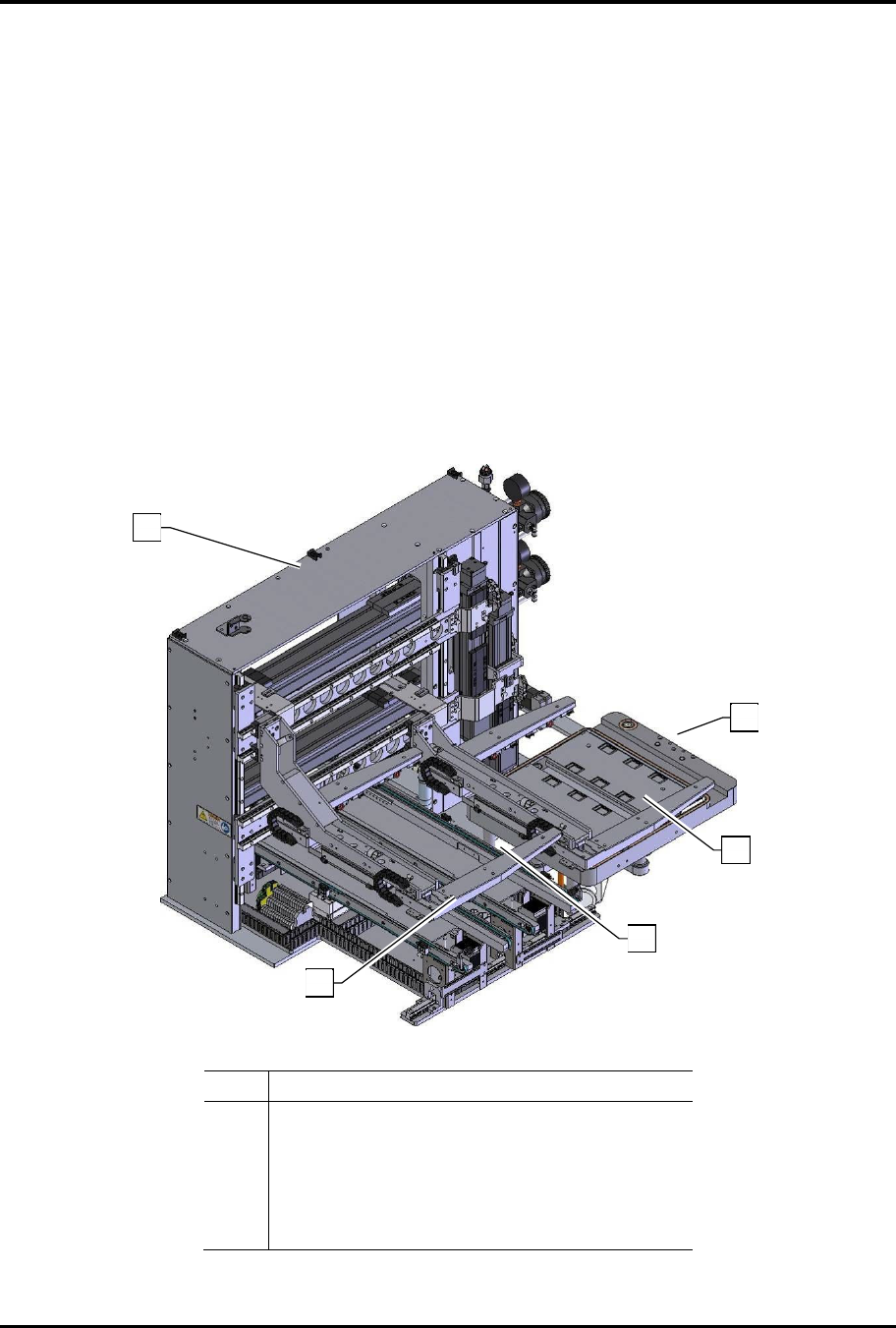
The FlexTRAK-2MB’s Material Handler (MH) conveys parts from an upstream system to the plasma
processing chamber, and then to a downstream system (Figure 4-7).
Parts are conveyed from the upstream system to the gripper pick position, where the MH gripper
assembly delivers the carriers to and from the FlexTRAK plasma system for treatment, and then to a
downstream system.
The FlexTRAK-2MB’s MH Overview screen displays a real-time graphical interface representing all
sensors, signals, and motion. The MH assigns each carrier a unique process carrier ID# in order to track
the carriers as they move through the system. The MH can be operated in automatic mode or in manual
mode.
The MH system’s two major components are listed below:
q Dual Lane Conveyor
q Shuttler Assembly
Item Description
1 Shuttler Assembly
2 Dual Lane Conveyor
3 Upper Gripper
4 Lower Gripper
5 Chamber Base
Figure 4-7 FlexTRAK-2MB Material Handling System
2
1
3
4
5
FlexTRAK Series 2MB Material Handler Addendum System Components
© 2023 Nordson Corporation 4-9
4.3.1 Dual Lane Conveyor
The standard system features a SMEMA compatible dual lane conveyor. Each lane consists of two (2) rail
assemblies which include a high temperature belt, a stepper motor, a pneumatic carrier stop, roller bearing
assemblies and a belt tensioner. Each lane has sensors to track the part’s location throughout the entire
length of the conveyor. The number of sensors varies, depending upon the size of the process carrier.
There are three dual-lane conveyor configurations, which are defined in the following paragraphs.
?
NOTE Systems designed to accommodate extra wide process carriers may require the removal
of the second lane resulting in a single-lane conveyor.
4.3.1.1 Fully Adjustable Dual-Lane Conveyor
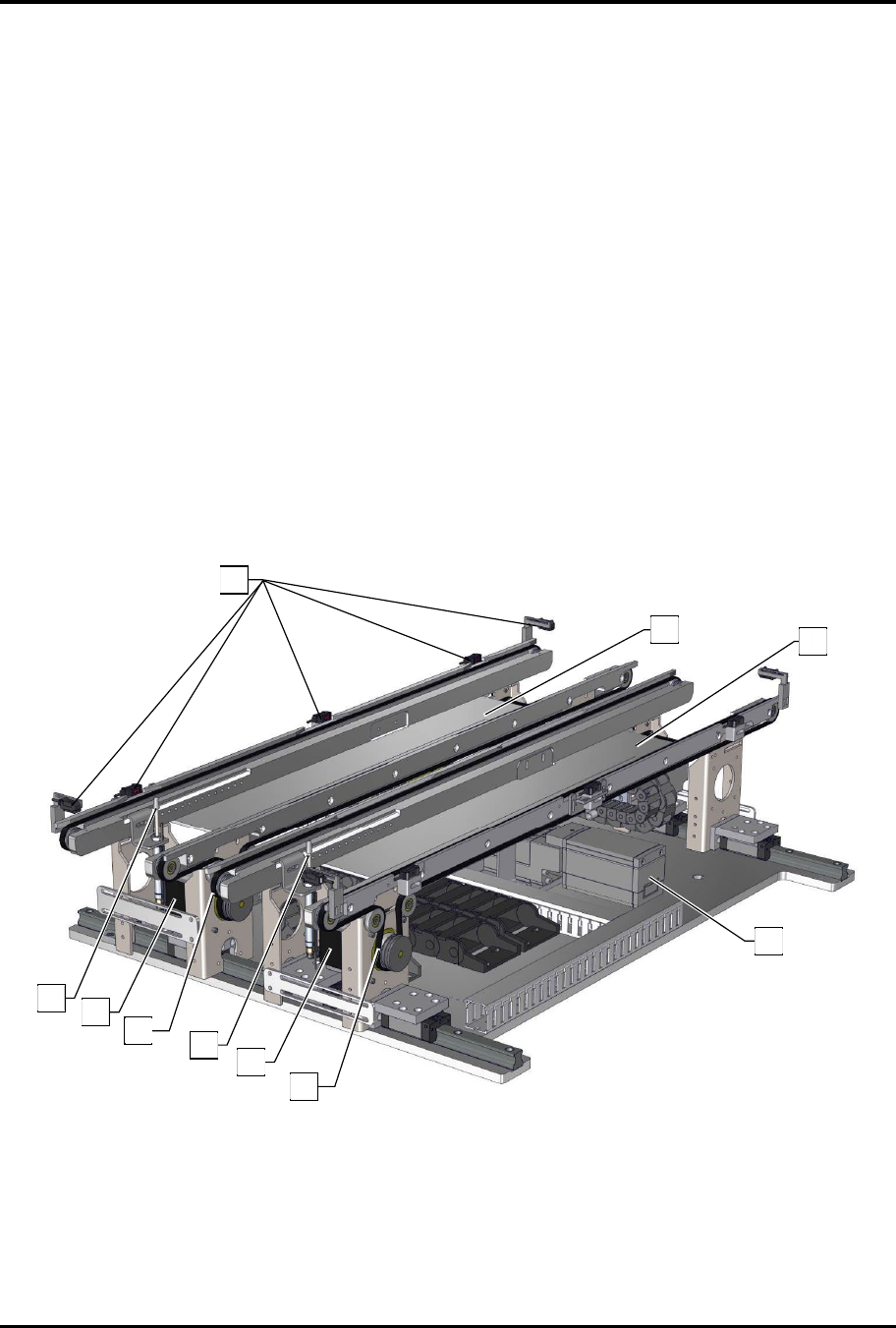
In this configuration, Lane 1 is a fixed assembly, manually aligned, leveled, and secured at the factory. It
is used during initial setup to align both the upstream and downstream systems (Figure 4-8). It is typically
used with fixed dual-lane systems upstream and downstream. Parts can be delivered at a teachable lane
spacing and the separator lane adjusts the lane spacing required for plasma processing.
Lane 2 is closest to the processing chamber, also known as the separator. This lane is controlled by a
linear actuator, and its positions are taught using the FlexTRAK-2MB software, see 5.5.1 Axis Status
Screen.
Figure 4-8 Fully Adjustable Dual-Lane Conveyor
1
2
3
4
5
7
6
3
4
5
FlexTRAK Series 2MB Material Handler Addendum System Components
4-10 © 2023 Nordson Corporation
Table 4-1 Fully Adjustable Dual-Lane Conveyor Components
Item Name Description
1 Lane 1 Lane position is fixed.
2 Lane 2
Lane position is adjustable along the Y-axis. The width of the lane is teachable,
see 7.1 Teaching MH Axis Positions.
3 Stepper Motor
The stepper motors supply power to the belt assemblies. There are two
stepper motors per lane. Both motors are synchronized to operate together and
drive the carriers down the length of the conveyor.
4 Belts
High temperature belts move the parts through the system. There are two belts
per lane, see 4.3.1.7 High Temperature Belts.
5 Carrier Stops
The pneumatic carrier stop prevents over travel of the part. There is one carrier
stop per lane, see 4.3.1.6 Carrier Stops.
6
Lane Position
Sensors
The lane position sensors detect parts throughout the length of the conveyor.
The number of sensors per lane can vary, depending upon the size of the
process carrier and ensure traceability of the carrier, see 4.3.1.4 Lane Position
Sensors.
7
Separator
Actuator
The separator actuator controls the position of Lane 2. There are two teachable
positions (grip and conveyance). Home position is built into the actuator, see
4.3.1.5 Separator Actuator.