00197783-01_AI_Gantry-Retrofit_X-Series_S_INTERNAL_de_en.pdf - 第84页
Introduction Safety information 1.1.2 Safety Instructions for Working with St rong Magnetic Fields 84 Gantry Retrofit Portalna chrüstung 1.1.2 1 . 1 . 2 S a f e t y I n s t r u c t io n s f o r W o r k in g w it h S t r …
Introduction
1.1.1 Conventions for the use of safety instructions Safety information
Gantry Retrofit Portalnachrüstung 83
1
1 Introduction
Introduction
This manual describes the retrofitting of a gantry in SIPLACE® X-Series S machines.
1.1
1.1 Safety information
Safety information
Nonobservance of these safety instructions may cause injury to personnel and damage to the machine
1.1.1
1.1.1 Conventions for the use of safety instructions
Conventions for the use of safety instructions
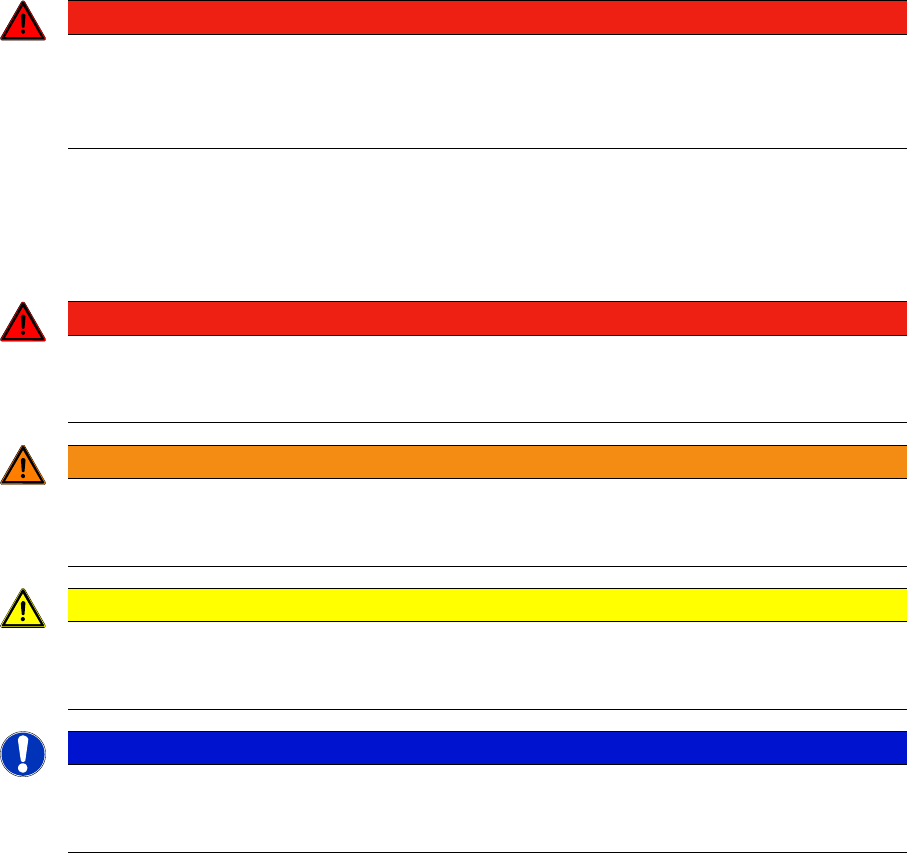
This manual contains notes that must be observed to guarantee your personal safety and to avoid dam-
age to equipment. These notes are highlighted by warning triangles and are indicated as follows accord-
ing to the level of risk:
DANGER
Nonobservance of these safety instructions may cause injury to personnel and damage to the
machine!
► Please observe the safety instructions in the user manual of the relevant machine for all
work!
DANGER
Definition
For the purposes of this manual, this indicates that fatal or severe injuries or considerable dam-
age to property will occur if this hazard warning is not observed.
WARNING
Definition
For the purposes of this manual, this indicates that fatal or severe injuries or considerable dam-
age to equipment may occur if these warning instructions are not followed.
CAUTION
Definition
For the purposes of this manual, this indicates that minor injuries or damage to property may
occur if this caution is not observed.
NOTICE
Definition
For the purposes of this manual, this note provides information about the product or indicates
a part of the manual that requires particular attention.
Introduction
Safety information 1.1.2 Safety Instructions for Working with Strong Magnetic Fields
84 Gantry Retrofit Portalnachrüstung
1.1.2
1.1.2 Safety Instructions for Working with Strong Magnetic Fields
Safety Instructions for Working with Strong Magnetic Fields
Strong pe rmanent magnet fie lds
Danger of crushing
Strong pe rmanent magnet fie lds
1.1.3
1.1.3 Safety Instructions for Working with Strong Magnetic Fields (internal)
Safety Instructions for Working with Strong Magnetic Fields (internal)
Preparation
The following steps must always be observed when disassembling or removing magnets, guide rails and
gantries.
► Provide an empty box for the removal of each magnet. Only one magnet may be placed in each box!
► Switch off the machine, disconnect it from the power supply and secure it to prevent unauthorized
reactivation. Observe the instructions in section "1.2 Preparatory Work..." [ ➙ 89].
► Complete all necessary repair/replacement work before removing the magnet.
► Clear the area, in which the magnet is to be unpacked, of all ferromagnetic objects (steel particles,
screws, tools, and metal tables, etc.).
► Move all recording and measuring equipment to a safe place.
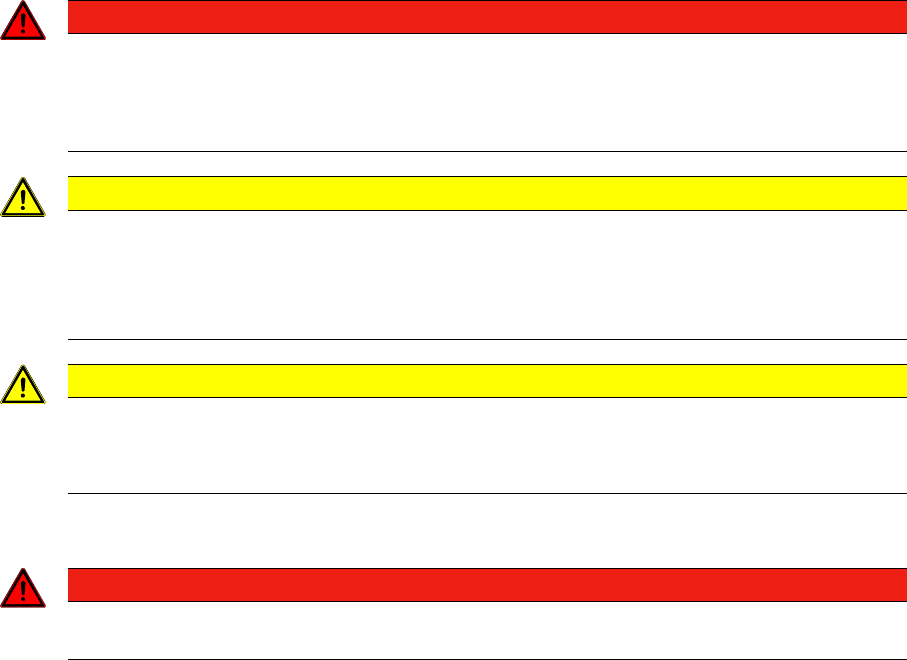
DANGER
Strong permanent magnet fields
Fatal hazard: persons with active implants (e.g. pacemakers, defibrillators, insulin pumps etc.)
are at risk from strong permanent magnetic fields inside the machine.
Persons at risk should avoid the immediate vicinity of the machine.
CAUTION
Danger of crushing
Danger of crushing for persons with passive metal implants (e.g. plates, screws).
► Do not reach or lean over into the machine when the protective covers are open.
► Do not bring any metal objects into the hazard area.
CAUTION
Strong permanent magnet fields
There is a risk that the strong magnetic fields could corrupt data on data media or check cards.
► Keep sensitive data supports away from the permanent magnets.
DANGER
Only SIPLACE engineers may remove the magnets, guide rails and gantries which relate to the
linear actuators.

Introduction
1.1.3 Safety Instructions for Working with Strong Magnetic Fields (internal) Safety information
Gantry Retrofit Portalnachrüstung 85
1.1.3.1
1.1.3.1 Removing the Magnetic Track
Removing the Magnetic Track
DANGER
Observe the following points during removal:
► Persons wearing active implants (e.g. pacemakers) or other ferromagnetic prostheses are
explicitly forbidden to work on this equipment or approach the vicinity of it. Keep at a safe
distance from the magnet.
► Special precautions need to be taken due to the strong magnetic attraction forces in the di-
rect vicinity of the magnetic track and the moving primary unit. Heavy or wide objects made
of steel or iron must never be brought close to the magnetic track by hand. Because the
magnetic attraction forces are not visible, their effects close to the magnetic track are gen-
erally underestimated. The magnetic attraction force can start to take effect abruptly. In the
vicinity of ferromagnetic objects (made of steel or iron) of a similar size to that of the mag-
netic track, they can increase to several thousand newtons.
► Always wear appropriate work clothes and protective clothing (e.g. gloves, shoes, etc.)
when handling the magnetic track.
► Only suitably trained SIPLACE engineers are permitted to carry out assembly work and oth-
er tasks associated with replacing the magnetic track.
► In the event of emergencies, always have at least two wedges (approximately 10° through
15°) made of solid, non-magnetic material (e.g. plastic or aluminum) [Item.No.: 03097870-
xx] and a non-magnetic hammer (approximately 2 - 3 kg) [Item.No.: 03097897-xx] to hand.
These tools are required in the event of an emergency in order to separate parts that have
become magnetically attached to the magnetic track and to release any parts of the body
(finger, hand, foot) that may have become trapped.
► Never place the coil assembly of an iron-core motor directly on the magnetic track.
► Electronic equipment and measuring instruments can be damaged or destroyed by strong
magnetic fields. Do not place any equipment that contains magnetic components in the vi-
cinity of computers, monitors or magnetic data media (e.g. hard disks, credit cards, audio-
tapes, videotapes etc.).
► Always keep a distance of at least 45 cm (18 inches) between individual magnetic tracks
or between a magnetic track and other magnetic surfaces!