IPC-7095C-2013.pdf - 第53页
5.2.2.4 Aramid Paper The supply of nonwoven aramid paper has diminished due to a lack of manufacturing sources. Aramid papers have been ef fectively used in a number of multilayer applications. They have most of the bene…
of faithful service among the traditional resin systems.
However, to support the move to meet legislated lead free
requirements by the EU, many new resins are being devel-
oped to meet the higher temperature assembly reflow
requirements. Test methods have been developed, i.e., Td
(Temperature of decomposition) and T260, T288, T300
(Time to Delaminate), to quantify material properties for
conformance to the new EU requirements. Some of the
new resin systems are classified to new material slash
sheets such as IPC-4101 /99, /101, /121, /124, /126 and
/129.
5.2.1.1 Epoxy Epoxy is among the organic resins with
the longest history and it is one of the most commonly used
resin systems for PCBs. It offers a good blend of physical,
electrical and processing properties at reasonable cost. The
general properties are provided in Table 5-1. Higher tem-
perature capability epoxy resin systems have been devel-
oped for lead-free applications and are available at a cost
premium.
5.2.1.2 Polyimide Polyimide offers the highest operating
temperature among resin systems in use today. It has been
a favorite for military applications where the potential for
board rework and repair in the field with uncontrolled sol-
dering tools is anticipated. Because of its high glass transi-
tion temperature, polyimide provides a safety margin and
potential to reduce damage to the board when uncontrolled
soldering irons are used to remove or replace a component.
The general properties are provided in Table 5-1.
5.2.1.3 Bismaleimide Triazine Bismaleimide triazine or
BT resin is the most popular choice for the construction of
BGA packages because of its combined advantages of high
temperature capability at reasonable cost. The general
properties are provided in Table 5-1.
5.2.2 Reinforcements Reinforcements provide the
dimensional stability and the bulk of the mechanical prop-
erties of the organic substrate laminate. Following are some
of the more commonly used reinforcements.
5.2.2.1 Glass Cloth Glass cloths are the most commonly
used reinforcement for PCB substrates. They are widely
available and are processed with relative ease. The cloths
are available in a number of different thicknesses and
weaves. The chemical make-up of the glass can vary and
can affect the electrical properties. Presently, E type glass
is the most commonly used glass cloth for PCB substrates.
5.2.2.2 Glass Felt Glass felt or nonwoven glass mat has
been commonly used as a reinforcement material for fluo-
roplastic resins and is commonly used in low loss, RF or
microwave applications. It has seen some application in
formable laminates as well.
5.2.2.3 Aramid Cloth Aramid cloth has been used to
reinforce certain laminates. It is unusual in that it has a
negative CTE in the X and Y direction which helps to off-
set the in-plane CTE of the resin. Because of the counter-
acting expansion and contraction, laminate materials of this
combination can match approximately the CTE of ceramic.
However, a drawback of the material is that the aramid has
Z-axis CTE much higher than glass and, in thermal excur-
sions, can fracture nearby resin, leaving micro-cracks along
the surface of the fibers.
IPC-7095c-5-01a,b,c,d
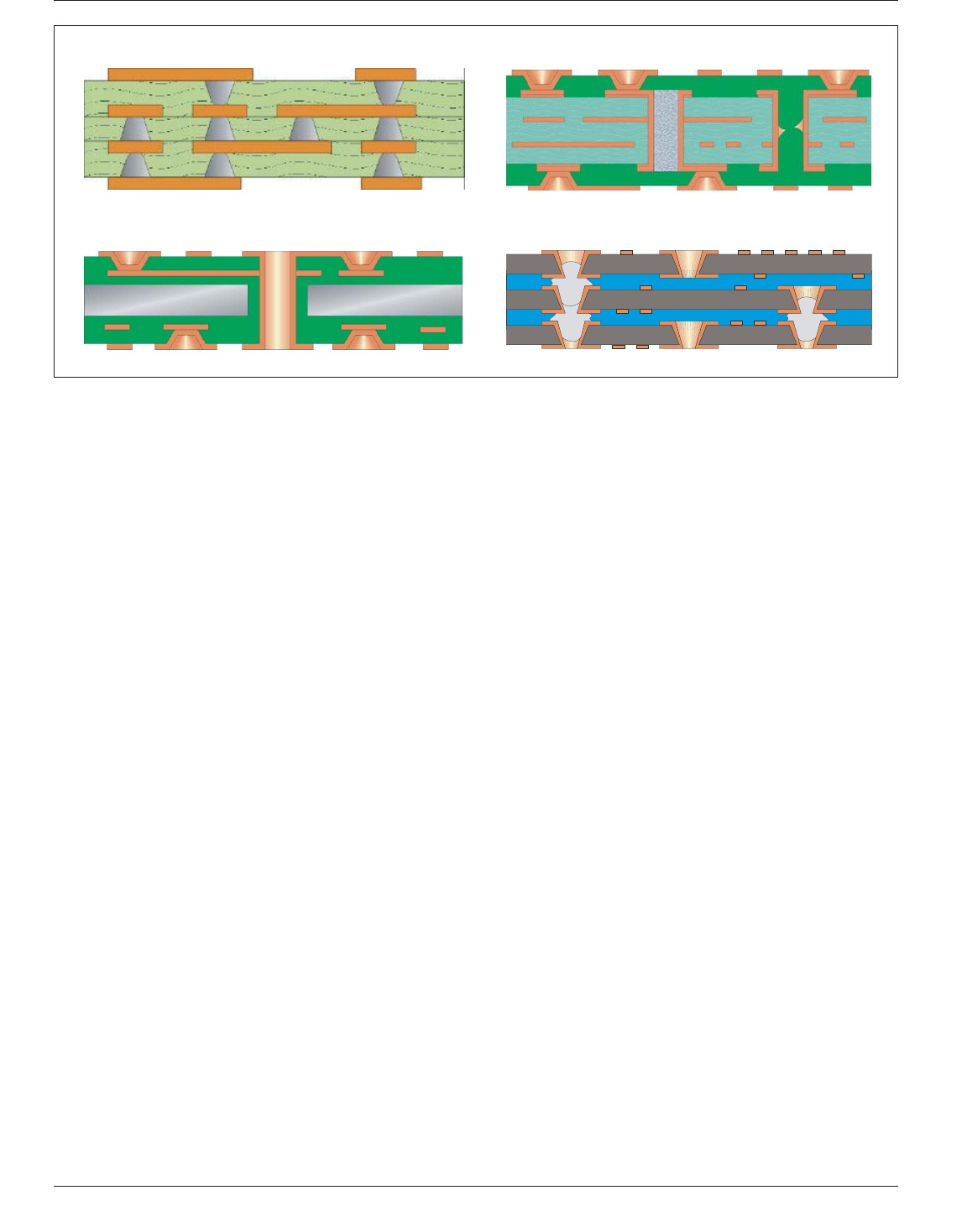
Figure 5-1 Examples of Different Build-Up Constructions
A. Piercing post co-laminated structure - Type IV HDI Construction
B. Sequentially built-up multilayer - Type II HDI Construction
C. Passive substrate with external microvia layers interposer - Type IV HDI Construction
D. Filled via sequentially co-laminated substrate - Coreless Type V HDI Construction
A
C
B
D
IPC-7095C January 2013
38
Copyright IPC-Association Connecting Electronics Industries
Provided by IHS under license with IPC
Not for Resale
No reproduction or networking permitted without license from IHS
--`,,```,,,,````-`-`,,`,,`,`,,`---

5.2.2.4 Aramid Paper The supply of nonwoven aramid
paper has diminished due to a lack of manufacturing
sources. Aramid papers have been effectively used in a
number of multilayer applications. They have most of the
benefits of the aramid cloth with more process latitude.
They are often used for thin core layers at or near the sur-
faces of the printed boards to better control CTE. Because
the aramid is organic, it has the added advantage of being
more easily processed by laser ablation and can also be
processed using plasma etching for making holes. The
organic nature of the material also helps to keep the dielec-
tric constant low.
5.2.3 Laminate Material Properties There are a number
of different material properties that are important in the
selection of a laminate for BGA substrate manufacture.
5.2.3.1 Thermal Expansion Thermal expansion is usu-
ally characterized in terms of changes to the x-y plane,
which is controlled primarily by the reinforcement of the
material. The x-y expansion will have the greatest effect on
surface mounted components and their reliability. Thermal
expansion also occurs in the z-axis at a rate significantly
larger than in the x-y plane, particularly at temperatures
above the T
g
. The z-axis expansion will have its greatest
effect on plated-through hole and via reliability.
Table 5-1 shows the conditions for various reinforced resin
types. All thermal expansion is measured in parts/million/
change in temperature (°C).
5.2.3.2 Glass Transition Temperature Glass transition
temperature is that property of the material where the rein-
forcement and the resin systems transition from a linear
coefficient of thermal expansion and expand at a much
higher rate. The glass transition temperature (T
g
) indicates
a temperature range within which resins change molecular
structure from a glassy to an amorphous state; these differ-
ent molecular structures result in very different physical
properties. This occurs when the resin system exceeds its
cured polymer state. It is usually an expansion in the Z-axis
of the material and the temperature stated expands at a
faster rate, although still linear (mm/mm of thickness).
Table 5-1 shows some of the characteristics of the condi-
tions for glass transition temperature of various material
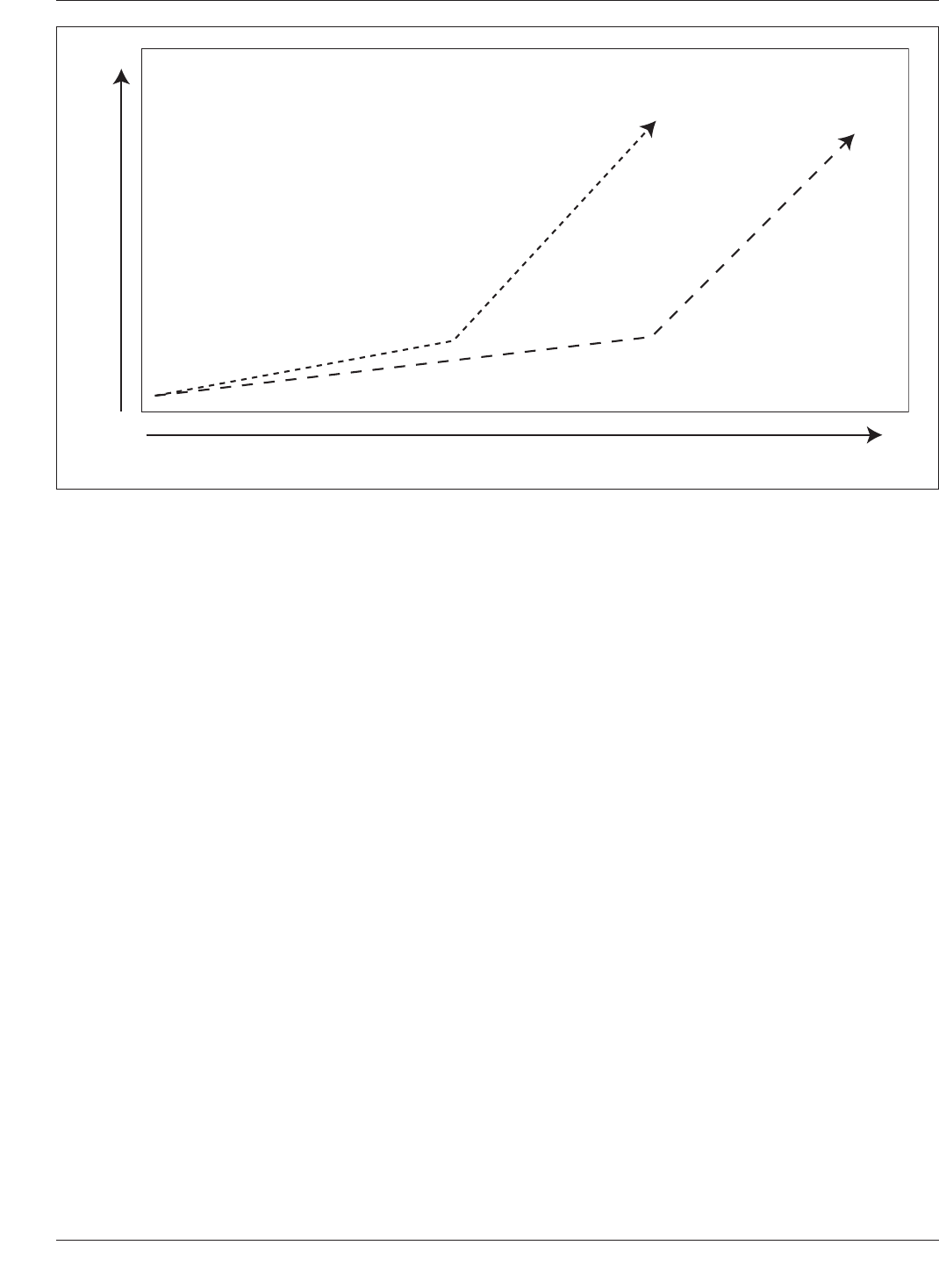
types. Figure 5-2 illustrates the concept graphically and
shows how different resins might perform.
Table 5-1 Environmental Properties of Common Dielectric Materials
Environmental Property
Material
FR-4
(Epoxy
E-glass)
Multi-
Functional
Epoxy
High
Performance
Epoxy
Bismaleimide
Triazine/
Epoxy Polyimide
Cyanate
Ester
Coefficient of Thermal Expansion,
xy-plane, CTE(xy) (ppm/°C)
16-19 14-18 14-18 ~15 8-18 ~15
Coefficient of Thermal Expansion,
z-axis below T
g
1
, CTE(z,<T
g
) (ppm/°C)
50 - 85 44 - 80 ~44 ~70 35 - 70 ~81
Coefficient of Thermal Expansion
z-axis above T
g
1, CTE(z,>T
g
) (ppm/°C)
240 - 390 240 - 390 240 - 390 220 - 370 200 - 350 210 - 360
Thermal Expansion z-axis,
TE(50-260°C) (%)
3.0 - 4.5 2.5 - 4.0 2.0 - 3.5 2.0 - 3.5 1.8 - 3.0 2.0 - 3.3
Glass Transition Temperature
2
,
T
g
(°C)
110 - 140 130 - 160 165 - 190 175 - 200 220 - 280 180 - 260
Decomposition Temperature
3
,
Td (5%) (°C)
310 - 330 320 - 350 330 - 400 ~334 ~376 ~376
Soldering Temperature Impact Index
4
,
STII
170 - 205 200 - 220 215 - 260 TBD TBD TBD
Flexural Modulus (GPa)
Fill
5
Warp
6
18.6
12.0
18.6
20.7
19.3
22.0
20.7
24.1
26.9
28.9
20.7
22.0
Tensile Strength (MPa)
Fill
5
Warp
6
413
482
413
448
413
524
393
427
482
551
345
413
Water Absorption (wt%) 0.5 0.1 0.3 1.3 1.3 0.8
1. CTE (z,<T
g
) is also known as Alpha 1, and CTE(z, >T
g
) as Alpha 2. Contact supplier for specific values of the other materials.
2. The glass transition temperature can be measured by three different methods (TMA, DSC, DMA). Of these the values obtained by TMA are the most
pertinent for the purpose of assessing reliability issues. A very rough relationship between the results of these three methods is T
g
(TMA) ≈T
g
(DSC) -10°C
≈T
g
(DMA) -20°C. Contact supplier for specific values of other materials.
3. The decomposition temperature can be measured to two different values of weight loss, Td (2%) and Td (5%). Td (5%) is more commonly used, but Td (2%)
is becoming popular because of its greater usefulness. Contact supplier for specific values of other materials.
4. Soldering Temperature Impact Index, STII, which is defined as STII = T
g
/2 + Td/2 — (TE%(50 to 260°C) x 10).
5. Fill - yarns that are woven in a crosswise direction of the fabric.
6. Warp (cloth) - yarns that are woven in a lengthwise direction of the fabric.
January 2013 IPC-7095C
39
Copyright IPC-Association Connecting Electronics Industries
Provided by IHS under license with IPC
Not for Resale
No reproduction or networking permitted without license from IHS
--`,,```,,,,````-`-`,,`,,`,`,,`---
Laminates of different resins often have different glass
transition temperatures resulting in different capabilities in
high temperature applications. Lead free with its high tem-
perature processing will require higher performance lami-
nates. These are normally a higher cost.
The glass transition temperature can be measured by three
different methods (TMA, DSC, DMA). Of these the values
obtained by TMA are the most pertinent for the purpose of
assessing reliability issues. A very rough relationship
between the results of these three methods is T
g
(TMA) ≈
T
g
(DSC) -10°C ≈ T
g
(DMA) -20°C.
5.2.3.3 Moisture Absorption Most organic materials are
hygroscopic to some degree and soak up moisture at differ-
ent rates; some do so relatively rapidly. This moisture
absorption changes the electrical properties of the material,
such as loss tangent and the processing characteristics of
the material, as outgassing can result in blisters. It can also
impact physical dimensions and the laminate’s weight.
Thus a simple way to determine that the material has
absorbed moisture is to note the increase in weight under
defined moisture exposure conditions. Table 5-1 shows the
water absorption rate by weight for the various materials
highlighted in this section. IPC-1601 defines packaging
standards to reduce moisture absorption and test procedures
to determine the moisture content in a printed board.
5.2.3.4 Reliability Concerns with High Lead-free Solder-
ing Temperatures
The higher temperatures required for
soldering lead-free solders creates reliability concerns for
the survivability of the PCB resins as well as the integrity
of the PCB interconnect structures, such as plated-through
holes and vias. The properties that are most important in
this respect are the decomposition temperature, thermal
expansion, and the glass transition temperature. The
decomposition temperature (T
d
) measures the temperature
at which the resin decomposes irreversibly and thereby
loses weight; typically the temperature to a weight loss
of 2% or 5% is measured. The thermal expansion from
50-260°C, TE(50-260°C) is a composite of the thermal
expansions below and above the glass transition
temperature.
The impact of these three properties is captured with the
Soldering Temperature Impact Index, STII, which is
defined as STII = T
g
/2 + T
d
/2 - (TE%(50-260°C) 10).
5.3 Surface Finishes The primary purpose of a surface
finish is to prevent oxidation of exposed copper on the
PCB; this ensures the surface is solderable when compo-
nents are mounted or inserted. Surface finishes also provide
several other functions; these include: reliable contact sur-
face for probes, contacts or switches, wire bonding and a
flat surface for solder paste printing. Although BGAs are
the focus of this document, other components and assem-
bly operations must be taken into consideration when
choosing the most appropriate surface finish.
There is not an ideal surface finish that is best suited for all
applications; however, the search continues for improved-
surface finish solutions. Some of the application features
that must be considered in selection of a suitable surface
finish are given in Table 5-2. PCB handling is critical
because salts from hands can damage the surface finish
IPC-7095c-5-2
Figure 5-2 Expansion Rate Above T
g
Expansion
Temperature
T
g
-1
T
g
-2
Resin laminate
system 1
Resin laminate
system 2
IPC-7095C January 2013
40
Copyright IPC-Association Connecting Electronics Industries
Provided by IHS under license with IPC
Not for Resale
No reproduction or networking permitted without license from IHS
--`,,```,,,,````-`-`,,`,,`,`,,`---