00198829-01_SM_X-Series-S_Hxxxx_EN.pdf - 第19页
1 Introduction 1.3 Other instructions Service Manual SIPLACE X-Series S (from Hxxxx) 01/2021 19 1.3.4 ESD guidelines 1.3.4.1 What does ESD mean? Fig.4: ESD label Almost all of the modules in use today are equipped with …
1 Introduction
1.3 Other instructions
18 Service Manual SIPLACE X-Series S (from Hxxxx) 01/2021
The following steps must be taken to restore the machine to operation.
► Check the workspace. Authorized employees should remove all of their tools and reinstall all
safety features.
► Notify all affected employees.
► Before removing even one lock or tag, inform all workers in the affected area that the machine
is going to be restarted.
► Remove all locks/tags.
Every authorized employee must remove his own lock and shut it away.
► Switch on the machine. Make sure that authorized staff check the equipment in operation to
ensure that all repairs were performed correctly.
Testing
Service personnel may test circuits by energizing them briefly without suspending the lock out / tag
out procedure. This may only be done when no other work is being performed by any other person
on the equipment being tested.
It is extremely important that all remote Start switches are tagged with the "Do Not Operate" tag to
prevent inadvertent operation of the equipment during these periods.
Responsibilities
●
It shall be the responsibility of the maintenance and service personnel to make sure this pro-
cedure is adhered to.
●
It shall be the responsibility of the maintenance and service personnel's immediate supervisor
to instruct their personnel on this procedure.
●
It shall be the responsibility of the Safety Officer to administer the lock out / tag out procedure.
1.3 Other instructions
1.3.1 Environmentally-friendly disposal of materials and components
Our products are manufactured using only materials and parts that can be easily separated and
disposed of in an environmentally-friendly way.
NOTICE
Observe the applicable regulations
The company operating the system has sole responsibility for the proper, environmentally-
friendly disposal of machines, working materials, consumable materials and wear parts.
► Please observe your national statutory provisions for waste disposal and environ-
mental protection.
1.3.2 Use of original accessories and spare parts
Only use original spare parts and authorized accessories. The use of other parts will affect safety
and will invalidate the liability for any consequential damage.
1.3.3 Information about this service manual
WARNING
Additional qualifications required
The service work described in this manual may only be performed by specially trained ser-
vice technicians, with appropriate qualifications and expertise.
If you should have any questions during the service work, please contact the SIPLACE customer
hotline directly or send an e-mail to hotline.siplace@asmpt.com.
1 Introduction
1.3 Other instructions
Service Manual SIPLACE X-Series S (from Hxxxx) 01/2021 19
1.3.4 ESD guidelines
1.3.4.1 What does ESD mean?
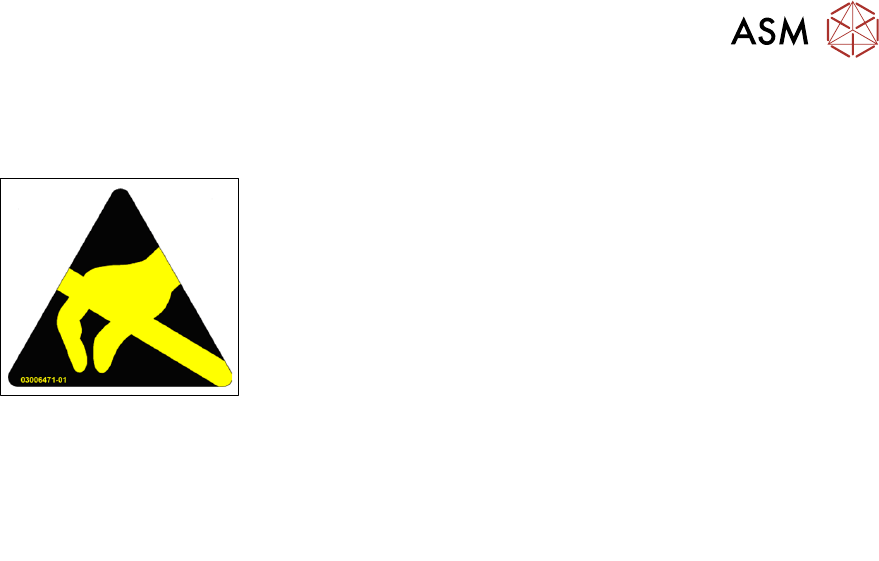
Fig.4: ESD label
Almost all of the modules in use today are equipped with highly integ-
rated Metal-Oxide-Semiconductor (MOS) blocks and components.
The manufacturing techniques used mean that these electronic com-
ponents are extremely sensitive to overvoltage and thus to electro-
static discharge.
The abbreviation for such modules is "ESD" (Electrostatic Sensitive
Device). "ESD" is used internationally. The following symbol on cab-
inet rating plates, racks or packaging indicates that components
which are sensitive to electrostatic discharge have been used and
thus that the modules concerned are also touch-sensitive.
ESDs can be destroyed by voltages and power levels that are far below the level that can be per-
ceived by humans. Such voltages occur if a person touches a component or module without
earthing themselves. Components that are exposed to such overvoltages do not generally appear
to be defective immediately - incorrect behavior starts after the component or module has been in
operation for some time.
1.3.4.2 Important measures to protect against static charging
► Most plastics can easily become charged and must therefore be kept away from at-risk com-
ponents.
► Always ensure that people, the workplace and packaging are safely earthed when handling
electrostatic sensitive components.
1.3.4.3 Handling ESD modules
As a general rule: Only touch electronic modules if you must carry out work on the modules. In that
case, make sure that you do not touch the pins or printed conductors when you pick up flat mod-
ules.
Only touch components if you are earthed by one of the following measures:
●
You are wearing an ESD wristband.
●
You are wearing ESD shoes.
●
You are wearing ESD shoe earthing strips on an ESD floor.
Immediately before you touch an electronic module, discharge your own body by touching a con-
ductive and earthed object (such as unpainted parts of a switch cabinet, a water pipe, etc.).
Do not allow modules with chargeable and highly insulating materials to touch one another, e.g.
plastic films, insulating table surfaces or items of clothing made from synthetic fibers.
Always place the modules on a conductive surface (table with an ESD coating, conductive ESD
foam, ESD bag or container).
Do not move the assemblies near to data view devices, monitors or television units. Keep a min-
imum distance of 10 cm to monitors.
1.3.4.4 Measurements and modifications to ESD modules
Only perform measurements on modules if one of the following conditions is fulfilled:
●
You are using an earthed measuring device (e.g. via PE conductors).
●
You are using a potential-free measuring device and discharge the measuring head before
the measurement (e.g.by touching an unpainted metal part of the controller casing).
► Always use an earthed soldering iron if you carry out any soldering work.

1 Introduction
1.3 Other instructions
20 Service Manual SIPLACE X-Series S (from Hxxxx) 01/2021
1.3.4.5 Dispatching ESD modules
► Always store modules and components in conductive packaging (e.g. metallized plastic bags
or metal sleeves) and dispatch them in conductive packaging
► If the packaging is not conductive, place the modules in a conductive envelope before pack-
aging. Use conductive expanded rubber, ESD bags, domestic aluminum foil or paper, for
example. NEVER use plastic bags or film.
► If the module has integral batteries, ensure that the conductive packaging does not touch or
short circuit the battery terminals and, if necessary, first cover the terminals with insulating
tape or material.
1.3.5 Validity of Document
This document contains service work instructions for all SIPLACEX3 S, X4and X4iS machines.
The service work described in this manual is divided into modules and is largely identical for all
machine types:
●
If the work required for specific machines differs from the standard procedure, this will be in-
dicated with reference to the machine number, series and delivery state.
●
Diagrams should be seen as examples e.g. the diagram of a SIPLACEX3 S or a different
machine paint finish does not mean that the following information only applies to the machine
type shown.
The manual focuses on describing mechanical service work.
Please refer to the circuit diagram folder for any electrical checks:
●
Detailed circuit diagrams folder for SIPLACE X-Series S (from Hxxxx) [DE+EN:00197920‑03]
●
Detailed circuit diagrams folder for SIPLACE X-Series S (from H1440) [DE EN: 00197920-04]
●
Detailed circuit diagrams folder for SIPLACE X-Series S (from H2500) [DE EN: 00198730-xx]
1.3.6 Release History
Document
SIPLACE X-Series S
(from Hxxxx)
Service manual
Release 01/2021
●
Initial release
1.3.7 SIPLACE on the World Wide Web (WWW)
Log in to our SIPLACE® homepage at http://www.asm-smt.com.
You can choose between the German and English version.
The different sections contain information about our products, services and contact persons.
In addition, registered customers can also access the MySIPLACE user group. Here, you can
access special information about our placement systems, e.g.:
●
Technical documentation
●
Technical information
●
Spare parts lists
Registration for the MySIPLACE user group is very simple:
► Click on MyASM and then on Registrieren.
► Fill in the registration form and send it off to us.
Soon afterwards, you will receive your access authorization with user name and password.