00198829-01_SM_X-Series-S_Hxxxx_EN.pdf - 第231页
7 Conveyor 7.8 Laser light barriers, fiber optic cable and PCB sensors Service Manual SIPLACE X-Series S (from Hxxxx) 01/2021 231 Equipment and tools 03017821-xx Loctite 406 (instant glue highly viscous) 03019481-xx Dosa…
7 Conveyor
7.8 Laser light barriers, fiber optic cable and PCB sensors
230 Service Manual SIPLACE X-Series S (from Hxxxx) 01/2021
► Check the setting for the transmitter/receiver and correct if necessary.
7.8.3 "Checking the laser light barrier" [}222]
7.8.4 "Correcting the Laser Light Barrier Setting" [}225]
► Teach the PCB sensors.
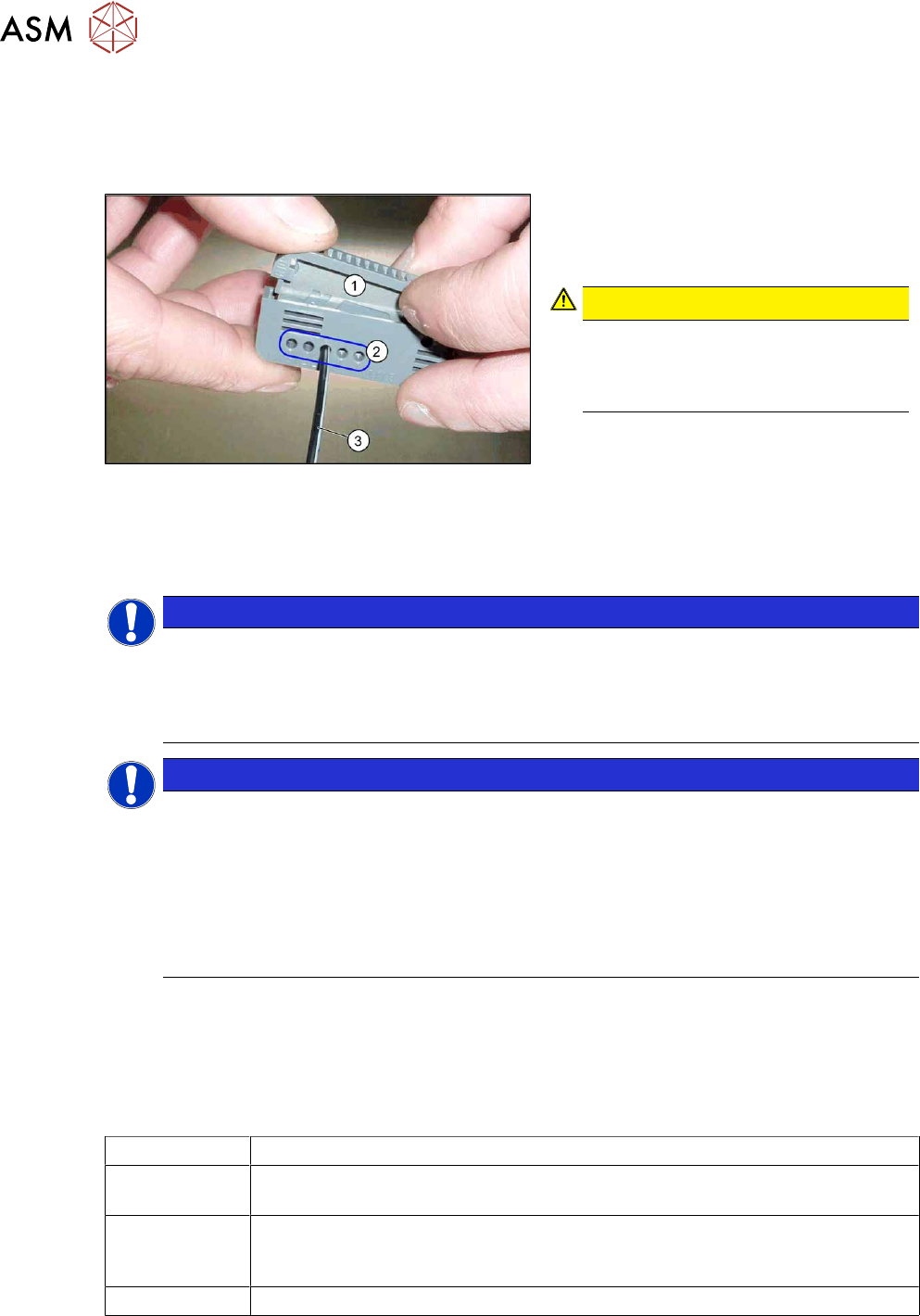
Fig.305: Cutter tool
1. Cutter tool
2. Cutting aperture
3. Fiber optic cable
CAUTION!
Make sure that you only use each cut-
ting aperture once. If they are used
more than once, good quality cuts can
not be guaranteed.
.
7.8.6 Repairing the fiber optic cables
To avoid machine downtimes, it is possible to repair fiber optic cables temporarily, using the repair hose.
NOTICE
Repair hose for fiber optic cable LL3-TV05
► The repair hose may only be used for short periods to avoid machine downtimes.
► The repair hose may only be used once per fiber optic cable.
► The fiber optic cable must be replaced during the next repair or maintenance cycle.
NOTICE
No guarantee
► No guarantee is given if the fiber optic cable is repaired using the repair hose.
► There is no long-term experience with the repair hose.
► Depending on the board width, the intensity of the light beam may diminish in such a
way that an evaluation is no longer possible.
► The repair hose must not be bended. For this reason, there is an additional danger of
rupture after the repair, in areas where the fiber optic cable is routed in narrow radii.
► If another rupture of the fiber optic cable occurs and it is not possible to replace the whole
fiber optic cable, replace the defective part of the fiber optic cable in such a way that only one
repair hose is used.
Parts
03092407-xx Fibre optic cable LL3-TV05 2m (including cutting tool for fibre optic cables)
03092408-xx Fibre optic cable LL3-TV05 3m (spare part) (including cutting tool for fibre optic
cables)
03122383-xx Hose PUN 3x0.5-SW, 100mm (repair hose)
A repair hose is supplied with each fiber optic cable. The repair hose is not
available on its own.
Sheet with yellow glue dots
7 Conveyor
7.8 Laser light barriers, fiber optic cable and PCB sensors
Service Manual SIPLACE X-Series S (from Hxxxx) 01/2021 231
Equipment and tools
03017821-xx Loctite 406 (instant glue highly viscous)
03019481-xx Dosage tip for Loctite
00372972-xx Protective latex gloves
00353832-xx Allen key set
Cable tie
Wire cutters
Troubleshooting
► In the station software, activate all fiber optic cables (transmitters). These may need to be re-
calibrated without boards in the conveyor.
► A red light must be visible for the transmitters.
If no light is visible at the transmitter, there is probably an error.
► As a cross-check, you can switch the transmitting and receiving fiber optic cable at the corres-
ponding fiber optic sensor (WLL180T-F preconfigured SXa [03093295‑xx] or WLL180T-M pre-
configured SXa [03093294‑xx]).
NOTICE
Do not confuse the transmitter with the receiver
► Make sure not to confuse the transmitting and receiving fiber optic cable. If you do,
other optical sensors may be sporadically affected.
NOTICE
Display on the fiber optic sensors
The display on the fiber optic sensors corresponds to the currently measured intensity.
► The intensity can vary depending on installation position, cable length and environ-
mental conditions.
► The value shown should be not less than 100.
► The fiber optic sensor reacts to intensity deviations during operation.
Performing the repair
► Use the software or manually move the conveyor rail into a position which allows you best
access.
► Switch off the machine, disconnect it from the power supply and secure it to prevent
unauthorized reactivation.
1.2 "Preparatory work..." [}16]
► Remove the fiber optic cable from the conveyor side.
NOTICE
Sticker
If the fiber optic cable has already been repaired, a yellow adhesive sticker dot will be
attached to the optical system or the fiber optic sensor.
One repair hose may be used per fiber optic cable. You must either replace the whole fiber
optic cable or the part that has already been repaired.
► Check the fiber optic cable for damages.
The most common error causes are:
– Optical system of the fiber optic cable damaged
– Fiber optic cable pinched in conveyor side
– Fiber optic cable ruptured (e.g. caused by a too narrow bending radius)
7 Conveyor
7.8 Laser light barriers, fiber optic cable and PCB sensors
232 Service Manual SIPLACE X-Series S (from Hxxxx) 01/2021
NOTICE
Fiber optic cable ruptured at the trailing chain
If the fiber optic cable is ruptured in the trailing chain or at the transition from the trailing
chain to the conveyor side, the effort for finding the error cause is often identical to the ef-
fort for replacing the complete fiber optic cable.
► Cut the fiber optic cable at the defective position.
► Use the cutter tool to cut off 10mm of the fiber optic cable on each side of the rupture.
Make sure to preserve a minimum distance of approx. 50mm to the optical system of the fiber
optic cable.
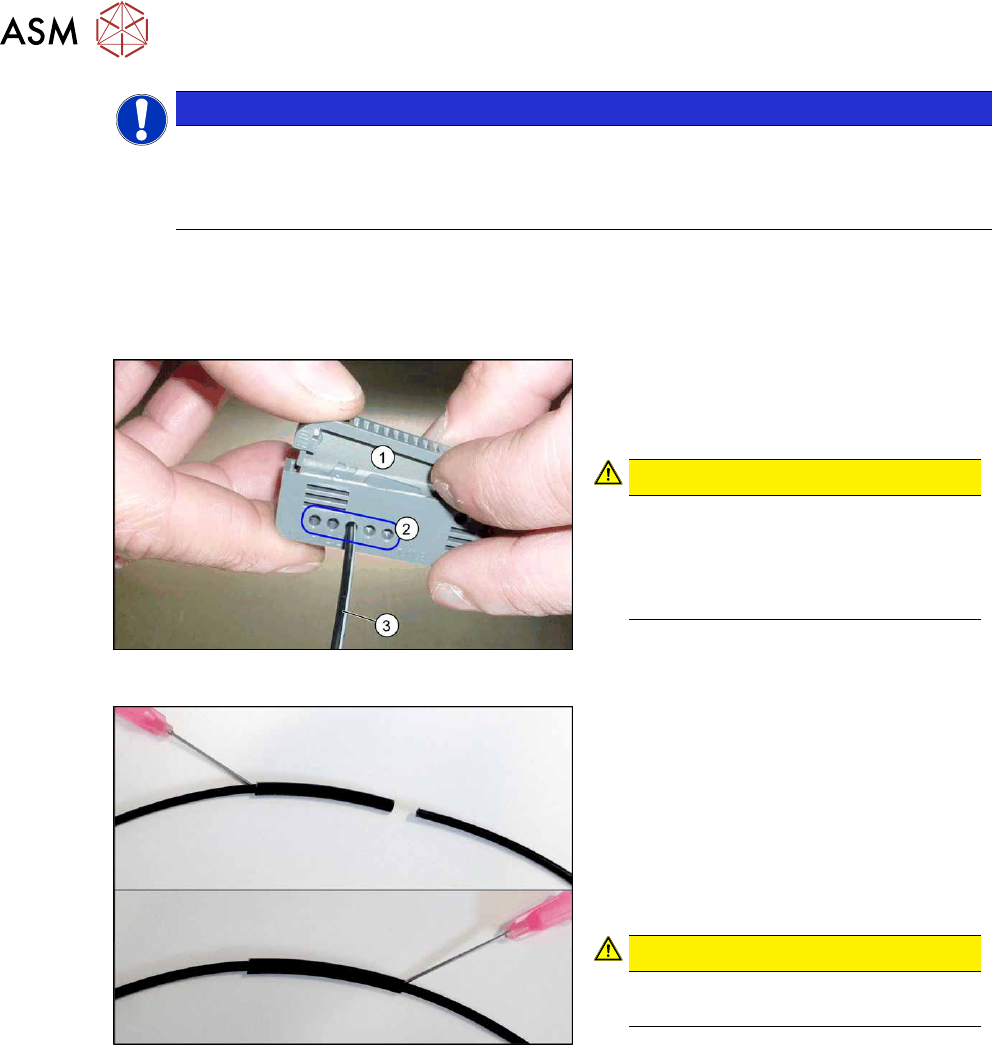
Fig.306: Cutter tool
1. Cutter tool
2. Cutter openings
3. Fiber optic cable
CAUTION!
Only use each cutter opening once
Make sure that each cutter opening is
only used once. The quality of the cut
cannot be guaranteed if it is used more
than once.
.
Fig.307: Repairing the fiber optic cables
► Slide both ends of the fiber optic cable
into the repair hose until they touch
each other.
► Fix the repair hose into place with Loc-
tite 406.
This adhesive is used to fix the fiber
optic cable in the hose. The two ends
of the fiber optic cable are not fixed to
one another with adhesive.
CAUTION!
Highly viscous instant glue
Use gloves and a dosage tip.
.
Further installation is performed by following the above instructions in the reverse order. Also
observe the following instructions:
► Check the setting for the transmitter/receiver and correct if necessary.
7.8.3 "Checking the laser light barrier" [}222]
7.8.4 "Correcting the Laser Light Barrier Setting" [}225]
► Calibrate the sensors of the PCB conveyor.
► Check the display on the fiber optic sensor. The value shown must be over 100. Check the
value for the various conveyor widths (red = output / green = input).
► Mark the optical system and the fiber optic cable at the fiber optic sensor with the glue dot
supplied. The glue dot indicates that the fiber optic cable has already been repaired and that a
replacement is compulsory at the next defect.