MDS-C1-SPA Series INSTRUCTION MANUALib1500152(eng)a.pdf - 第164页
4. Spindle Adjustment 4 - 73 2) Changing the coil during spindle motor rotati on This method uses the characteristics of coil chang eover to change the coil during motor rotation, and changing directly from the low-speed…
4. Spindle Adjustment
4 - 72
1) Stopping the spindle motor and changing the coil
With this method, the high-speed coil and low-speed coils are viewed as electronic gears that are
handled in the same manner as the mechanical gears.
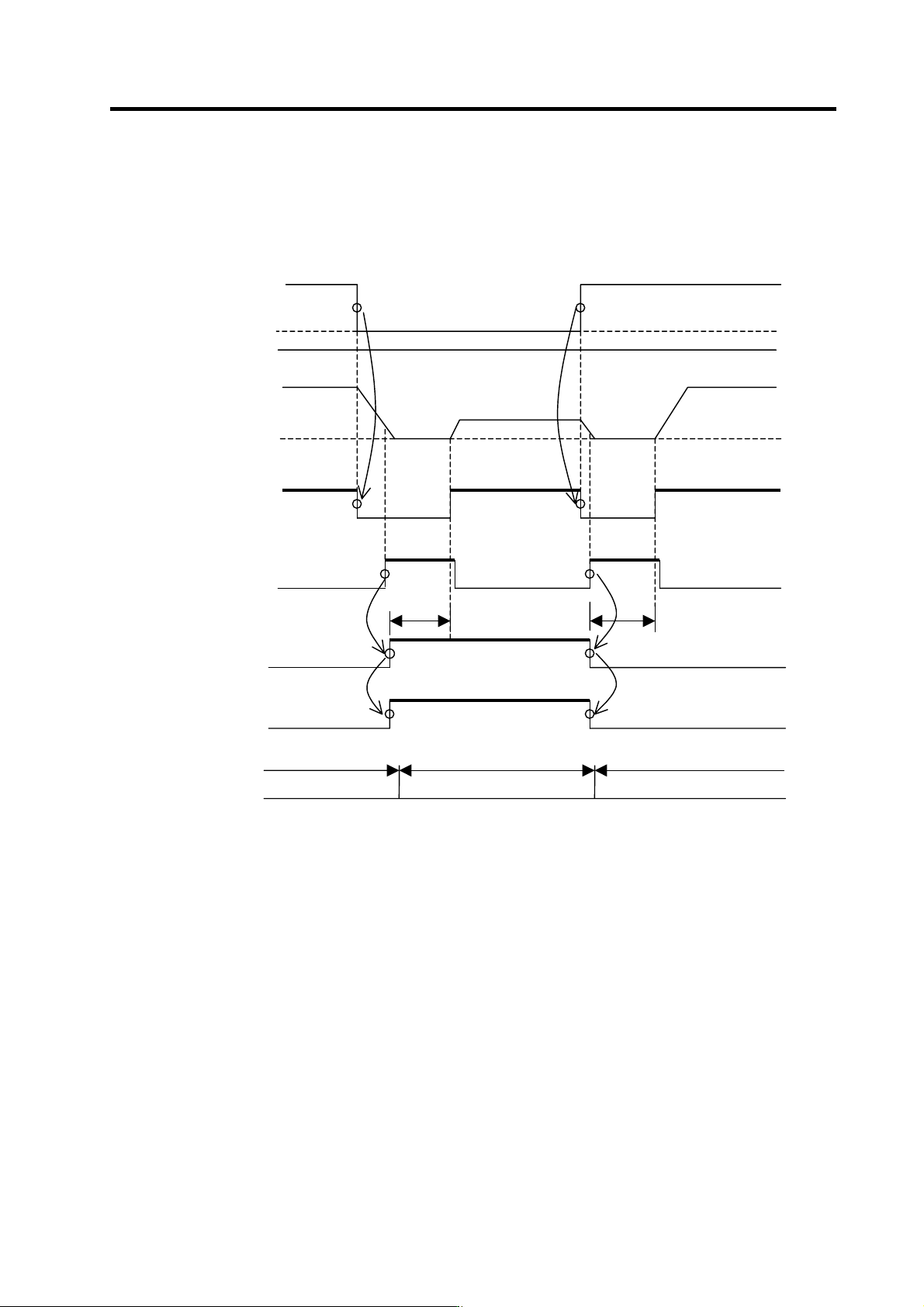
<Example of N3 → N1 → N3 changeover sequence>
N3
N1
0
N3
0
Speed command
Motor rotation speed command
Start signal
(SRN or SRI)
Zero speed output signal
(ZS)
L coil selection command
signal (LCS)
L coil selected signal
(LCSA)
N1
ON
ON
ON
OFF
OFF
ON
ON
OFF OFF OFF
ON
ON
OFF OFF
(Note) (Note)
OFF
OFF
High-speed coil selection Low-speed coil selection High-speed coil selection
[1] If the speed command changes to N1 while the motor is rotating in N3 (hig h-speed coil range),
the motor is stopped once by the user's seq uence. After confirmin g that the zero speed outp ut
signal (ZS) has turned ON, the L coil selection command signal (LCS) is turned ON. After
changing from the low-speed coil to the high-speed coil, the start signal (SRN or SRI) is turned
ON again, and the motor is accelerated to N1.
[2] In the same manner, when changi ng the sp eed co mmand from N1 to N3, the motor is stop ped
once. After confirming that the zero speed output signal (ZS) has turned ON, the L coil
selection command signal is turned OFF. After changing from the high-speed coil to the
low-speed coil, the start signal is turned ON, and the motor is rotated at the spe ed of N3.
(Note) Provide a time longer than T
M
from when the L coil selection command signal (LCS) is input to
when the start signal turns ON. Or, set the sequence so that the start signal turns ON after the coil
changed signal (MKC) changes from ON to OFF instead of using a timer.
4. Spindle Adjustment
4 - 73
2) Changing the coil during spindle motor rotation
This method uses the characteristics of coil changeover to change the coil during motor rotation,
and changing directly from the low-speed coil to the high-speed coil. The transition time is shorter
compared to the method explained in the previous section. The speed detection signal (SD) is
used with this method, and the L coil selection command signal (LCS) is input in the following
manner.
[1] To accelerate from a stopped state (To accelerate after zero speed output signal turns ON)
(i) First, judge the high-speed/low-speed coil range with the speed command, and select the
coil. (Input the L coil selection command signal (LCS).)
(ii) Next, turn the start signal ON and accelerate the motor.
(iii) Hold the L coil selection command signal (L CS) in the state of (i).
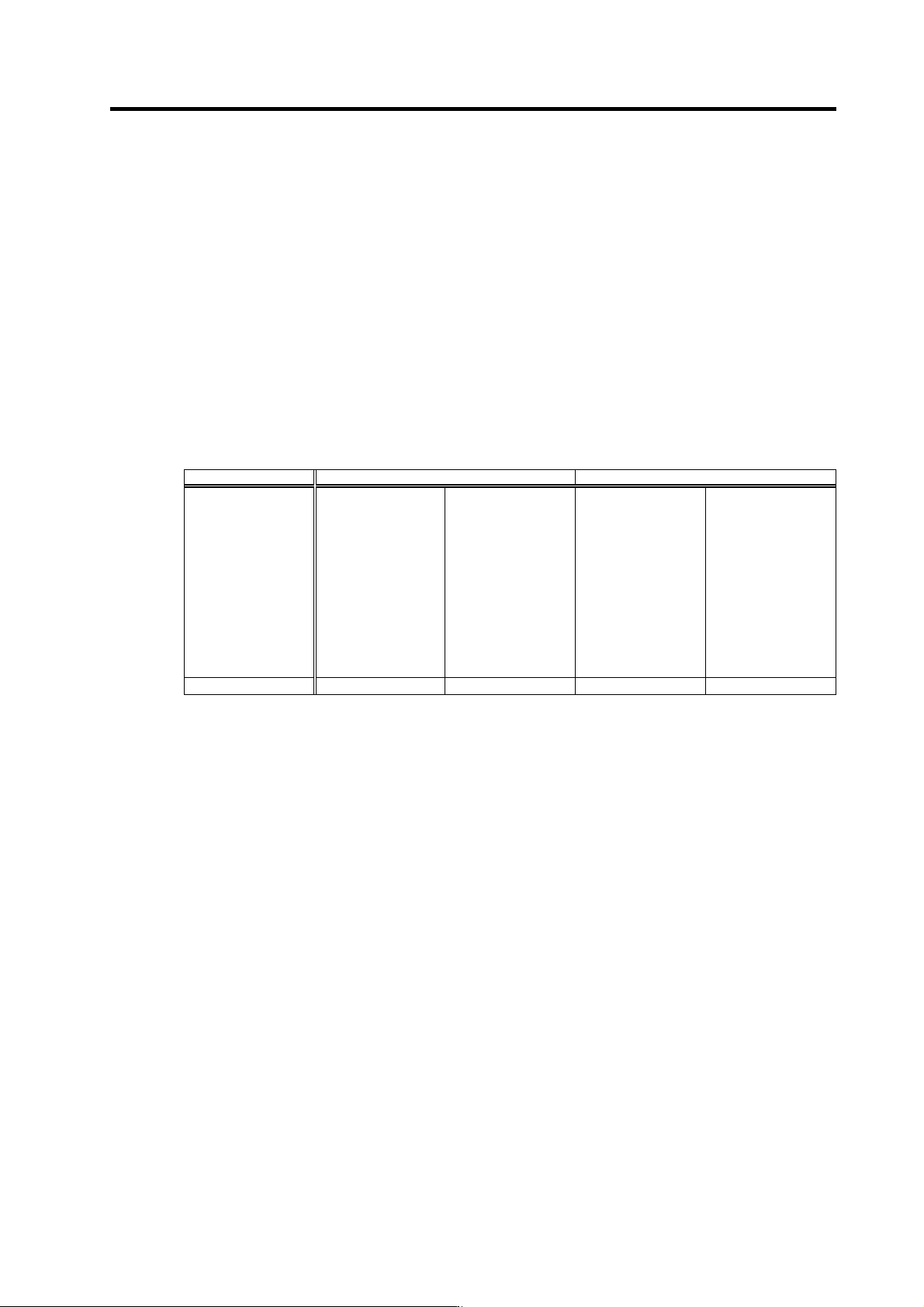
[2] When varying the speed, turn the L coil selection command signal (LCS) ON and OFF as
shown in the following table.
Current coil state When low-speed coil is selected When high-speed coil is selected
Next speed
command
Low-speed coil
range
Does not change
(LCS: ON)
High-speed coil
range
Judge state of SD
signal
[1] SD: ON
→LCS: ON
[2] SD: OFF
→LCS: OFF
Low-speed coil
range
Judge state of SD
signal
[1]SD: ON
→LCS: ON
[2] SD: OFF
→LCS: OFF
High-speed coil
range
Does not change
(LCS: OFF)
Operation mode
[2]-A [2]-B [2]-C [2]-D
(Note) The conditions in item 1) are applied to prevent the contactor from turning ON/OFF needlessly during
acceleration/deceleration.
Since the speed detection signal (SD) has a hysteresis, the conditions in item 2) are applied to prevent the
contactor from turning ON/OFF needlessly (inconsistently) when operating near the coil change speed and
continuously varying the speed.
4. Spindle Adjustment
4 - 74
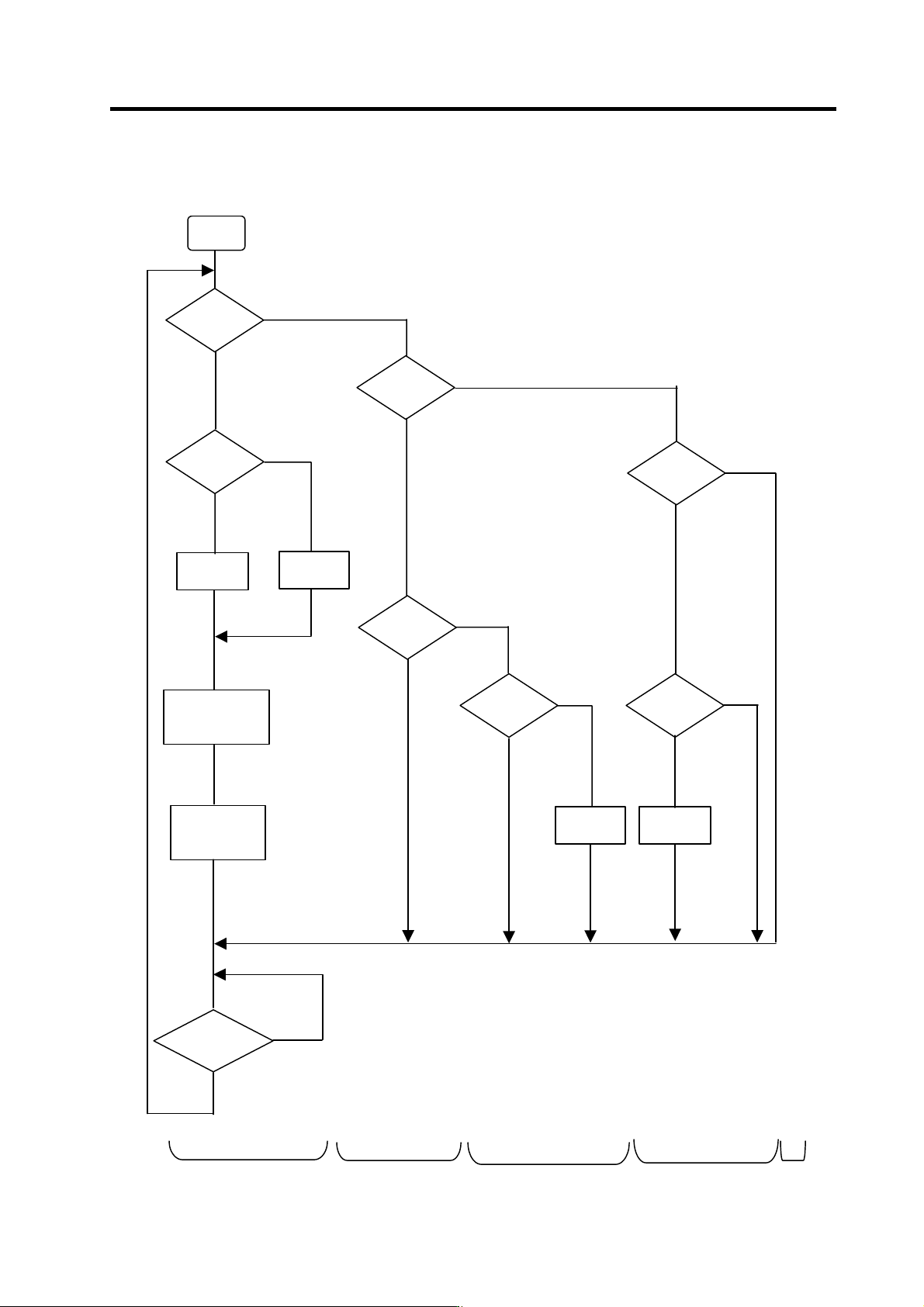
(Reference) The generation of the signals in item [1] and [2] are shown in the following flow chart.
START
ZS:ON ?
LCS:ON ?
SD:ON ?
LCS=ON
LCS=OFF
Speed
command
≦N2 ?
Speed
command
≦N2 ?
LCS=OFF
LCS=ON
Speed
command
≦N2 ?
SD:ON ?
Check TM timer
or coil changed
signal
SRN/SRI
:ON
Was speed
command changed?
NO
YES
YES
(Low-speed
coil range
command)
NO
(High-speed coil range command)
YES
(Low-speed
coil range)
NO
(High-speed
coil range)
NO
(High-speed
coil range)
YES
(Low-speed
coil range)
NO
YES
(Low-speed coil
range command)
NO
(High-speed coil selected)
YES
(Low-speed coil selected)
NO
YES
NO
YES
(Operation mode) [1] [2] - A [2] - B [2] - D[2] - C