743844-015.pdf - 第146页
The PCI Express* Host Bridge is required to translate the memory -mapped PCI Express* configuration space accesses from the host processor to PCI Express* configuration cycles. T o maintain compatibility with PCI configu…
PCI Express* Architecture
Compatibility with the PCI addressing model is maintained to ensure that all existing
applications and drivers operate unchanged.
The PCI Express* configuration uses standard mechanisms as defined in the PCI Plug-
and-Play specification.
The processor PCI Express* port supports Gen 4 at 16GT/s uses a 128b/130b
encoding and Gen 5 at 32 GT/s uses a 128b/130b encoding
S/HX/S Refresh/HX Refresh/E/E Refresh-Processor Line: The 4 lanes port can
operate at 2.5 GT/s, 5 GT/s, 8 GT/s or 16 GT/s.
S/HX/S Refresh/HX Refresh/E/E Refresh-Processor Line: The 16 lanes port
can operate at 2.5 GT/s, 5 GT/s, 8 GT/s, 16 GT/s or 32 GT/s**
H/H Refresh/P/PX/U/U Refresh -Processor Line: Each of the 4 lanes ports can
operate at 2.5 GT/s, 5 GT/s, 8 GT/s or 16 GT/s.
H/H Refresh-Processor Line: The 8 lane port can operate at 2.5 GT/s, 5 GT/s, 8
GT/s, 16 GT/s or 32 GT/s**
PX-Processor Line: The 8 lane port can operate at 2.5 GT/s, 5 GT/s, 8 GT/s, or 16
GT/s**
The PCI Express* architecture is specified in three layers – Transaction Layer, Data
Link Layer, and Physical Layer. Refer to the PCI Express Base Specification 5.0 for
details of PCI Express* architecture.
PCI Express* Configuration Mechanism
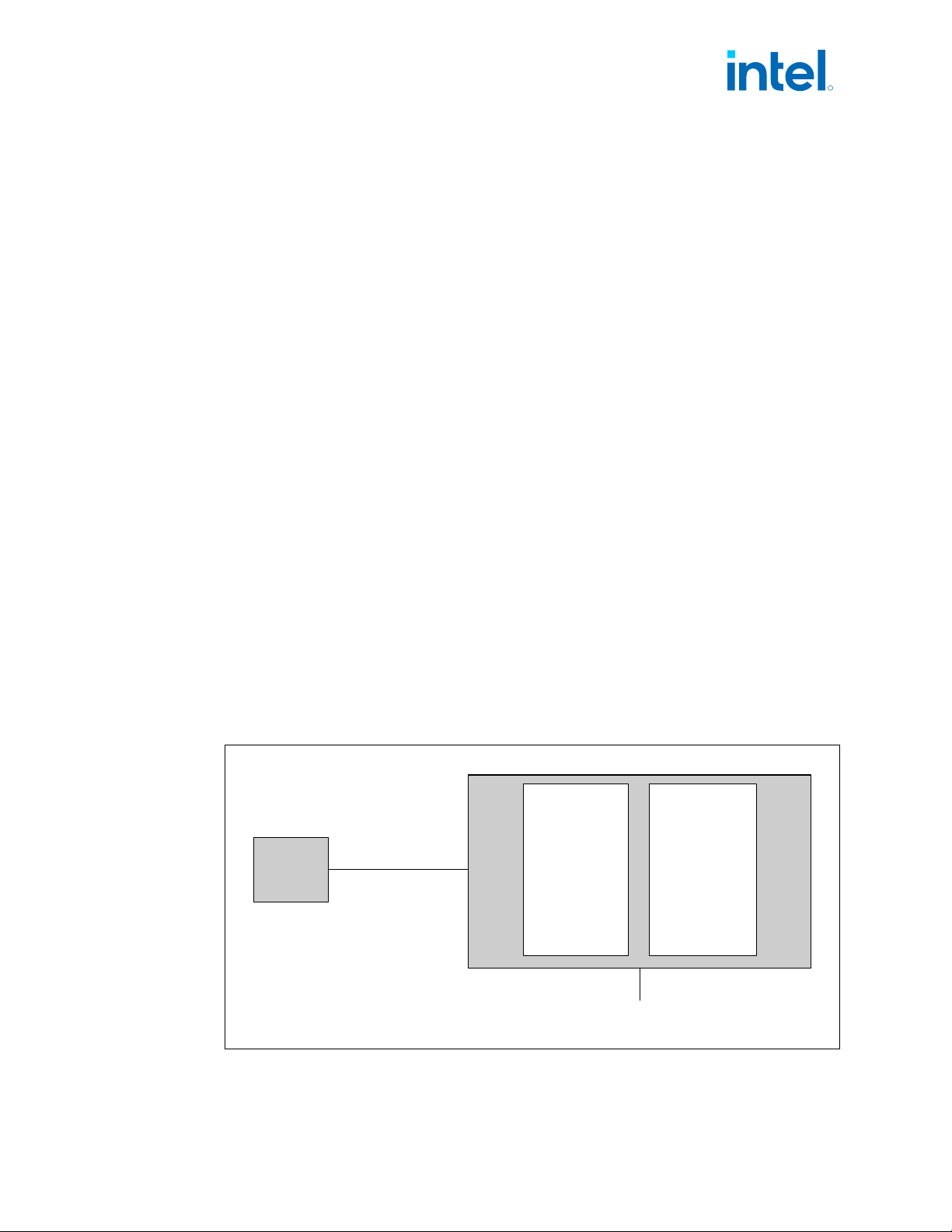
The PCI Express* (external graphics) link is mapped through a PCI-to-PCI bridge
structure.
Figure 21. PCI Express* Related Register Structures in the Processor
PCI-PCI Bridge
representing
root PCI
Express* ports
(Device 1)
PCI Compatible
Host Bridge
Device
(Device 0)
PCI
Express*
Device
PEG
DMI
7.1.2
7.1.3
R
PCIe* Interface—Intel
®
Core
™
, Xeon
™
6300 And Xeon
™
E 2400 Processors
13
th
Generation Intel
®
Core
™
, Intel
®
Core
™
14
th
Generation, Intel
®
Core
™
Processor (Series 1) and (Series 2), Intel
®
Xeon
™
E
2400 Processor and Intel
®
Xeon
™
6300 Processor
May 2025 Datasheet, Volume 1 of 2
Doc. No.: 743844, Rev.: 015 145

The PCI Express* Host Bridge is required to translate the memory-mapped PCI
Express* configuration space accesses from the host processor to PCI Express*
configuration cycles. To maintain compatibility with PCI configuration addressing
mechanisms, it is recommended that system software access the enhanced
configuration space using 32-bit operations (32-bit aligned) only. Refer to the PCI
Express Base Specification for details of both the PCI-compatible and PCI Express*
Enhanced configuration mechanisms and transaction rules.
PCI Express* Equalization Methodology
Link equalization requires equalization for both TX and RX sides for the processor and
for the Endpoint device.
Adjusting transmitter and receiver of the lanes is done to improve signal reception
quality and for improving link robustness and electrical margin.
The link timing margins and voltage margins are strongly dependent on equalization of
the link.
The processor supports the following:
• Full TX Equalization: Three Taps Linear Equalization (Pre, Current and Post
cursors), with FS/LF (Full Swing /Low Frequency) values.
• Full RX Equalization and acquisition for AGC (Adaptive Gain Control), CDR (Clock
and Data Recovery), adaptive DFE (decision feedback equalizer) and adaptive
CTLE peaking (continuous time linear equalizer).
• Full adaptive phase 3 EQ compliant with PCI Express* Gen 3 and Gen 4
specification.
PCI Express* Hot Plug
PCI Express Hot Plug not supported.
7.1.4
7.1.5
R
Intel
®
Core
™
, Xeon
™
6300 And Xeon
™
E 2400 Processors—PCIe* Interface
13
th
Generation Intel
®
Core
™
, Intel
®
Core
™
14
th
Generation, Intel
®
Core
™
Processor (Series 1) and (Series 2), Intel
®
Xeon
™
E
2400 Processor and Intel
®
Xeon
™
6300 Processor
Datasheet, Volume 1 of 2 May 2025
146 Doc. No.: 743844, Rev.: 015

8.0 Direct Media Interface and On Package Interface
Direct Media Interface (DMI)
NOTE
The DMI interface is only present in 2-Chip platform processors.
Direct Media Interface (DMI) connects the processor and the PCH.
The main characteristics are as follows:
• 8 lanes Gen 4 DMI support
• 4 lanes Gen 4 Reduced DMI support
• 16 GT/s point-to-point DMI interface to PCH
• DC coupling - no capacitors between the processor and the PCH
• PCH end-to-end lane reversal across the link
• L0 (Active) and L1 (Low power) states support
• Half-Swing support (low-power/low-voltage)
DMI Error Flow
DMI can only generate SERR in response to errors; never SCI, SMI, MSI, PCI INT, or
GPE. Any DMI related SERR activity is associated with Device 0.
DMI Link Down
The DMI link going down is a fatal, unrecoverable error. If the DMI data link goes to
data link down, after the link was up, then the DMI link hangs the system by not
allowing the link to retrain to prevent data corruption. This link behavior is controlled
by the PCH.
Downstream transactions that had been successfully transmitted across the link prior
to the link going down may be processed as normal. No completions from
downstream, non-posted transactions are returned upstream over the DMI link after a
link down event.
On Package Interface (OPI)
OPI Support
The processor communicates with the PCIe using an internal interconnect BUS named
OPI.
8.1
8.1.1
8.1.2
8.2
8.2.1
R
Direct Media Interface and On Package Interface—Intel
®
Core
™
, Xeon
™
6300 And Xeon
™
E 2400
Processors
13
th
Generation Intel
®
Core
™
, Intel
®
Core
™
14
th
Generation, Intel
®
Core
™
Processor (Series 1) and (Series 2), Intel
®
Xeon
™
E
2400 Processor and Intel
®
Xeon
™
6300 Processor
May 2025 Datasheet, Volume 1 of 2
Doc. No.: 743844, Rev.: 015 147