743844-015.pdf - 第89页
Note Definition 14 Possessor Base P ower (a.k.a TDP) workload does not reflect various I/O connectivity cases such as Thunderbolt. 15 Hardware default of PL1 T au=1s, By including the benefits available from power and th…

DRAM Refresh Rate Control
The MRC will natively interface with MR4 or MPR readings to adjust DRAM refresh rate
as needed to maintain data integrity. This capability is enabled by default and occurs
automatically. Direct override of this capability is available for debug purposes, but
this cannot be adjusted during runtime.
General Notes
The following notes apply to Processor Line Power and Frequency Specifications on
page 89 and Processor Line Thermal and Power Specifications on page 101.
Note Definition
1
The Processor Base Power (a.k.a TDP) and Assured Power (cTDP) values are the average power
dissipation in junction temperature operating condition limit, for the SKU Segment and
Configuration, for which the processor is validated during manufacturing when executing an
associated Intel-specified high-complexity workload at the processor IA core frequency
corresponding to the configuration and SKU.
2
Thermal workload (Processor Base Power (a.k.a TDP) ) may consist of a combination of processor
IA core intensive and graphics core intensive applications.
3 Can be modified at runtime by MSR writes, with MMIO and with PECI commands.
4
'Turbo Time Parameter' is a mathematical parameter (units of seconds) that controls the processor
turbo algorithm using a moving average of energy usage. Do not set the Turbo Time Parameter to a
value less than 0.1 seconds. refer to Platform Power Control on page 78 for further information.
5
The shown limit is a time averaged-power, based upon the Turbo Time Parameter. Absolute product
power may exceed the set limits for short durations or under virus or uncharacterized workloads.
6
The Processor will be controlled to a specified power limit as described in
Intel
®
Turbo Boost
Technology 2.0 Power Monitoring on page 49. If the power value and/or 'Turbo Time Parameter' is
changed during runtime, it may take a short period of time (approximately 3 to 5 times the 'Turbo
Time Parameter') for the algorithm to settle at the new control limits.
7 This is a hardware default setting and not a behavioral characteristic of the part.
8 For controllable turbo workloads, the PL2 limit may be exceeded for up to 10ms.
9
Power limits may vary depending on if the product supports the Minimum Assured Power (cTDP
Down) and/or Maximum Assured Power (cTDP Up) modes. Default power limits can be found in the
PKG_PWR_SKU MSR (614h).
10
The processor die do not reach maximum sustained power simultaneously since the sum of the 2
die's estimated power budget is controlled to be equal to or less than the package Processor Base
Power (a.k.a TDP) (PL1) limit.
11
Minimum Assured Power(cTDP Down) power is based on 96EU equivalent graphics configuration.
Minimum Assured Power(cTDP Down) does not decrease the number of active Processor Graphics
EUs but relies on Power Budget Management (PL1) to achieve the specified power level.
12 May vary based on SKU.
13
• The formula of PL2=PL1*1.25 is the hardware.
• PL2- SoC opportunistic higher Average Power with limited duration controlled by Tau_PL1
setting,
• the larger the Tau, the longer the PL2 duration.
• PL1 Tau - PL1 average power is controlled via PID algorithm with this Tau, The larger the Tau,
the longer the PL2 duration.
continued...
4.2
R
Intel
®
Core
™
, Xeon
™
6300 And Xeon
™
E 2400 Processors—Thermal Management
13
th
Generation Intel
®
Core
™
, Intel
®
Core
™
14
th
Generation, Intel
®
Core
™
Processor (Series 1) and (Series 2), Intel
®
Xeon
™
E
2400 Processor and Intel
®
Xeon
™
6300 Processor
Datasheet, Volume 1 of 2 May 2025
88 Doc. No.: 743844, Rev.: 015
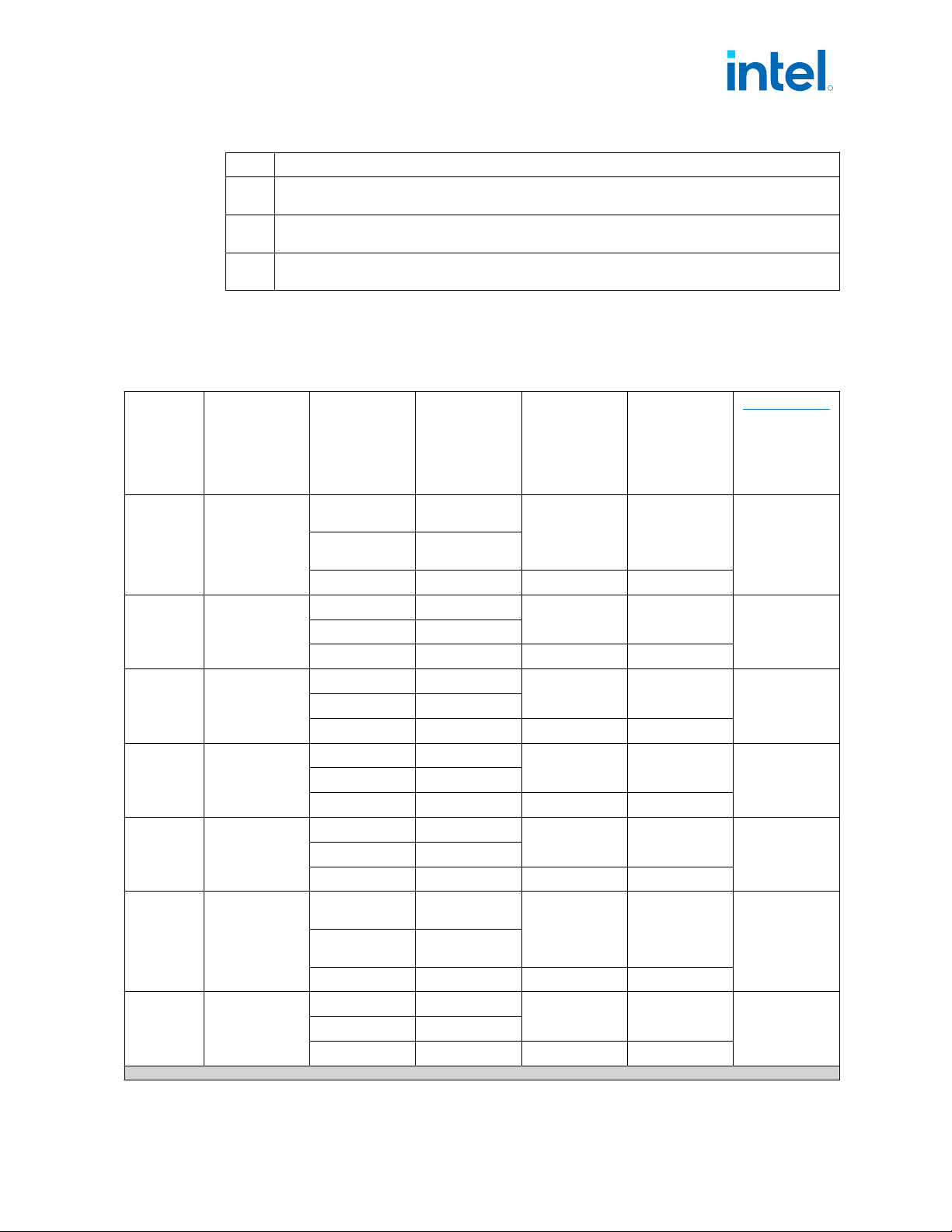
Note Definition
14
Possessor Base Power (a.k.a TDP) workload does not reflect various I/O connectivity cases such as
Thunderbolt.
15
Hardware default of PL1 Tau=1s, By including the benefits available from power and thermal
management features the recommended is to use PL1 Tau=28s.
17
System cooling solution and designs found to not being able to support the Performance Tau PL1,
adjust the TauPL1 to cooling capability.
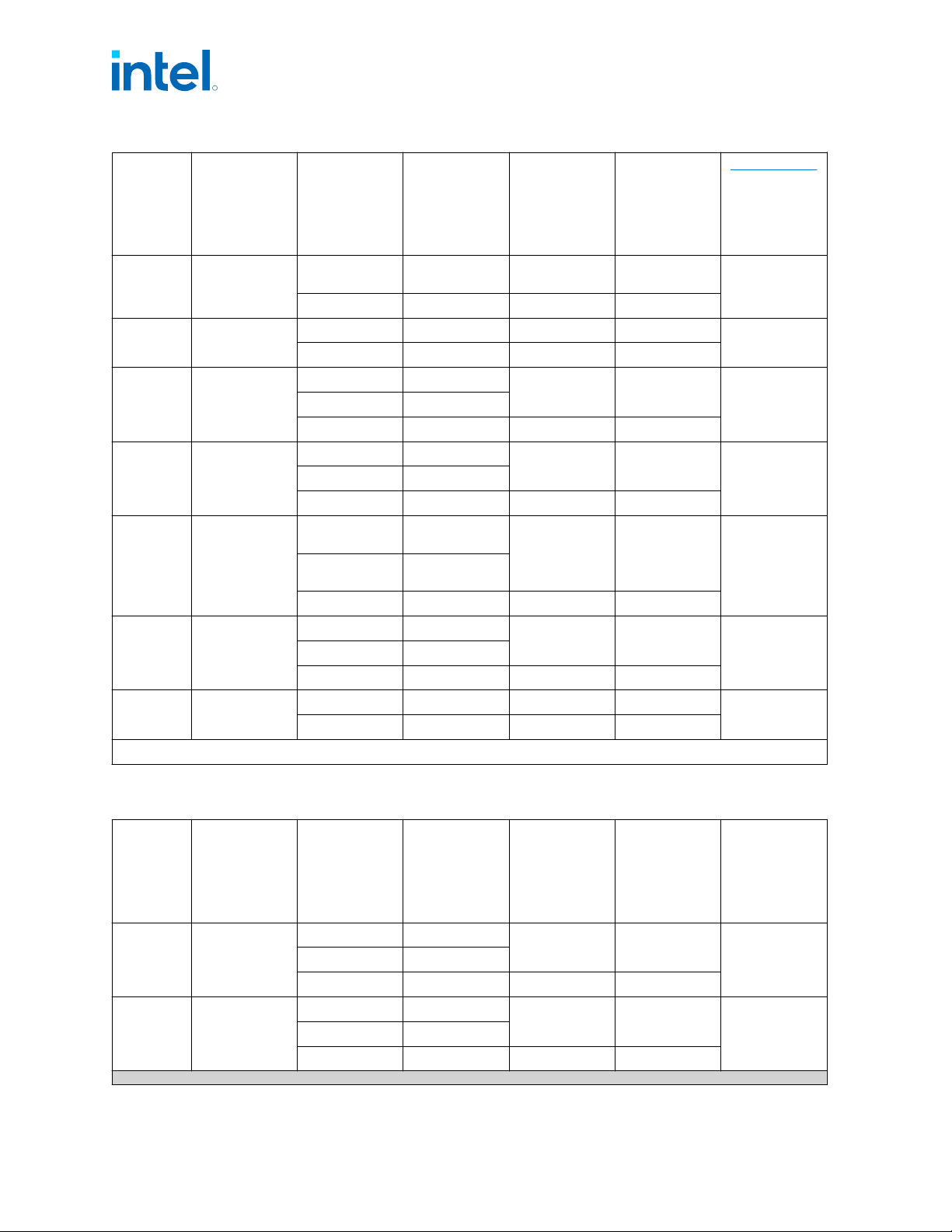
Processor Line Power and Frequency Specifications
Table 12. Processor Base Power (a.k.a TDP) and Frequency Specifications Options (S-
Processor Line)
Segment
and
Package
Processor IA
Cores,
Graphics
Configuration
and Processor
Base Power
(a.k.a TDP)
Configuration Base Power
Frequency
Graphics Core
Frequency
Thermal
Design Power
(Processor
Base Power
(a.k.a TDP))
[w]
General Notes
S-Processor 8P+16E Core
125W
P-core 3GHz up to
3.5GHz
300 MHz 125 1,9,10, 11,12,
15
E-core 2.2GHz up to
2.6GHz
LFM 800 MHz 300 MHz N/A
S-Processor 8P+8E Core
125W
P-core 3.4 GHz 300 MHz 125 1,9,10, 11,12,
15
E-core 2.5 GHz
LFM 800 MHz 300 MHz N/A
S-Processor 6P+8E Core
125W
P-core 3.5 GHz 300 MHz 125 1,9,10, 11,12,
15
E-core 2.6 GHz
LFM 800 MHz 300 MHz N/A
S-Processor 8P+16E Core
65W
P-core 2 GHz 300 MHz 65 1,9,10, 11,12,
15
E-core 1.5 GHz
LFM 800 MHz 300 MHz N/A
S-Processor 8P+8E Core
65W
P-core 2.1 GHz 300 MHz 65 1,9,10, 11,12,
15
E-core 1.5 GHz
LFM 800 MHz 300 MHz N/A
S-Processor 6P+8E Core
65W
P-core 2.5 GHz up to
2.7 GHz
300 MHz 65 1,9,10, 11,12,
15
E-core 1.8 GHz up to 2
GHz
LFM 800 MHz 300 MHz N/A
S-Processor 6P+4E Core
65W
P-core 2.5 GHz 300 MHz 1,9,10, 11,12,
15
E-core 1.8 GHz
LFM 800 MHz 300 MHz
continued...
4.3
R
Thermal Management—Intel
®
Core
™
, Xeon
™
6300 And Xeon
™
E 2400 Processors
13
th
Generation Intel
®
Core
™
, Intel
®
Core
™
14
th
Generation, Intel
®
Core
™
Processor (Series 1) and (Series 2), Intel
®
Xeon
™
E
2400 Processor and Intel
®
Xeon
™
6300 Processor
May 2025 Datasheet, Volume 1 of 2
Doc. No.: 743844, Rev.: 015 89
Segment
and
Package
Processor IA
Cores,
Graphics
Configuration
and Processor
Base Power
(a.k.a TDP)
Configuration Base Power
Frequency
Graphics Core
Frequency
Thermal
Design Power
(Processor
Base Power
(a.k.a TDP))
[w]
General Notes
S-Processor 6P+0E Core
65W
P-core 1.8 GHz up to
2.1 GHz
300 MHz 65 1,9,10, 11,12,
15
LFM 800 MHz 300 MHz N/A
S-Processor 4P+0E Core
60W/58W
P-core 3.4 GHz 300 MHz 65 1,9,10, 11,12,
15
LFM 800 MHz 300 MHz N/A
S-Processor 8P+16E Core
35W
P-core 1.1 GHz 300 MHz 35 1,9,10, 11,12,
15
E-core 800 MHz
LFM 800 MHz 300 MHz N/A
S-Processor 8P+8E Core
35W
P-core 1.4 GHz 300 MHz 35 1,9,10, 11,12,
15
E-core 1 GHz
LFM 800 MHz 300 MHz N/A
S-Processor 6P+8E Core
35W
P-core 1.6 GHz up to
1.8 GHz
300 MHz 35 1,9,10, 11,12,
15
E-core 1.2 GHz up to
1.3 GHz
LFM 800 MHz 300 MHz N/A
S-Processor 6P+4E Core
35W
P-core 1.3 GHz 300 MHz 35 1,9,10, 11,12,
15
E-core 1 GHz
LFM 800 MHz 300 MHz N/A
S-Processor 4P+0E Core
35W
P-core 2.5 GHz 300 MHz 35 1,9,10, 11,12,
15
LFM 800 MHz 300 MHz N/A
Note: Refer to General Notes
Table 13. Processor Base Power (a.k.a TDP) and Frequency Specifications Options (S
Refresh-Processor Line)
Segment
and
Package
Processor IA
Cores,
Graphics
Configuration
and Processor
Base Power
(a.k.a TDP)
Configuration Base Power
Frequency
Graphics Core
Frequency
Thermal
Design Power
(Processor
Base Power
(a.k.a TDP))
[w]
General Notes
S Refresh-
Processor
8P+16E Core
150W
P-core 3.2 GHz 300 MHz 150 1,9,10, 11,12,
15
E-core 2.4 GHz
LFM 800 MHZ 300 MHz N/A
S Refresh-
Processor
8P+16E Core
125W
P-core 3.2 GHz 300 MHz 125 1,9,10, 11,12,
15
E-core 2.4 GHz
LFM 800 MHZ 300 MHz N/A
continued...
R
Intel
®
Core
™
, Xeon
™
6300 And Xeon
™
E 2400 Processors—Thermal Management
13
th
Generation Intel
®
Core
™
, Intel
®
Core
™
14
th
Generation, Intel
®
Core
™
Processor (Series 1) and (Series 2), Intel
®
Xeon
™
E
2400 Processor and Intel
®
Xeon
™
6300 Processor
Datasheet, Volume 1 of 2 May 2025
90 Doc. No.: 743844, Rev.: 015