743844-015.pdf - 第55页
• TPAUSE : similar to PAUSE but with a software-specified delay . Commonly used in spin loops. Intel ® Adaptive Boost Technology Intel ® Adaptive Boost T echnology (Intel ® AB T) opportunistically increases the multicore…

Cache Line Write Back
Writes back to memory the cache line (if dirty) that contains the linear address
specified with the memory operand from any level of the cache hierarchy in the cache
coherence domain. The line may be retained in the cache hierarchy in the non-
modified state. Retaining the line in the cache hierarchy is a performance optimization
(treated as a hint by hardware) to reduce the possibility of a cache miss on a
subsequent access. Hardware may choose to retain the line at any of the levels in the
cache hierarchy, and in some cases, may invalidate the line from the cache hierarchy.
The source operand is a byte memory location.
The Cache Line Write Back (CLWB) instruction is documented in the Intel
®
Architecture Instruction Set Extensions Programming Reference (future architectures):
https://software.intel.com/sites/default/files/managed/b4/3a/319433-024.pdf
Remote Action Request
Remote Action Request (RAR) enables a significant speed up of several inter-processor
operations by moving such operations from software (OS or application) to hardware.
The main feature is the speedup of TLB shootdowns.
A single RAR operation can invalidate multiple memory pages in the TLB.
A TLB (Translation Lookaside Buffer) is a per-core cache that holds mappings from
virtual to physical addresses.
A TLB shootdown is the process of propagating a change in memory mapping (page
table entry) to all the cores.
RAR supports the following operations:
• Page Invalidation: imitates the operation of performing INVLPG instructions
corresponding or the TLB invalidation corresponding with “MOV CR3 / CR0”
• Page Invalidation without CR3 Match: identical to “Page invalidation”, except
that the processor does not check for a CR3 match
• PCID Invalidation: imitates the operation of performing INVPCID instructions
• EPT Invalidation: imitates the operation of performing INVEPT instructions
• VPID Invalidation: imitates the operation of performing INVVPID instructions
• MSR Write: imitates the operation of WRMSR instructions on all cores
User Mode Wait Instructions
The UMONITOR and UMWAIT are user mode (Ring 3) instructions similar to the
supervisor mode (Ring 0) MONITOR/MWAIT instructions without the C-state
management capability.
TPAUSE us an enhanced PAUSE instruction.
The mnemonics for the three new instructions are:
• UMONITOR: operates just like MONITOR but allowed in all rings.
• UMWAIT: allowed in all rings, and no specification of target C-state.
2.4.16
2.4.17
2.4.18
R
Intel
®
Core
™
, Xeon
™
6300 And Xeon
™
E 2400 Processors—Technologies
13
th
Generation Intel
®
Core
™
, Intel
®
Core
™
14
th
Generation, Intel
®
Core
™
Processor (Series 1) and (Series 2), Intel
®
Xeon
™
E
2400 Processor and Intel
®
Xeon
™
6300 Processor
Datasheet, Volume 1 of 2 May 2025
54 Doc. No.: 743844, Rev.: 015

• TPAUSE: similar to PAUSE but with a software-specified delay. Commonly used in
spin loops.
Intel
®
Adaptive Boost Technology
Intel
®
Adaptive Boost Technology (Intel
®
ABT) opportunistically increases the multicore
turbo frequency while operating within IccMAX and temperature spec limitations.
Intel
®
ABT opportunistically delivers in-spec performance gains that are incremental to
existing Turbo technologies. In systems equipped with performance spec power
delivery, Intel
®
ABT allows additional multi-core turbo frequency while still operating
within specified current and temperature limits.
NOTE
Intel Adaptive Boost technology may not be available on all SKUs.
Intel
®
Image Processing Unit
Platform Imaging Infrastructure
The platform imaging infrastructure is based on the following hardware components:
• Camera Subsystem: Located in the lid of the system and contains CMOS sensor,
flash, LED, I/O interface (MIPI* CSI-2 and I2C*), focus control and other
components.
• Camera I/O Controller: The I/O controller is located in the processor and
contains a MIPI-CSI2 host controller. The host controller is a PCI device
(independent of the IPU device). The CSI-2 HCI brings imaging data from an
external image into the system and provides a command and control channel for
the image using I
2
C.
• Intel
®
IPU (Image Processing Unit): The IPU processes raw images captured
by Bayer sensors. The result images are used by still photography and video
capture applications (JPEG, H.264, and so on.).
2.4.19
2.5
2.5.1
R
Technologies—Intel
®
Core
™
, Xeon
™
6300 And Xeon
™
E 2400 Processors
13
th
Generation Intel
®
Core
™
, Intel
®
Core
™
14
th
Generation, Intel
®
Core
™
Processor (Series 1) and (Series 2), Intel
®
Xeon
™
E
2400 Processor and Intel
®
Xeon
™
6300 Processor
May 2025 Datasheet, Volume 1 of 2
Doc. No.: 743844, Rev.: 015 55
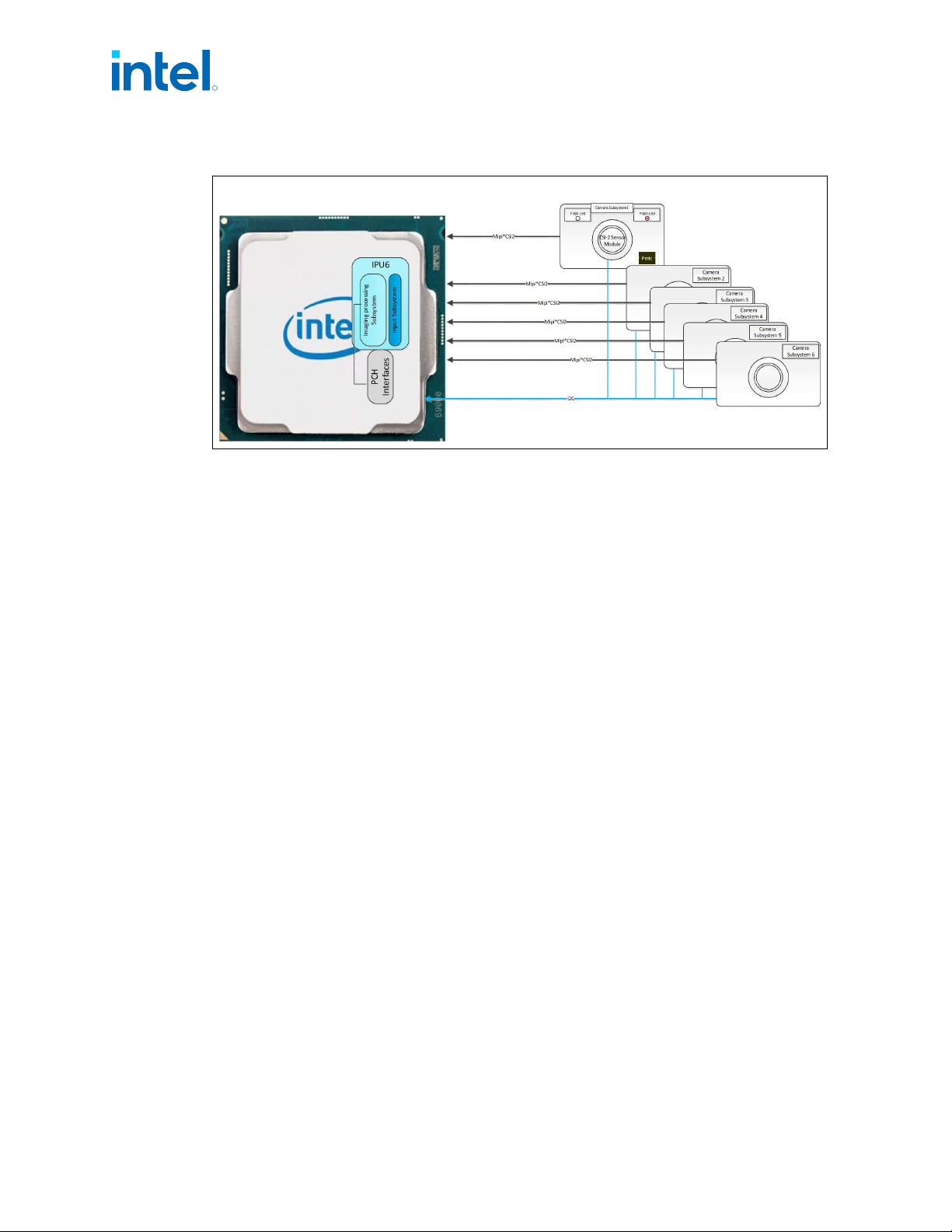
Figure 12. Processor Camera System
Intel
®
Image Processing Unit
IPU6 is Intel's 6th generation solution for an Imaging Processing Unit, providing
advanced imaging functionality for Intel
®
Core
™
branded processors, as well as more
specialized functionality for High Performance Mobile Phones, Automotive, Digital
Surveillance Systems (DSS), and other market segments.
IPU6 is a continuing evolution of the architecture introduced in IPU4 and enhanced in
IPU5. Additional image quality improvements are introduced, as well as hardware
accelerated support for temporal de-noising and new sensor technologies such as
Spatially Variant Exposure HDR and Dual Photo Diode, among others.
IPU6 provides a complete high quality hardware accelerated pipeline, and is therefore
not dependent on algorithms running on the vector processors to provide the highest
quality output.
• Processor Line has a lighter version of the IPU
Debug Technologies
Intel
®
Processor Trace
Intel
®
Processor Trace (Intel
®
PT) is a tracing capability added to Intel
®
Architecture,
for use in software debug and profiling. Intel
®
PT provides the capability for more
precise software control flow and timing information, with limited impact on software
execution. This provides an enhanced ability to debug software crashes, hangs, or
other anomalies, as well as responsiveness and short-duration performance issues.
Intel
®
VTune
™
Amplifier for Systems and the Intel
®
System Debugger are part of
Intel
®
System Studio 2015 (and newer) product, which includes updates for the new
debug and trace features, including Intel
®
PT and Intel
®
Trace Hub.
Intel
®
System Studio 2015 is available for download at
https://software.intel.com/en-
us/system-studio.
2.5.2
2.6
2.6.1
R
Intel
®
Core
™
, Xeon
™
6300 And Xeon
™
E 2400 Processors—Technologies
13
th
Generation Intel
®
Core
™
, Intel
®
Core
™
14
th
Generation, Intel
®
Core
™
Processor (Series 1) and (Series 2), Intel
®
Xeon
™
E
2400 Processor and Intel
®
Xeon
™
6300 Processor
Datasheet, Volume 1 of 2 May 2025
56 Doc. No.: 743844, Rev.: 015