743844-015.pdf - 第85页
Bi-Directional PROCHOT# By default, the PROCHOT# signal is set to input only . When configured as an input or bi-directional signal, PROCHOT# can be used for thermally protecting other platform components should they ove…
The error associated with DTS measurements will not exceed ±5 °C within the entire
operating range.
Fan Speed Control with Digital Thermal Sensor
Digital Thermal Sensor based fan speed control (T
FAN
) is a recommended feature to
achieve optimal thermal performance. At the T
FAN
temperature, Intel recommends full
cooling capability before the DTS reading reaches Tj
MAX
.
PROCHOT# Signal
The PROCHOT# (processor hot) signal is asserted by the processor when the TCC is
active. Only a single PROCHOT# pin exists at a package level. When any DTS
temperature reaches the TCC activation temperature, the PROCHOT# signal will be
asserted. PROCHOT# assertion policies are independent of Adaptive Thermal Monitor
enabling.
The PROCHOT# signal can be configured to the following modes:
• Input Only: PROCHOT is driven by an external device.
• Output Only: PROCHOT is driven by processor.
• Bi-Directional: Both Processor and external device can drive PROCHOT signal
PROCHOT Input Only
The PROCHOT# signal should be set to input only by default. In this state, the
processor will only monitor PROCHOT# assertions and respond by setting the
maximum frequency to 10Khz.
The following two features are enabled when PROCHOT is set to Input only:
• Fast PROCHOT: Respond to PROCHOT# within 1uS of PROCHOT# pin assertion,
reducing the processor power.
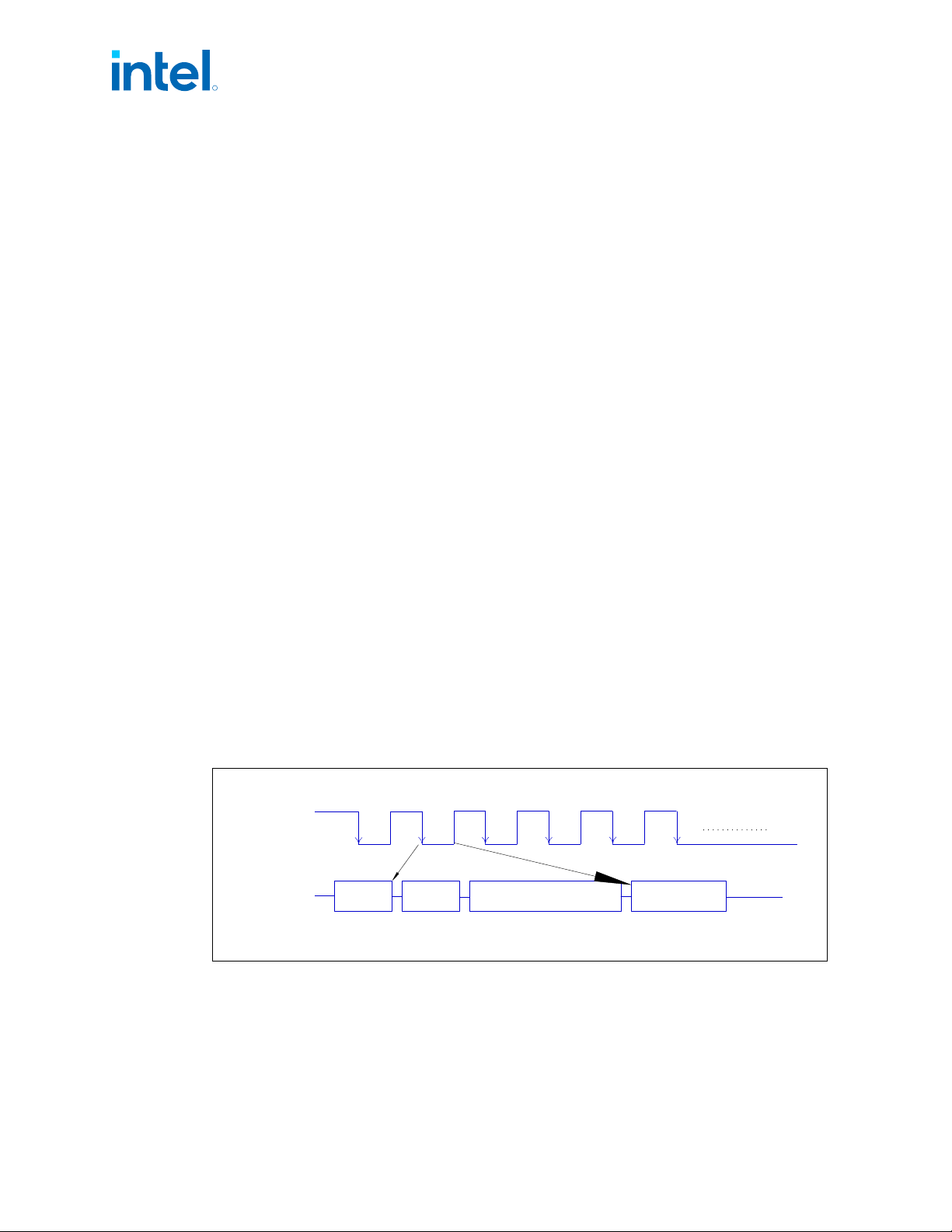
• PROCHOT Demotion Algorithm: designed to improve system performance
during multiple PROCHOT assertions.
Figure 18. PROCHOT Demotion Description
X GHz
IA CLK
Dilution
LFM X GHz
X GHzX GHz X GHz X GHz (X-1) GHz (X-2) GHz
LFM LFM LFM LFM LFM LFM
X : IA high frequency (SKU dependent)
PROCHOT /
Core frequency
IA freq
Max Prochot
Frequency 10 kHz
PROCHOT Output Only
Legacy state, PROCHOT is driven by the processor to external device.
4.1.3.3
4.1.3.4
R
Intel
®
Core
™
, Xeon
™
6300 And Xeon
™
E 2400 Processors—Thermal Management
13
th
Generation Intel
®
Core
™
, Intel
®
Core
™
14
th
Generation, Intel
®
Core
™
Processor (Series 1) and (Series 2), Intel
®
Xeon
™
E
2400 Processor and Intel
®
Xeon
™
6300 Processor
Datasheet, Volume 1 of 2 May 2025
84 Doc. No.: 743844, Rev.: 015

Bi-Directional PROCHOT#
By default, the PROCHOT# signal is set to input only. When configured as an input or
bi-directional signal, PROCHOT# can be used for thermally protecting other platform
components should they overheat as well. When PROCHOT# is driven by an external
device:
• The package will immediately transition to the lowest P-State (Pn) supported by
the processor IA cores and graphics cores. This is contrary to the internally-
generated Adaptive Thermal Monitor response.
• Clock modulation is not activated.
The processor package will remain at the lowest supported P-state until the system
de-asserts PROCHOT#. The processor can be configured to generate an interrupt upon
assertion and de-assertion of the PROCHOT# signal. Refer to the appropriate
processor family BIOS Specification for specific register and programming details.
When PROCHOT# is configured as a bi-directional signal and PROCHOT# is asserted
by the processor, it is impossible for the processor to detect a system assertion of
PROCHOT#. The system assertion will have to wait until the processor de-asserts
PROCHOT# before PROCHOT# action can occur due to the system assertion. While the
processor is hot and asserting PROCHOT#, the power is reduced but the reduction rate
is slower than the system PROCHOT# response of < 100 us. The processor thermal
control is staged in smaller increments over many milliseconds. This may cause
several milliseconds of delay to a system assertion of PROCHOT# while the output
function is asserted.
PROCHOT Demotion Algorithm
PROCHOT demotion algorithm is designed to improve system performance following
multiple Platform PROCHOT consecutive assertions. During each PROCHOT assertion
processor will eventually transition to the lowest P-State (Pn) supported by the
processor IA cores and graphics cores (LFM). When detecting several PROCHOT
consecutive assertions the processor will reduce the max frequency in order to reduce
the PROCHOT assertions events. The processor will keep reducing the frequency until
no consecutive assertions detected. The processor will raise the frequency if no
consecutive PROCHOT assertion events will occur. PROCHOT demotion algorithm
enabled only when the PROCHOT is configured as input.
NOTE
PROCHOT Demotion Algorithm is enabled by Hardware default only when the
PROCHOT is configured as input. This feature can be disabled through BIOS policy. .
Voltage Regulator Protection using PROCHOT#
PROCHOT# may be used for thermal protection of voltage regulators (VR). System
designers can create a circuit to monitor the VR temperature and assert PROCHOT#
and, if enabled, activate the TCC when the temperature limit of the VR is reached.
When PROCHOT# is configured as a bi-directional or input only signal, if the system
assertion of PROCHOT# is recognized by the processor, results in power reduction.
Power reduction down to LFM and duration of the platform PROCHOT# assertion as
described in paragraph 4.1.3.6. supported by the processor IA cores and graphics
cores. Systems should still provide proper cooling for the VR and rely on bi-directional
PROCHOT# only as a backup in case of system cooling failure. Overall, the system
4.1.3.5
4.1.3.6
4.1.3.7
R
Thermal Management—Intel
®
Core
™
, Xeon
™
6300 And Xeon
™
E 2400 Processors
13
th
Generation Intel
®
Core
™
, Intel
®
Core
™
14
th
Generation, Intel
®
Core
™
Processor (Series 1) and (Series 2), Intel
®
Xeon
™
E
2400 Processor and Intel
®
Xeon
™
6300 Processor
May 2025 Datasheet, Volume 1 of 2
Doc. No.: 743844, Rev.: 015 85

thermal design should allow the power delivery circuitry to operate within its
temperature specification even while the processor is operating at its Processor Base
Power.
NOTE
During PROCHOT demotion, the core frequency may be reduced below LFM for several
uSec.
Thermal Solution Design and PROCHOT# Behavior
With a properly designed and characterized thermal solution, it is anticipated that
PROCHOT# will only be asserted for very short periods of time when running the most
power intensive applications. The processor performance impact due to these brief
periods of TCC activation is expected to be so minor that it would be immeasurable.
However, an under-designed thermal solution that is not able to prevent excessive
assertion of PROCHOT# in the anticipated ambient environment may:
• Cause a noticeable performance loss.
• Result in prolonged operation at or above the specified maximum junction
temperature and affect the long-term reliability of the processor.
• May be incapable of cooling the processor even when the TCC is active
continuously (in extreme situations).
Low-Power States and PROCHOT# Behavior
Depending on package power levels during package C-states, outbound PROCHOT#
may de-assert while the processor is idle as power is removed from the signal. Upon
wake up, if the processor is still hot, the PROCHOT# will re-assert, although typically
package idle state residency should resolve any thermal issues. The PECI interface is
fully operational during all C-states and it is expected that the platform continues to
manage processor IA core and package thermals even during idle states by regularly
polling for thermal data over PECI.
THRMTRIP# Signal
Regardless of enabling the automatic or on-demand modes, in the event of a
catastrophic cooling failure, the package will automatically shut down when the silicon
has reached an elevated temperature that risks physical damage to the product. At
this point, the THRMTRIP# signal will go active.
Critical Temperature Detection
Critical Temperature detection is performed by monitoring the package temperature.
This feature is intended for graceful shutdown before the THRMTRIP# is activated.
However, the processor execution is not guaranteed between critical temperature and
THRMTRIP#. If the Adaptive Thermal Monitor is triggered and the temperature
remains high, a critical temperature status and sticky bit are latched in the
PACKAGE_THERM_STATUS (0x1B1) MSR and the condition also generates a thermal
interrupt, if enabled.
4.1.3.8
4.1.3.9
4.1.3.10
4.1.3.11
R
Intel
®
Core
™
, Xeon
™
6300 And Xeon
™
E 2400 Processors—Thermal Management
13
th
Generation Intel
®
Core
™
, Intel
®
Core
™
14
th
Generation, Intel
®
Core
™
Processor (Series 1) and (Series 2), Intel
®
Xeon
™
E
2400 Processor and Intel
®
Xeon
™
6300 Processor
Datasheet, Volume 1 of 2 May 2025
86 Doc. No.: 743844, Rev.: 015