743844-015.pdf - 第47页
NOTES 1. L1 Data cache (DCU) - 48KB (P-core) - 32KB (E-Core) 2. L1 Instruction cache (IFU) - 32KB (P-Core) - 64KB (E-Core) 3. MLC - Mid Level Cache - 2MB (P-Core) - 4MB (shared by 4 E-Cores ) Ring Interconnect The Ring i…
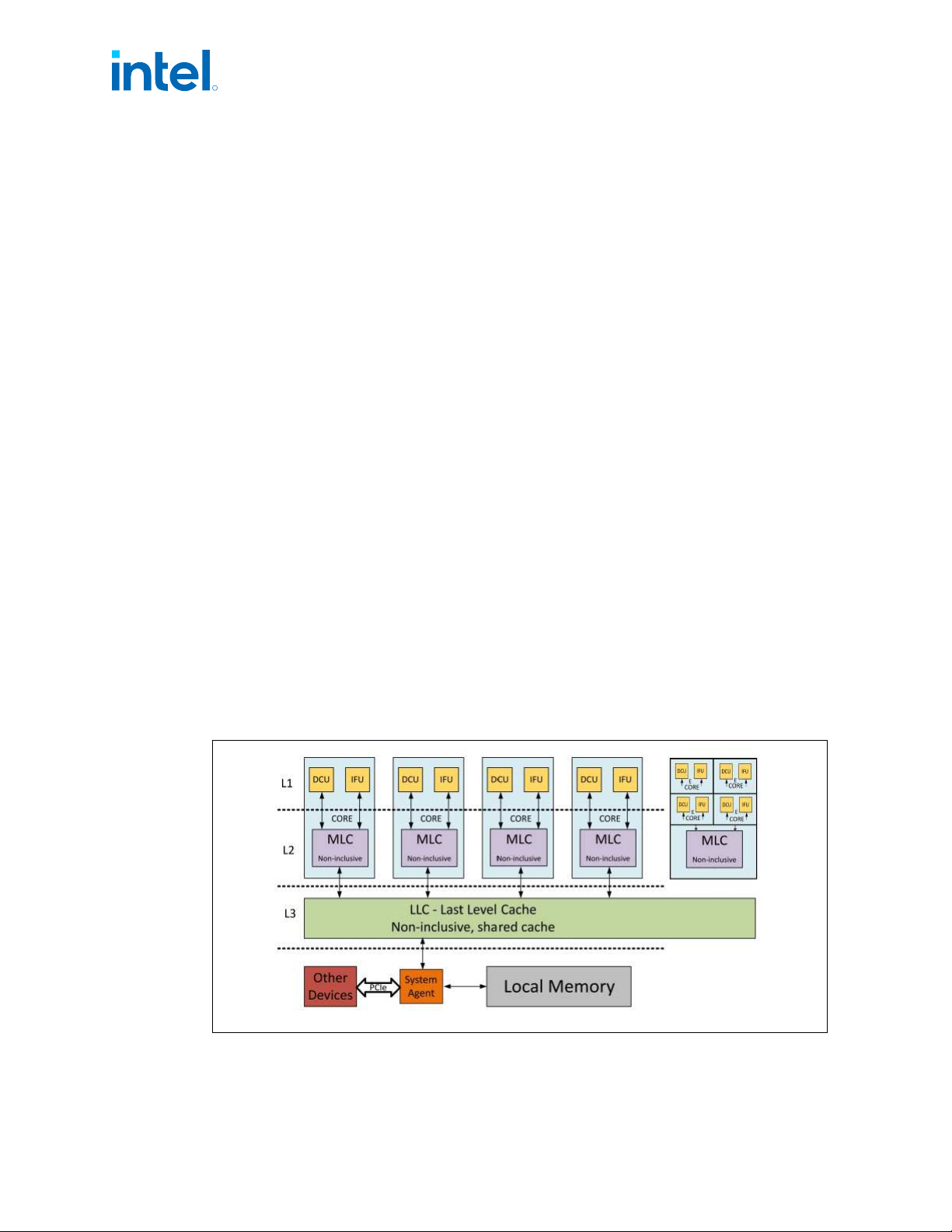
• For E Cores The 2nd level cache is shared between 4 physical cores.
• The size of the LLC is SKU specific with a maximum of 3MB per P physical core or
4 E cores and is a 12-way associative cache.
IA Cores Level 1 and Level 2 Caches
P Cores 1st level cache is divided into a data cache (DFU) and an instruction cache
(IFU). The processor 1st level cache size is 48KB for data and 32KB for instructions.
The 1st level cache is an 12-way associative cache.
E Cores 1st level cache is divided into a data cache (DFU) and an instruction cache
(IFU). The processor 1st level cache size is 32KB for data and 64KB for instructions.
The 1st level cache is an 8-way associative cache.
The 2nd level cache holds both data and instructions. It is also referred to as mid-level
cache or MLC.
For P/H/H Refresh/U, S/HX 8P+8E, S 6P+0E predecessor lines, the P Cores 2nd level
cache size is 1.25 MB and is a 10-way non-inclusive associative cache, 4 E Cores
processors 2nd level cache size is 2MB and is a 16-way non-inclusive associative
cache.
For S refresh 8P+8E, S refresh 6P+0E predecessor lines, the P Cores 2nd level cache
size is 1.25 MB and is a 10-way non-inclusive associative cache, 4 E Cores processors
2nd level cache size is 2MB and is a 16-way non-inclusive associative cache.
For S/HX 8P+16E and E Processors Lines, the P Cores 2nd level cache size is2 MB and
is a 16-way non-inclusive associative cache, 4 E Cores processors 2nd level cache size
is 4MB and is a 16-way non-inclusive associative cache.
For S Refresh/HX Refresh 8P+16E Processors Lines, the P Cores 2nd level cache size is
2 MB and is a 16-way non-inclusive associative cache, 4 E Cores processors 2nd level
cache size is 4MB and is a 16-way non-inclusive associative cache
Figure 11. Hybrid Cache
2.4.2
R
Intel
®
Core
™
, Xeon
™
6300 And Xeon
™
E 2400 Processors—Technologies
13
th
Generation Intel
®
Core
™
, Intel
®
Core
™
14
th
Generation, Intel
®
Core
™
Processor (Series 1) and (Series 2), Intel
®
Xeon
™
E
2400 Processor and Intel
®
Xeon
™
6300 Processor
Datasheet, Volume 1 of 2 May 2025
46 Doc. No.: 743844, Rev.: 015

NOTES
1. L1 Data cache (DCU) - 48KB (P-core) - 32KB (E-Core)
2. L1 Instruction cache (IFU) - 32KB (P-Core) - 64KB (E-Core)
3. MLC - Mid Level Cache - 2MB (P-Core) - 4MB (shared by 4 E-Cores)
Ring Interconnect
The Ring is a high speed, wide interconnect that links the processor cores, processor
graphics and the System Agent.
The Ring shares frequency and voltage with the Last Level Cache (LLC).
The Ring's frequency dynamically changes. Its frequency is relative to both processor
cores and processor graphics frequencies.
Intel
®
Performance Hybrid Architecture
The processor contains two types of cores, denoted as P-Cores and E-Cores (P core is
a Performance core and E core is efficient core ).
The P-Cores and E-Cores share the same instruction set.
The available instruction sets, when hybrid computing is enabled, is limited compared
to the instruction sets available to P-Cores.
P core and E core frequency's will be determined by the processor algorithmic, to
maximize performance and power optimization.
For more details, refer to: https://www.intel.com/content/www/us/en/developer/
articles/technical/hybrid-architecture.html
NOTE
Hybrid Computing may not be available on all SKUs.
Intel
®
Turbo Boost Max Technology 3.0
The Intel
®
Turbo Boost Max Technology 3.0 (ITBMT 3.0) grants a different maximum
Turbo frequency for individual processor cores.
To enable ITBMT 3.0 the processor exposes individual core capabilities; including
diverse maximum turbo frequencies.
An operating system that allows for varied per core frequency capability can then
maximize power savings and performance usage by assigning tasks to the faster
cores, especially on low core count workloads.
Processors enabled with these capabilities can also allow software (most commonly a
driver) to override the maximum per-core Turbo frequency limit and notify the
operating system via an interrupt mechanism.
2.4.3
2.4.4
2.4.5
R
Technologies—Intel
®
Core
™
, Xeon
™
6300 And Xeon
™
E 2400 Processors
13
th
Generation Intel
®
Core
™
, Intel
®
Core
™
14
th
Generation, Intel
®
Core
™
Processor (Series 1) and (Series 2), Intel
®
Xeon
™
E
2400 Processor and Intel
®
Xeon
™
6300 Processor
May 2025 Datasheet, Volume 1 of 2
Doc. No.: 743844, Rev.: 015 47

For more information on the Intel
®
Turbo Boost Max 3.0 Technology, refer to http://
www.intel.com/content/www/us/en/architecture-and-technology/turbo-boost/turbo-
boost-max-technology.html
NOTE
Intel
®
Turbo Boost Max 3.0 Technology may not be available on all SKUs.
Power Aware Interrupt Routing (PAIR)
The processor includes enhanced power-performance technology that routes interrupts
to threads or processor IA cores based on their sleep states. As an example, for
energy savings, it routes the interrupt to the active processor IA cores without waking
the deep idle processor IA cores. For performance, it routes the interrupt to the idle
(C1) processor IA cores without interrupting the already heavily loaded processor IA
cores. This enhancement is most beneficial for high-interrupt scenarios like Gigabit
LAN, WLAN peripherals, etc.
Intel
®
Hyper-Threading Technology
The processor supports Intel
®
Hyper-Threading Technology (Intel
®
HT Technology)
that allows an execution processor IA core to function as two logical processors. While
some execution resources such as caches, execution units, and buses are shared,
each logical processor has its own architectural state with its own set of general-
purpose registers and control registers. This feature should be enabled using the BIOS
and requires operating system support.
Intel recommends enabling Intel
®
Hyper-Threading Technology with Microsoft*
Windows* 7 or newer and disabling Intel
®
Hyper-Threading Technology using the
BIOS for all previous versions of Windows* operating systems.
NOTE
Intel
®
HT Technology may not be available on all SKUs.
Intel
®
Turbo Boost Technology 2.0
The Intel
®
Turbo Boost Technology 2.0 allows the processor IA core/processor
graphics core to opportunistically and automatically run faster than the processor IA
core base frequency/processor graphics base frequency if it is operating below power,
temperature, and current limits. The Intel
®
Turbo Boost Technology 2.0 feature is
designed to increase the performance of both multi-threaded and single-threaded
workloads.
Compared with previous generation products, Intel
®
Turbo Boost Technology 2.0 will
increase the ratio of application power towards Processor Base Power (a.k.a TDP) and
also allows to increase power above Processor Base Power (a.k.a TDP) as high as PL2
for short periods of time. Thus, thermal solutions and platform cooling that are
designed to less than thermal design guidance might experience thermal and
performance issues since more applications will tend to run at the maximum power
limit for significant periods of time.
2.4.6
2.4.7
2.4.8
R
Intel
®
Core
™
, Xeon
™
6300 And Xeon
™
E 2400 Processors—Technologies
13
th
Generation Intel
®
Core
™
, Intel
®
Core
™
14
th
Generation, Intel
®
Core
™
Processor (Series 1) and (Series 2), Intel
®
Xeon
™
E
2400 Processor and Intel
®
Xeon
™
6300 Processor
Datasheet, Volume 1 of 2 May 2025
48 Doc. No.: 743844, Rev.: 015