743844-015.pdf - 第60页
A V olume Management Device (VMD) exposes a single device to the oper ating system, which will load a single storage driver . The VMD resides in the processor's PCIe root complex and it appears to the OS as a root b…

Integrated Reference Clock PLL
The processor includes a phase lock loop (PLL) that generates the reference clock for
the processor from a fixed crystal clock. The processor reference clock is also referred
to as Base Clock or BCLK.
By integrating the BCLK PLL into the processor die, a cleaner clock is achieved at a
lower power compared to the legacy PCH BCLK PLL solution.
The BCLK PLL has controls for RFI/EMI mitigations as well as Overclocking capabilities.
Intel Volume Management Device Technology
Objective
Standard Operating Systems generally recognize individual PCIe Devices and load
individual drivers. This is undesirable in some cases such as, for example, when there
are several PCIe-based hard-drives connected to a platform where the user wishes to
configure them as part of a RAID array. The Operating System current treats
individual hard-drives as separate volumes and not part of a single volume.
In other words, the Operating System requires multiple PCIe devices to have multiple
driver instances, making volume management across multiple host bus adapters
(HBAs) and driver instances difficult.
Intel Volume Management Device (VMD) technology provides a means to provide
volume management across separate PCI Express HBAs and SSDs without requiring
operating system support or communication between drivers. For example, the OS will
see a single RAID volume instead of multiple storage volumes, when Volume
Management Device is used.
Overview
Intel Volume Management Device technology does this by obscuring each storage
controller from the OS, while allowing a single driver to be loaded that would control
each storage controller.
Intel Volume Management technology requires support in BIOS and driver, memory
and configuration space management.
2.7.1
2.8
R
Technologies—Intel
®
Core
™
, Xeon
™
6300 And Xeon
™
E 2400 Processors
13
th
Generation Intel
®
Core
™
, Intel
®
Core
™
14
th
Generation, Intel
®
Core
™
Processor (Series 1) and (Series 2), Intel
®
Xeon
™
E
2400 Processor and Intel
®
Xeon
™
6300 Processor
May 2025 Datasheet, Volume 1 of 2
Doc. No.: 743844, Rev.: 015 59
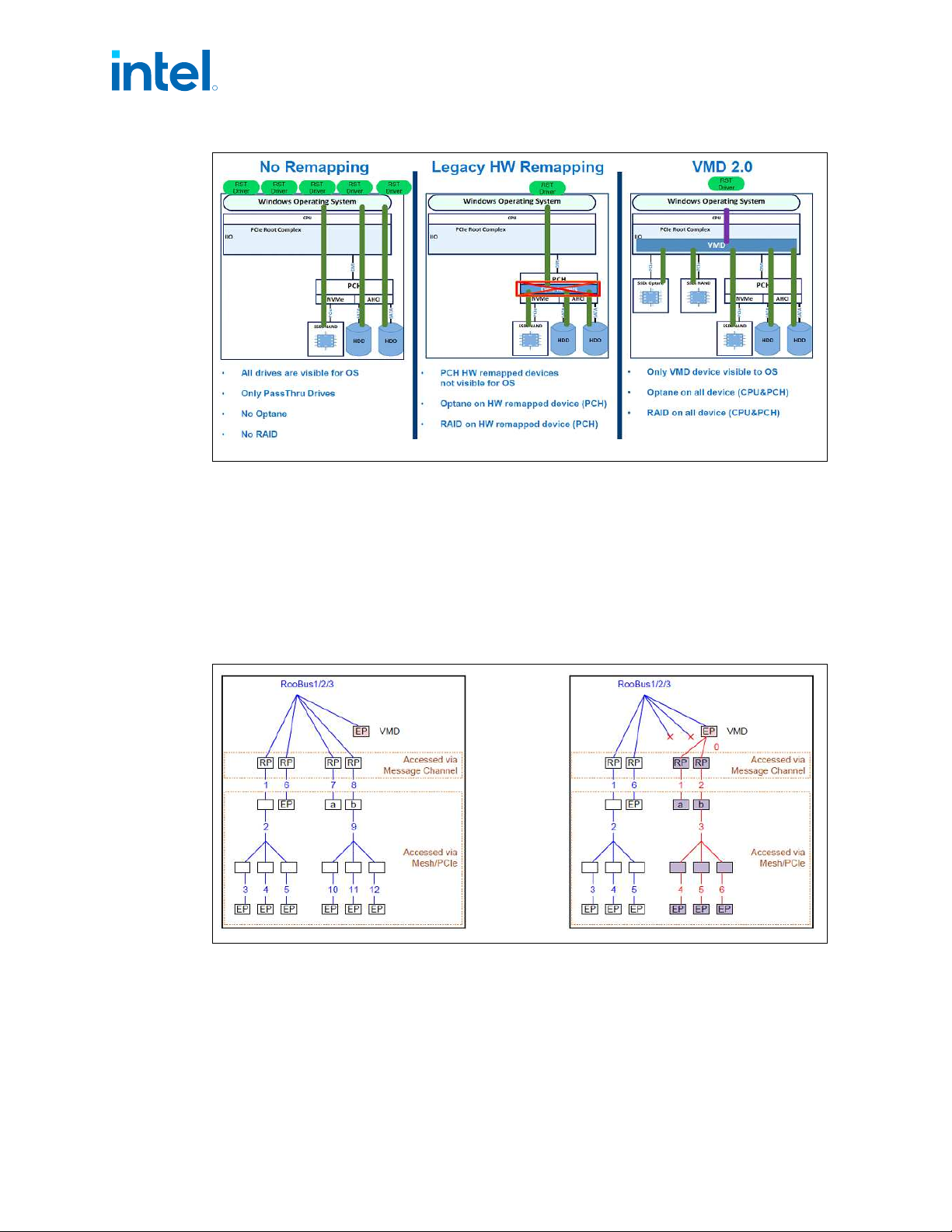
A Volume Management Device (VMD) exposes a single device to the operating system,
which will load a single storage driver. The VMD resides in the processor's PCIe root
complex and it appears to the OS as a root bus integrated endpoint. In the processor,
the VMD is in a central location to manipulate access to storage devices which may be
attached directly to the processor or indirectly through the PCH. Instead of allowing
individual storage devices to be detected by the OS and therefore causing the OS to
load a separate driver instance for each, VMD provides configuration settings to allow
specific devices and root ports on the root bus to be invisible to the OS.
Access to these hidden target devices is provided by the VMD to the single, unified
driver.
Features Supported
Supports MMIO mapped Configuration Space (CFGBAR):
• Supports MMIO Low
• Supports MMIO High
• Supports Register Lock or Restricted Access
R
Intel
®
Core
™
, Xeon
™
6300 And Xeon
™
E 2400 Processors—Technologies
13
th
Generation Intel
®
Core
™
, Intel
®
Core
™
14
th
Generation, Intel
®
Core
™
Processor (Series 1) and (Series 2), Intel
®
Xeon
™
E
2400 Processor and Intel
®
Xeon
™
6300 Processor
Datasheet, Volume 1 of 2 May 2025
60 Doc. No.: 743844, Rev.: 015

• Supports Device Assign
• Function Assign
• MSI Remapping Disable
Deprecated Technologies
The processor has deprecated the following technologies and they are no longer
supported:
• Intel
®
Memory Protection Extensions (Intel
®
MPX)
• Branch Monitoring Counters
• Hardware Lock Elision (HLE), part of Intel
®
TSX-NI
• Intel
®
Software Guard Extensions (Intel
®
SGX)
• Intel
®
TSX-NI
• Power Aware Interrupt Routing (PAIR)
• DDR Running Average Power Limit (DDR RAPL)
Processor Lines that support Intel's Performance Hybrid Architecture do not
support the following:
• Intel
®
Advanced Vector Extensions 512 Bit
2.9
R
Technologies—Intel
®
Core
™
, Xeon
™
6300 And Xeon
™
E 2400 Processors
13
th
Generation Intel
®
Core
™
, Intel
®
Core
™
14
th
Generation, Intel
®
Core
™
Processor (Series 1) and (Series 2), Intel
®
Xeon
™
E
2400 Processor and Intel
®
Xeon
™
6300 Processor
May 2025 Datasheet, Volume 1 of 2
Doc. No.: 743844, Rev.: 015 61