743844-015.pdf - 第78页
Figure 17. Package Power Control SOC/Pla tf orm P ow er Limiting Knobs Op tions Visual PL4 1 PL1/PsysPL1 1 PL2/PsysPL2 1 Å Po wer c ould sustain her e up to ~100s sec onds (Av erage po wer) Time Power PL3 1 /PsysPL3 1 Å …

• The processor may exceed the Processor Base Power (a.k.a TDP) for short
durations to utilize any available thermal capacitance within the thermal solution.
The duration and time of such operation can be limited by platform runtime
configurable registers within the processor.
• Graphics peak frequency operation is based on the assumption of only one of the
graphics domains (GT/GTx) being active. This definition is similar to the IA core
Turbo concept, where peak turbo frequency can be achieved when only one IA
core is active. Depending on the workload being applied and the distribution
across the graphics domains the user may not observe peak graphics frequency
for a given workload or benchmark.
• Thermal solutions and platform cooling that is designed to less than thermal
design guidance may experience thermal and performance issues.
NOTE
Intel
®
Turbo Boost Technology 2.0 availability may vary between the different SKUs.
Package Power Control
The package power control settings of PL1, PL2, PL3, PL4, and Tau allow the designer
to configure Intel
®
Turbo Boost Technology 2.0 to match the platform power delivery
and package thermal solution limitations.
• Power Limit 1 (PL1): A threshold for average power that will not exceed -
recommend to set to equal Processor Base Power (a.k.a TDP). PL1 should not be
set higher than thermal solution cooling limits.
• Power Limit 2 (PL2): A threshold that if exceeded, the PL2 rapid power limiting
algorithms will attempt to limit the spike above PL2.
• Power Limit 3 (PL3): A threshold that if exceeded, the PL3 rapid power limiting
algorithms will attempt to limit the duty cycle of spikes above PL3 by reactively
limiting frequency. This is an optional setting
• Power Limit 4 (PL4): A limit that will not be exceeded, the PL4 power limiting
algorithms will preemptively limit frequency to prevent spikes above PL4.
• Turbo Time Parameter (Tau): An averaging constant used for PL1 exponential
weighted moving average (EWMA) power calculation.
NOTES
1. Implementation of Intel
®
Turbo Boost Technology 2.0 only requires configuring
PL1, PL1, Tau and PL2.
2. The Turbo Implementation guide and BIOS Specification.
3. PL3 and PL4 are disabled by default.
4. The Intel Dynamic Tuning (DTT) is recommended for performance improvement in
mobile platforms. Dynamic Tuning is configured by system manufacturers
dynamically optimizing the processor power based on the current platform thermal
and power delivery conditions. Contact Intel Representatives for enabling details.
4.1.1.1
R
Thermal Management—Intel
®
Core
™
, Xeon
™
6300 And Xeon
™
E 2400 Processors
13
th
Generation Intel
®
Core
™
, Intel
®
Core
™
14
th
Generation, Intel
®
Core
™
Processor (Series 1) and (Series 2), Intel
®
Xeon
™
E
2400 Processor and Intel
®
Xeon
™
6300 Processor
May 2025 Datasheet, Volume 1 of 2
Doc. No.: 743844, Rev.: 015 77
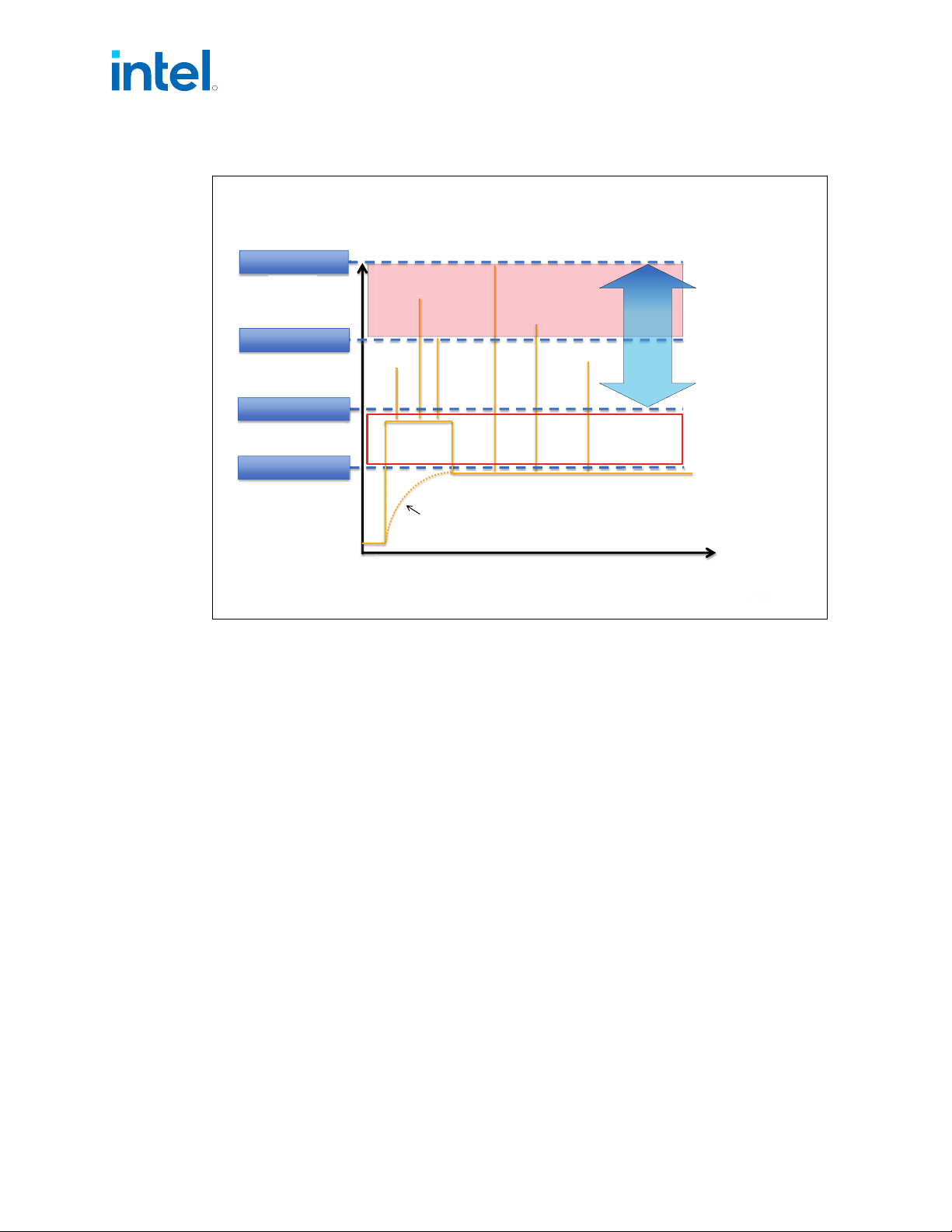
Figure 17. Package Power Control
SOC/Platform Power Limiting Knobs Options Visual
PL4
1
PL1/PsysPL1
1
PL2/PsysPL2
1
Å Power could
sustain here up to
~100s seconds
(Average power)
Time
Power
PL3
1
/PsysPL3
1
Å Power could
sustain here
forever
Note1: Optional Feature, default is disabled
Power in this region can be configured
via PL1 Tau/PsysPL1 Tau
Power
could
peak
for up
to
10ms
Duty cycles of power peaks in
this region can be configurable
via PL3/PsysPL3
Platform Power Control
The processor introduces Psys (Platform Power) to enhance processor power
management. The Psys signal needs to be sourced from a compatible charger circuit
and routed to the IMVP9.1 (voltage regulator). This signal will provide the total
thermally relevant platform power consumption (processor and rest of platform) via
SVID to the processor.
When the Psys signal is properly implemented, the system designer can utilize the
package power control settings of PsysPL1, PsysPL1 Tau , PsysPL2, and PsysPL3 for
additional manageability to match the platform power delivery and platform thermal
solution limitations for Intel
®
Turbo Boost Technology 2.0. The operation of the
PsysPL1, PsysPL1 Tau , PsysPL2 and PsysPL3 are analogous to the processor power
limits described in Package Power Control on page 77.
• Platform Power Limit 1 (PsysPL1): A threshold for average platform power
that will not be exceeded - recommend to set to equal platform thermal capability.
• Platform Power Limit 2 (PsysPL2): A threshold that if exceeded, the PsysPL2
rapid power limiting algorithms will attempt to limit the spikes above PsysPL2.
• Platform Power Limit 3 (PsysPL3): A threshold that if exceeded, the PsysPL3
rapid power limiting algorithms will attempt to limit the duty cycle of spikes above
PsysPL3 by reactively limiting frequency.
• PsysPL1 Tau: An averaging constant used for PsysPL1 exponential weighted
moving average (EWMA) power calculation.
4.1.1.2
R
Intel
®
Core
™
, Xeon
™
6300 And Xeon
™
E 2400 Processors—Thermal Management
13
th
Generation Intel
®
Core
™
, Intel
®
Core
™
14
th
Generation, Intel
®
Core
™
Processor (Series 1) and (Series 2), Intel
®
Xeon
™
E
2400 Processor and Intel
®
Xeon
™
6300 Processor
Datasheet, Volume 1 of 2 May 2025
78 Doc. No.: 743844, Rev.: 015

• The Psys signal and associated power limits / Tau are optional for the system
designer and disabled by default.
• The Psys data will not include power consumption for charging.
• The Intel Dynamic Tuning (DTT) is recommended for performance improvement in
mobile platforms. Dynamic Tuning is configured by system manufacturers
dynamically optimizing the processor power based on the current platform thermal
and power delivery conditions. Contact Intel Representatives for enabling details.
Turbo Time Parameter (Tau)
Turbo Time Parameter (Tau) is a mathematical parameter (units of seconds) that
controls the Intel
®
Turbo Boost Technology 2.0 algorithm. During a maximum power
turbo event, the processor could sustain PL2 for a duration longer than the Turbo Time
Parameter. If the power value and/or Turbo Time Parameter is changed during
runtime, it may take some time based on the new Turbo Time Parameter level for the
algorithm to settle at the new control limits. The time varies depending on the
magnitude of the change, power limits and other factors. There is an individual Turbo
Time Parameter associated with Package Power Control and Platform Power Control.
Assured Power (cTDP)
Assured Power (cTDP) form a design option where the processor's behavior and
package Processor Base Power (a.k.a TDP) are dynamically adjusted to a desired
system performance and power envelope. Assured Power (cTDP) and Low-Power Mode
technologies offer opportunities to differentiate system design while running active
workloads on select processor SKUs through scalability, configuration and adaptability.
The scenarios or methods by which each technology is used are customizable but
typically involve changes to PL1 and associated frequencies for the scenario with a
resultant change in performance depending on system's usage. Either technology can
be triggered by (but are not limited to) changes in OS power policies or hardware
events such as docking a system, flipping a switch or pressing a button. Assured
Power (cTDP) is designed to be configured dynamically and do not require an
operating system reboot.
NOTE
Assured Power (cTDP) is not battery life improvement technologies.
Assured Power (cTDP)
NOTE
Assured Power (cTDP) availability may vary between the different SKUs.
With Assured Power (cTDP), the processor is capable of altering the maximum
sustained power with an alternate processor IA core base frequency. Assured Power
(cTDP) allows operation in situations where extra cooling is available or situations
where a cooler and quieter mode of operation is desired.
cTDP consists of three modes as shown in the following table.
4.1.1.3
4.1.2
4.1.2.1
R
Thermal Management—Intel
®
Core
™
, Xeon
™
6300 And Xeon
™
E 2400 Processors
13
th
Generation Intel
®
Core
™
, Intel
®
Core
™
14
th
Generation, Intel
®
Core
™
Processor (Series 1) and (Series 2), Intel
®
Xeon
™
E
2400 Processor and Intel
®
Xeon
™
6300 Processor
May 2025 Datasheet, Volume 1 of 2
Doc. No.: 743844, Rev.: 015 79