743844-015.pdf - 第52页
• Increased range of processor addressability in x2APIC mode: — Physical xAPIC ID field increases from 8 bits to 32 bits, allowing for interrupt processor addressability up to 4G-1 processors in physical destination mode…

achieve any or maximum turbo frequencies. Performance varies depending on
hardware, software and system configuration and you should consult your system
manufacturer for more information.
Intel
®
Advanced Vector Extensions refers to Intel
®
AVX or Intel
®
AVX2 .
For more information on Intel
®
AVX, refer to https://software.intel.com/en-us/isa-
extensions/intel-avx.
NOTE
Intel
®
AVX and AVX2 Technologies may not be available on all SKUs.
Intel
®
AVX2 Vector Neural Network Instructions (AVX2 VNNI)
Vector instructions for deep learning extension for AVX2.
NOTE
Intel
®
AVX and AVX2 Technologies may not be available on all SKUs.
Intel
®
64 Architecture x2APIC
The x2APIC architecture extends the xAPIC architecture that provides key
mechanisms for interrupt delivery. This extension is primarily intended to increase
processor addressability.
Specifically, x2APIC:
• Retains all key elements of compatibility to the xAPIC architecture:
— Delivery modes
— Interrupt and processor priorities
— Interrupt sources
— Interrupt destination types
• Provides extensions to scale processor addressability for both the logical and
physical destination modes
• Adds new features to enhance the performance of interrupt delivery
• Reduces the complexity of logical destination mode interrupt delivery on link
based architectures
The key enhancements provided by the x2APIC architecture over xAPIC are the
following:
• Support for two modes of operation to provide backward compatibility and
extensibility for future platform innovations:
— In xAPIC compatibility mode, APIC registers are accessed through memory
mapped interface to a 4K-Byte page, identical to the xAPIC architecture.
— In the x2APIC mode, APIC registers are accessed through the Model Specific
Register (MSR) interfaces. In this mode, the x2APIC architecture provides
significantly increased processor addressability and some enhancements on
interrupt delivery.
2.4.12.1
2.4.13
R
Technologies—Intel
®
Core
™
, Xeon
™
6300 And Xeon
™
E 2400 Processors
13
th
Generation Intel
®
Core
™
, Intel
®
Core
™
14
th
Generation, Intel
®
Core
™
Processor (Series 1) and (Series 2), Intel
®
Xeon
™
E
2400 Processor and Intel
®
Xeon
™
6300 Processor
May 2025 Datasheet, Volume 1 of 2
Doc. No.: 743844, Rev.: 015 51

• Increased range of processor addressability in x2APIC mode:
— Physical xAPIC ID field increases from 8 bits to 32 bits, allowing for interrupt
processor addressability up to 4G-1 processors in physical destination mode. A
processor implementation of x2APIC architecture can support fewer than 32-
bits in a software transparent fashion.
— Logical xAPIC ID field increases from 8 bits to 32 bits. The 32-bit logical
x2APIC ID is partitioned into two sub-fields – a 16-bit cluster ID and a 16-bit
logical ID within the cluster. Consequently, ((2^20) - 16) processors can be
addressed in logical destination mode. Processor implementations can support
fewer than 16 bits in the cluster ID sub-field and logical ID sub-field in a
software agnostic fashion.
• More efficient MSR interface to access APIC registers:
— To enhance inter-processor and self-directed interrupt delivery as well as the
ability to virtualize the local APIC, the APIC register set can be accessed only
through MSR-based interfaces in x2APIC mode. The Memory Mapped IO
(MMIO) interface used by xAPIC is not supported in x2APIC mode.
• The semantics for accessing APIC registers have been revised to simplify the
programming of frequently-used APIC registers by system software. Specifically,
the software semantics for using the Interrupt Command Register (ICR) and End
Of Interrupt (EOI) registers have been modified to allow for more efficient delivery
and dispatching of interrupts.
• The x2APIC extensions are made available to system software by enabling the
local x2APIC unit in the “x2APIC” mode. To benefit from x2APIC capabilities, a new
operating system and a new BIOS are both needed, with special support for the
x2APIC mode.
• The x2APIC architecture provides backward compatibility to the xAPIC architecture
and forwards extensible for future Intel platform innovations.
NOTE
Intel
®
x2APIC Technology may not be available on all SKUs.
For more information, refer to the Intel
®
64 Architecture x2APIC Specification at
http://www.intel.com/products/processor/manuals/
Intel
®
Dynamic Tuning Technology
Intel
®
Dynamic Tuning (Intel
®
DTT) consists of a set of software drivers and
applications that allow a system manufacturer to optimize system performance and
usability by:
• Dynamically optimize turbo settings of IA processors, power and thermal states of
the platform for optimal performance
• Dynamically adjust the processor’s peak power based on the current power
delivery capability for optimal system usability
• Dynamically mitigate radio frequency interference for better RF throughput.
Intel
®
GMM and Neural Network Accelerator
GNA stands for Gaussian Mixture Model and Neural Network Accelerator.
2.4.14
2.4.15
R
Intel
®
Core
™
, Xeon
™
6300 And Xeon
™
E 2400 Processors—Technologies
13
th
Generation Intel
®
Core
™
, Intel
®
Core
™
14
th
Generation, Intel
®
Core
™
Processor (Series 1) and (Series 2), Intel
®
Xeon
™
E
2400 Processor and Intel
®
Xeon
™
6300 Processor
Datasheet, Volume 1 of 2 May 2025
52 Doc. No.: 743844, Rev.: 015
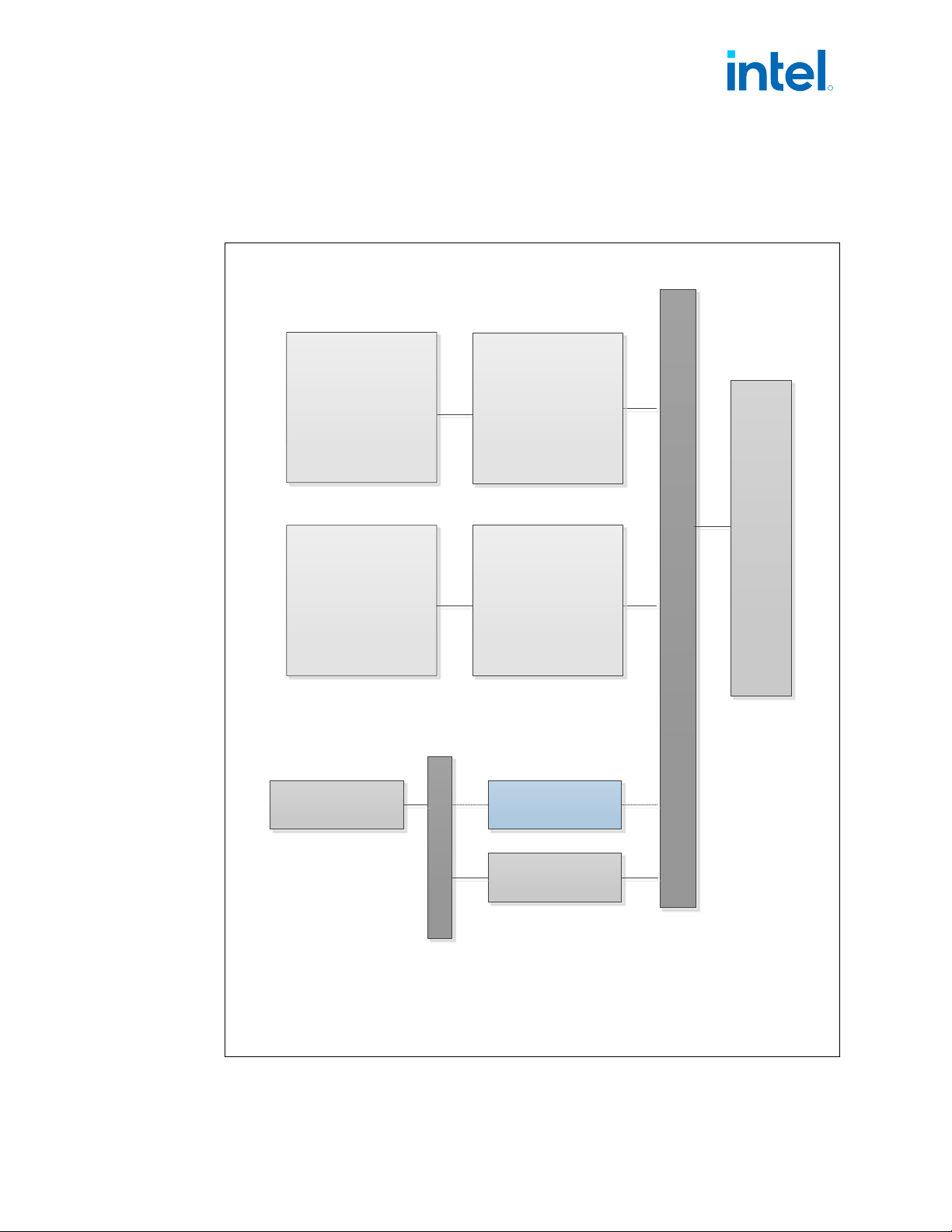
The GNA is used to process speech recognition without user training sequence. The
GNA is designed to unload the processor cores and the system memory with complex
speech recognition tasks and improve the speech recognition accuracy. The GNA is
designed to compute millions of Gaussian probability density functions per second
without loading the processor cores while maintaining low power consumption.
CPU
Core0
CPU
Core2
SRAM GNA
DSP
Memory Bus
DRAM
Memory Bus
CPU
Core3
CPU
Core1
R
Technologies—Intel
®
Core
™
, Xeon
™
6300 And Xeon
™
E 2400 Processors
13
th
Generation Intel
®
Core
™
, Intel
®
Core
™
14
th
Generation, Intel
®
Core
™
Processor (Series 1) and (Series 2), Intel
®
Xeon
™
E
2400 Processor and Intel
®
Xeon
™
6300 Processor
May 2025 Datasheet, Volume 1 of 2
Doc. No.: 743844, Rev.: 015 53