IPC-A-600H-2010 中文版 印制板的可接受性 (1).pdf - 第23页
T arget Condition - Class 1,2,3 (⽬标条件 - 1,2,3级) • No pits or voids. • 无 麻点 和空洞。 Acceptable - Class 1,2,3 (可接受条件 - 1,2,3级) • Pits or voids do not exceed 0.8 mm [0.031 in]. • Total printed board area affected is less than …
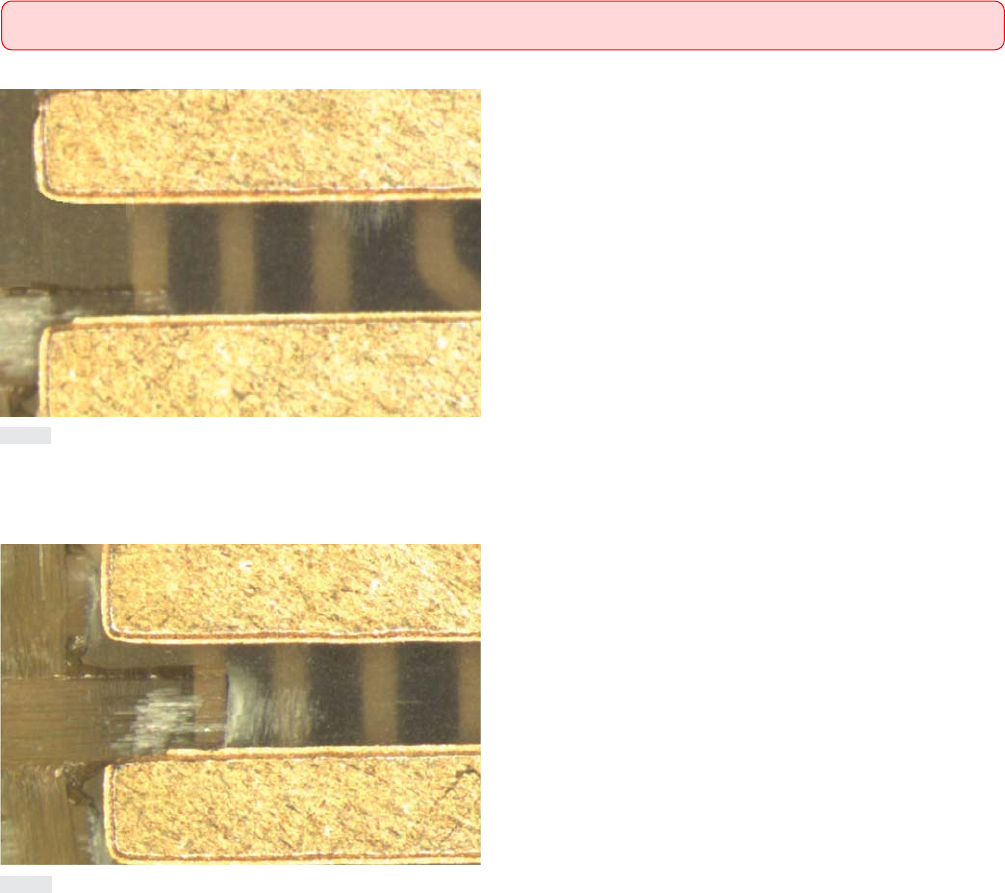
Acceptable - Class 1,2,3(可接受条件 - 1,2,3级)
• Exposed or disrupted fibers do not bridge conductors and do not
reduce the conductor spacing below the minimum requirements.
• 暴露或断裂的纤维未跨接导体,且未使导体的间距减少至低
于最小要求。
Nonconforming - Class 1,2,3(不符合条件 - 1,2,3级)
• Defects either do not meet or exceed above criteria.
• 缺陷不符合或超出上述要求。
图223a
图223b
2.2 BASE MATERIAL SURFACE(基材表⾯)
2.2.3 Exposed/Disrupted Fibers(暴露/断裂的纤维)
14 IPC-A-600H-20102010年4月
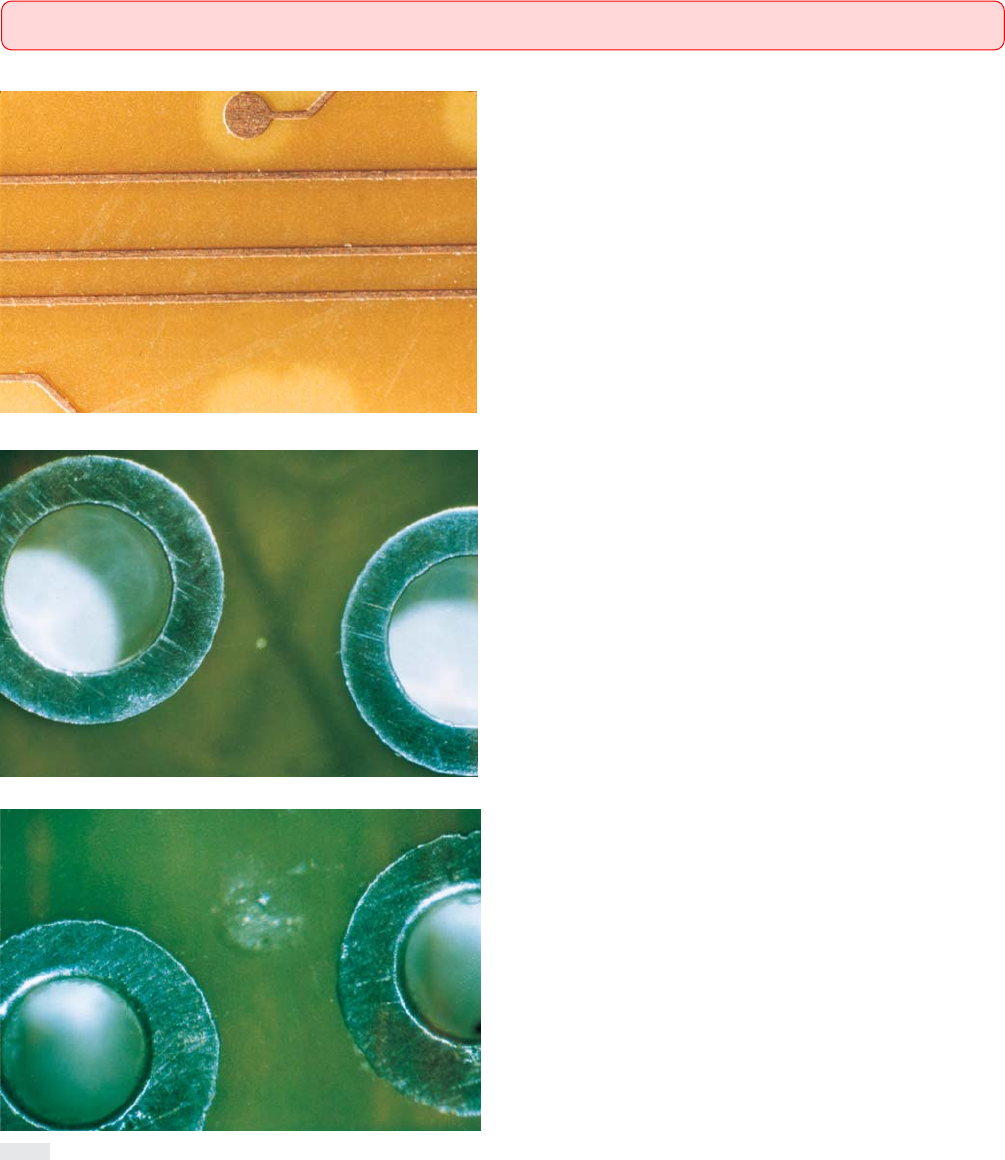
Target Condition - Class 1,2,3(⽬标条件 - 1,2,3级)
• No pits or voids.
• 无麻点和空洞。
Acceptable - Class 1,2,3(可接受条件 - 1,2,3级)
• Pits or voids do not exceed 0.8 mm [0.031 in].
• Total printed board area affected is less than 5% per either side.
• Pits or voids do not bridge conductors.
• 麻点或空洞不大于0.8mm[0.031in]。
• 印制板每面受影响的区域小于每面面积的5%。
• 麻点或空洞未跨接导体。
Nonconforming - Class 1,2,3(不符合条件 - 1,2,3级)
• Defects either do not meet or exceed above criteria.
• 缺陷不符合或超出上述要求。
图224a
图224b
图224c
2.2 BASE MATERIAL SURFACE(基材表⾯)
2.2.4 Pits and Voids(⿇点和空洞)
15IPC-A-600H-2010 2010年4月

This section is focused on those subsurface conditions of laminated
base materials that are externally observable through the base mate-
rial itself and some solder mask coatings. The most frequent sub-
surface base material conditions are termed measling, crazing,
delamination, blistering and foreign materials. These conditions
may be observed throughout the printed board manufacturing and
inspection process; such as:
• During incoming metal-clad base material evaluations after being
manufactured by the laminator,
• By the printed board manufacturer after having removed (etched)
the metal cladding in the preparation of ‘‘innerlayer’’ details for
multilayer printed boards,
• After etching the ‘‘outer’’ layers of printed board to form the
required arrangement of conductive patterns and markings,
• After baking operations (such as solder mask or component leg-
ends),
• After thermal shock, as in solder fusing/coating or solderability
testing processes.
Base material subsurface conditions have been the subject of con-
siderable discussion within the printed board industry for several
decades. Of the several subsurface conditions, measling and craz-
ing continue to cause the most concerns. Measles and crazing have
been the primary focus of three IPC ‘‘Blue Ribbon Committees’’ of
experts. The following are brief summaries and additional com-
ments from the IPC Blue Ribbon Committees:
本节重点介绍透过基材本身和某些阻焊膜涂覆层从外表可观
察到的层 压 基材表面下的状况。最常见的基材表面下状况
有:白斑、微裂纹、分层、起泡和外来夹杂物。这些状况可
在印制板整个生产过程和检验过程中发现,例如:
• 在来料检验基板生产商制造的覆金属箔基材时;
• 在印制板生产商蚀刻金属箔后为多层印制板制备“内层”图
形的过程中;
• 为了形成所需导电图形和标记,蚀刻印制板“外”层之后;
• 烘干操作(例如阻焊剂或元器件字符)之后;
• 热冲击之后,例如焊料热熔/涂覆或可焊性测试过程中。
几十年来,基材的表面下状况已成为印制板行业内不容忽视的
论题。在这些表面下状况中,白斑和微裂纹一直最受关注。
白斑和微裂纹已成为三届IPC“蓝带委员会”专家所关注的焦
点。下面是IPC蓝带委员会的概述和补充说明:
Brief summary of the First IPC Blue Ribbon Committee on
Measles
This first committee conducted a wide overview of printed board
base material surface and subsurface conditions with a major focus
on measles. IPC's ‘‘Measles in Printed Wiring Boards, Information
Document’’ was published in 1973 as a result of this effort. The
committee was to collect as much data as was available on measles
and other surface/subsurface conditions; and to standardize the
terms, definitions (descriptions), photographs, and illustrations of
surface and subsurface conditions. It was felt that sufficient
research had been done by industry and that a position on
‘‘measles’’ could be prepared by the committee. The committee's
recommendation was as follows, ‘‘comprehensive review of avail-
able literature and available research and test data, that while
measles may be objectionable cosmetically, their effect on func-
tional characteristics of finished products, are at worst minimal,
and in most cases insignificant.‘‘
Comments: Despite the committee's recommendation and industry
data, there was still a strong reluctance by most government and
industry personnel to accept that measles are a cosmetic condition
with no functional effect in most applications. Most companies
continued to retain ‘‘no measling’’ requirements in their specifica-
tions. But when measles or other nonconforming surface/
subsurface conditions had severe impact on their production sched-
ules, the customer (or acceptance agency) would produce a
document that established acceptance guidelines for measles (and
frequently other surface and subsurface conditions). The new
guidelines were based on size, percent reduction in conductor spac-
ing, and amount of affected area. They also varied from customer-
to-customer. As technology evolved, in particular reductions in
conductor spacing, the effect of measling and other surface/
subsurface conditions once again became a serious industry wide
concern. As a result, a second IPC Blue Ribbon Committee on
Measles was formed.
第⼀届IPC蓝带委员会关于⽩斑的概述
首届委员会对印制板基材表面和表面下的状况,主要是白斑
方面,进行了广泛的探讨。IPC于1973年发布了作为该项研究
的成果—《印制电路板中的白斑,报告文献》。该委员会旨在
尽可能多地搜集现有的关于白斑以及其他表面/表面下状况的
资料,并标准化其术语、定义(说明)、照片以及图例。委员
会认为业界已做了充分的研究,委员会可以为“白斑”作结
论了。委员会的建议如下:“根据对现有文献和研究及测试
数据的综合考察表明,从外观上讲,白斑可能是不美观的,
但即使是最严重的白斑,对成品的功能特性的影响也是极微
小的,且大多数情况下是无足轻重的”。
说明:尽管有委员会的建议和业界的研究数据,仍有多数政
府及业界人士强烈抵制,他们拒不接受白斑只是一种外观上
的状况,在大多数应用中无功能性影响的观点。多数公司的
规范中仍保留“没有白斑”的要求。但是当白斑或其他不符
合的表面/表面下状况严重影响其生产进度时,用户(或验收
部门)就 会 行文制订白斑(通常包括其他表面和表面下状
况)的验收导则。新的验收导则以导体间距减小的尺寸、减
小的百分比,以及受影响面积为基础,具体要求因用户不同
而异。随着技术的发展,尤其是导体间距的减小,白斑及其
他 表
面
/表面下状况的影响再一次成为业界关注的焦点。因
此,关于白斑的第二届IPC蓝带委员会应时而生。
2.3 BASE MATERIAL SUBSURFACE(基材表⾯下)
Introduction(引⾔)
16 IPC-A-600H-20102010年4月